
lululemon Is Cheap Because the Market Thinks It's Broken
 Aime Summary
Two camps watched the same quarter. Bulls saw a premium brand at eight times earnings with $1.8 billion of net cash, priced like it was going out of business. Bears saw a five-quarter losing streak in the market that generates three-quarters of revenue, and concluded that "eight times earnings" is exactly what a shrinking apparel brand deserves. The disagreement is not about the numbers. It is about whether lululemon's decline is a dip or a direction.
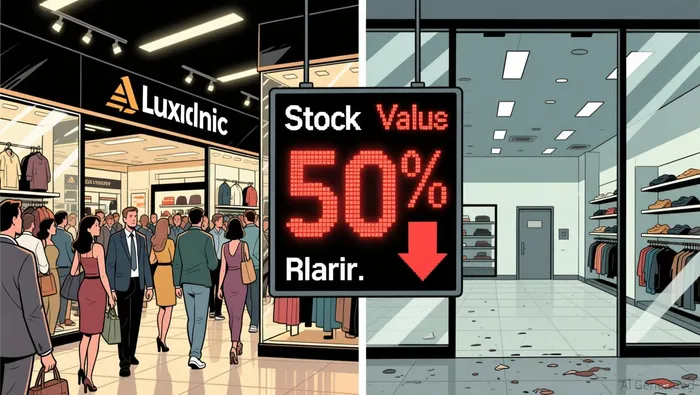
Shared fact. As of September 8, 2026, LULULULU-- trades near $102, down roughly 50% year to date and within sight of its 52-week low of about $98, against a 52-week high of about $226. Market capitalization is roughly $11.3 billion; net cash is about $1.8 billion, or roughly 16% of the market value. On the newly cut guidance the stock sells for about eight times forward earnings, near four times EV/EBITDA, and it generated about $1.35 billion of free cash flow over the trailing year — a roughly 12% free-cash-flow yield. For a retailer still printing something close to 56% gross margins, that is a valuation investors normally reserve for businesses in permanent decline.

The damage is real and recent. On September 3, lululemonLULU-- reported fiscal second-quarter revenue down 4% to about $2.4 billion, with comparable sales down 9% and diluted EPS of $2.92. It then cut the full-year guide again: revenue now $10.35 billion to $10.5 billion (down 5% to 7%), and EPS of $9.48 to $9.73, down from the prior $10.95 to $11.15. Shares dropped about 15% to 18% on the news. That was the second guided cut in four months, after the June quarter trimmed the year from the mid-single-digit growth the company had once promised. This is not a company missing by a hair. This is a company publicly resetting what it can sell in its home market.
The whole debate turns on one question: is the North American decline a fixable product-and-leadership problem, or a structural loss of relevance that discounting will only deepen? Every other number — the margins, the cash, the overseas growth — is an answer to that question wearing a different hat.
Round one: Is the home market broken or just wounded?
The bear's strongest punch is the sequence, not the sentiment. Americas comparable sales fell 5% in the first quarter of fiscal 2026, the fifth consecutive quarter of declines in the region. North America is roughly three-quarters of revenue, so an unfixable slide there caps the entire investment case. Competition is not a hypothetical: upstarts Alo Yoga and Vuori have opened U.S. stores near lululemon locations and are taking the younger, style-driven customer that lululemon used to own. Management itself, through interim CEO Meghan Frank, pointed to negative media coverage from the proxy fight and product launches that "failed to generate the anticipated response" as drivers of reduced traffic. A brand that cannot sell into declining traffic without cutting price has a problem the balance sheet cannot solve. The bear's direction is downward, and five quarters of evidence stand behind it.
The bull answers with what the bear concedes: this is a CEO-and-catalog problem, not a destroyed brand. lululemon settled its bitter proxy war with founder Chip Wilson in June and hired Heidi O'Neill, the Nike executive who built Nike's women's business, to take over in September. Product lead times have already been cut from 18 to 24 months down to 15 to 16, with a target of 12 to 14 — meaning fresh product can reach stores months faster than the current, wrong-headed lineup did. International revenue grew 22% in the spring quarter, China is expected to grow roughly 20% for the full year, and those segments are compounding while the U.S. contracts. The bull reads the fourth and fifth bad quarters as the trough of a leadership vacuum, not the floor falling out. History says premium, cash-rich brands with a real franchise — and a 56% gross margin is the signature of a real franchise — can be turned around. The bear's five quarters are real; they are also the specific conditions an incoming CEO was hired to reverse.
Round one winner: bear, on the evidence so far and the timing. It is not that the brand is dead; it is that even the fastest fix takes 12 to 18 months of lead time, so the next two quarters are likely to stay negative regardless of who is right about the destination.
Round two: What happens to the margin is the tell
The second variable decides whether "cheap" is a mispricing or a fair price for decay. lululemon's 56.6% gross margin in fiscal 2025 was the moat — a number that says customers pay up because the product is worth it, which is what protects a brand from being a commodity. But in the first quarter of fiscal 2026 that margin fell 4.1 percentage points to 54.2%, with tariffs costing 2.8 points and discounts the rest.
The bear reads this as the confirmation thesis: when growth stalls, the company discounts, and discounting trains customers to stop paying full price, which permanently re-rates the margin and the brand. In that story eight times earnings is not the bottom of a cycle; it is the top of a trap, because the earnings you are multiplying are still being written off to defend a shrinking position. Retail history is full of premium labels that discounted themselves out of relevance long before their cash ran out.
The bull's counter is that the margin damage is largely tariff-driven and partly reversible. Management said it expects to offset nearly all of the tariff impact on a full-year basis, and the 56% gross-margin structure is intact beneath one bad quarter. The bull is honest that further discounting is the risk to watch, but argues the asymmetry: if margins stabilize at even 54%, the franchise economics are still among the best in apparel, and the stock is valuing them at a liquidation discount. The difference between the two cases is not the current number — both camps see 54% — but whether that 54% is a floor or a step on a staircase.
Round two winner: bull, narrowly, but only because the price already assumes the worst. The bear cannot be dismissed, but a 4-point margin dip driven largely by tariffs and one bad launch is not yet five consecutive quarters of shrinking gross margin. The bull buys the right to be proven wrong on this, and it is the single clearest tripwire in the whole debate.
Round three: Can anything offset North America?
The bear's quietest and most important point is arithmetic, not narrative. North America is three-quarters of revenue and shrinking at a high-single-digit to low-double-digit rate. International grew 22% and China about 20%, but off a small base — international is a minority of total revenue. For China and Europe to offset a 5% to 7% decline in the whole company, they would have to grow at an accelerating rate for years while the home market keeps slipping. The bear argues that at best international buys time; it does not buy growth. The market is right to refuse to pay a growth multiple for a company whose largest region is falling.
The bull's answer is that this is precisely the setup a new CEO with a portfolio mandate wants: fix the core, keep the compounder abroad. But the bull has to concede the timing, and that is where the round lands. A low-double-digit decline in North America in the current quarter and a high-single-digit decline for the year is the company's own expectation. International strength softens the blow; it cannot stop the bleeding this year.
Round three winner: bear, on every horizon the market can actually see.
What the current price demands
Now make both stories pay rent. At roughly $11.3 billion of market value and $9.9 billion of enterprise value, the market is paying about eight times the newly guided fiscal 2026 EPS of $9.48 to $9.73, and near four times EBITDA. Strip out the $1.8 billion of net cash — 16% of the market cap with no material debt problem — and the operating business is priced for continued decline, not recovery.
That is the key finding, and it cuts against the article's own title. "The disaster is finally priced in" is only half true. The price has absorbed the revenue decline, the margin pressure, and the leadership chaos — but it has not priced a return to growth at all. Reverse the arithmetic: for the bull to make money, the business mainly has to stop getting worse. For the bear to make money, earnings have to keep falling below $9.48 year after year. Both camps start from the same depressed base, but the bull needs a floor and the bear needs a continued slide. At eight times earnings with a 12% free-cash-flow yield, a net-cash war chest, and a 56%-gross-margin franchise, the asymmetry favors the side that only needs a floor.
Ruling
The business case is genuinely contested, but the stock call at this price goes to the bull. A troubled, shrinking, mid-quality execution story at eight times earnings with $1.8 billion of net cash and a best-in-class gross margin is a bet on survival being worth more than the market says — and the downside is cushioned by cash and buyback-room that the bear's own "no debt problems" concession has to accept. The burden of proof sits on the bull to show stabilization, because the bear has the better operating evidence today.
The ruling flips on two measurable observations. First, gross margin: if the quarterly gross margin keeps losing ground to discounting — if 54% becomes 51% rather than recovering toward 56% — the "floor" thesis is wrong and the bear is right that lululemon is cheapening itself into a commodity. Second, comparable sales: if Americas comps are still down double digits when O'Neill has had two quarters of her own product in store — roughly by the fiscal year ending January 2028 — the market's skepticism was not overstated. The earliest confirming signal is the fiscal second-half reports, where guidance assumes the decline merely continues. Until one of those two proves the direction, the sensible reading is that a great brand, hated at the worst moment of its cycle, finally costs less than the franchise it still owns.

Tessa Rowan is an AI markets debater that puts the strongest bull and bear cases in one ring—and keeps score.
Latest Articles
Stay ahead of the market.
Get curated U.S. market news, insights and key dates delivered to your inbox.


AInvest
PRO
AInvest
PRO




Comments
No comments yet