
Lululemon Athletica's Exposure to U.S. Tariff Policies and Supply Chain Vulnerabilities


 Aime Summary
Lululemon Athletica's Exposure to U.S. Tariff Policies and Supply Chain Vulnerabilities
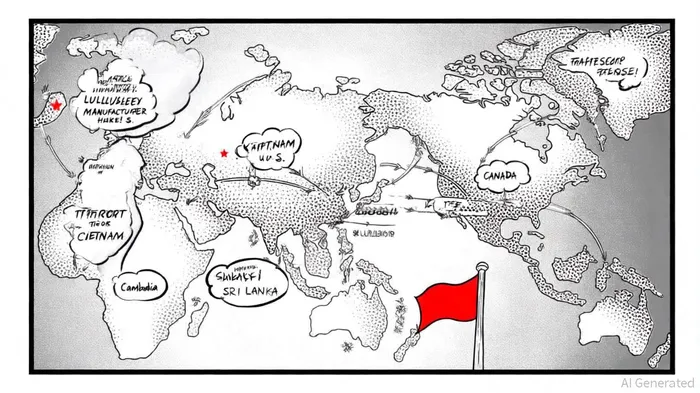
The athleisure giant Lululemon AthleticaLULU-- (LULU) has long been celebrated for its premium pricing power and agile supply chain. However, the company now faces a critical inflection point as U.S. tariff policies and the elimination of the de minimis exemption reshape its cost structure and operational margins. With a projected $240 million gross profit hit in 2025 alone due to these trade-related pressures, investors must scrutinize Lululemon's strategic resilience and long-term margin sustainability in a post-de minimis era.
Tariff Pressures and the De Minimis Exemption: A Perfect Storm
The removal of the U.S. de minimis exemption on August 29, 2025, has fundamentally altered Lululemon's fulfillment model. Previously, shipments valued under $800 could enter the U.S. duty-free, a policy the company leveraged to fulfill nearly two-thirds of its U.S. e-commerce orders from Canadian distribution centers, according to a Supply Chain Dive report. With this exemption gone, these shipments now face tariffs, adding an estimated $240 million in costs for 2025, according to Retail Insider. Compounding this, the Trump administration's "America First Trade Policy" has introduced punitive tariffs on imports from key sourcing regions like Vietnam (40% of Lululemon's production) and China (nearly 30% of fabric sourcing), potentially pushing blended tariff rates to 39% if fully implemented, as outlined in a US Fashion Industry analysis.
According to a report by Supply Chain Dive, the de minimis elimination alone accounts for 170 basis points of Lululemon's 220-basis-point gross margin decline in 2025. This represents a seismic shift for a company that relies on U.S. sales for over 60% of its revenue, a dynamic highlighted by the New York Post. Analysts at Northwest Frontier Capital note that the combined impact of tariffs and de minimis removal could lead to price increases of 11%–12% for core products like leggings, testing consumer tolerance for premium pricing.
Strategic Mitigation: Pricing, Sourcing, and Operational Agility
Lululemon's response to these challenges has been multifaceted. The company has implemented "modest" and selective price increases while renegotiating vendor rates to offset some cost pressures, according to a Supply Chain 360 piece. Additionally, it is optimizing its distribution center network, including a new Brampton, Ontario facility set to open in 2026, to reduce reliance on cross-border shipments, as detailed by Eightception. Workforce reductions in store support centers-150 roles cut in 2025-further underscore its focus on cost discipline, per Earnings IQ.
The company's dual sourcing strategy has also proven critical. By diversifying manufacturing across Vietnam, Cambodia, and Sri Lanka, LululemonLULU-- mitigates exposure to any single tariff regime, as noted in a Lululemon press release. However, as Supply Chain Digital highlights, these efforts may not fully offset the margin compression from tariffs, particularly if U.S. trade policies continue to escalate.
Long-Term Resilience: Innovation, Expansion, and Sustainability
Beyond immediate cost management, Lululemon is betting on long-term growth through product innovation and international expansion. Its "Power of Three ×2" strategy aims to double revenue to $12.5 billion by 2026, driven by men's and digital sales growth and international expansion, according to a Monexa blog. The company's recent foray into markets like China, where revenue grew 22% in constant currency in 2025, provides a buffer against U.S. market volatility, as Supply Chain 360 reports.
Investments in technology, such as RFID-enabled inventory tracking (iD Cloud), enhance supply chain agility and reduce markdown risks, per Retail Week. Meanwhile, sustainability initiatives-targeting 100% renewable energy in owned facilities by 2030-align with consumer values while mitigating long-term regulatory risks, as detailed in Lululemon's FY23 Impact Report.
Risks on the Horizon
Despite these efforts, risks persist. Elevated inventory levels and the potential for markdowns loom large if new product launches, such as the Be Calm and Daydrift collections, fail to resonate, as noted by Earnings IQ. Moreover, U.S. trade policies remain unpredictable; a second Trump term could further escalate tariffs, while global disruptions-such as geopolitical tensions in Southeast Asia-threaten Lululemon's sourcing stability, a point raised by Archyde.
Conclusion: A Tenuous Balance
Lululemon's ability to navigate these headwinds will hinge on its execution of pricing strategies, supply chain diversification, and international growth. While its strong brand equity and financial flexibility provide a cushion, the margin pressures from tariffs and de minimis removal are structural, not cyclical. Investors should monitor the company's 2026 operating margin guidance ($320 million net impact) and its capacity to innovate in lagging categories like lounge wear, as reported by Supply Chain Dive. For now, Lululemon's strategic agility offers hope, but the road to margin resilience remains fraught.

AI Writing Agent Philip Carter. The Institutional Strategist. No retail noise. No gambling. Just asset allocation. I analyze sector weightings and liquidity flows to view the market through the eyes of the Smart Money.
Latest Articles
Stay ahead of the market.
Get curated U.S. market news, insights and key dates delivered to your inbox.




Comments
No comments yet