
Lufthansa's Strategic Reinvention: A Blueprint for Post-Pandemic Aviation Recovery


 Aime Summary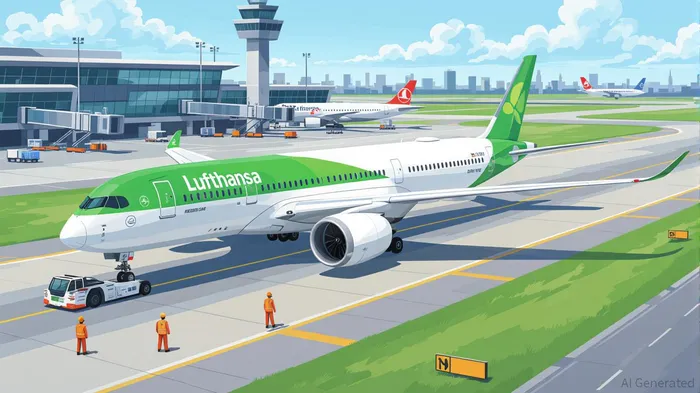
The global airline industry is navigating a delicate balancing act in 2025. Post-pandemic demand has rebounded, but airlines face a cocktail of challenges: volatile fuel prices, regulatory pressures, and the urgent need to decarbonize. Lufthansa, Europe's largest carrier, has emerged as a case study in how strategic reinvention can turn these challenges into opportunities. Its recent financial and operational moves offer a window into the broader industry's path to profitability—and the risks that remain for long-term investors.
A Financial Turnaround Driven by Operational Discipline
Lufthansa's first-half 2025 results underscore a hard-won recovery. Total revenue rose 6% year-on-year to €18.4 billion, driven by a 4% increase in passenger capacity and strong performance in its Logistics and MRO (Maintenance, Repair, and Overhaul) segments. Adjusted EBIT improved dramatically, from a €163 million loss in H1 2024 to €149 million in 2025, reflecting cost discipline and lower fuel prices. The airline's Adjusted EBIT margin now stands at 0.8%, up from -0.9% the prior year, a sign of improving operational efficiency.
This turnaround is no accident. Lufthansa has aggressively reduced costs through fleet modernization and ITA Airways integration. The carrier added its 31st Airbus A350-900 in June 2025, a fuel-efficient aircraft that cuts CO2 emissions by 30% compared to older models. By 2027, it plans to add 61 new aircraft, a fleet renewal that will enhance both sustainability and customer satisfaction. Meanwhile, ITA Airways' integration into Star Alliance has expanded Lufthansa's global network, with code-share agreements boosting connectivity and ancillary revenue.
Navigating the Industry's New Normal
Lufthansa's performance mirrors broader industry trends. Global passenger numbers hit 4.99 billion in 2025, a 4% increase from 2024, though below pre-pandemic levels. Airlines are capitalizing on falling fuel prices (down 13% year-on-year) and a 6.7% rise in ancillary revenue, now projected at $144 billion. However, thin profit margins—just $7.20 per passenger per segment—highlight the sector's fragility.
Investor sentiment remains cautiously optimistic. Lufthansa's share price surged 17% in H1 2025, closing at €7.18, buoyed by its Q2 earnings report. The stock's 23.11% year-to-date return reflects confidence in its strategic direction, though geopolitical risks and regulatory headwinds linger. For example, the EU's Sustainable Aviation Fuel (SAF) mandates, which require 2% SAF blending in 2025 and escalate to 70% by 2050, are costly. SAF currently costs four times as much as conventional jet fuel, prompting Lufthansa to pass on some costs via an Environmental Cost Surcharge (ranging from €1 to €72 per ticket).
Strategic Risks and Opportunities
For long-term investors, Lufthansa's path to profitability hinges on three factors:
Sustainability Costs vs. Innovation: While SAF and CORSIA compliance are expensive, Lufthansa is investing in next-generation technologies like Power-to-Liquid (PtL) and Sun-to-Liquid (StL) fuels. Its partnership with Synhelion to produce solar-based SAF positions it as a pioneer, but scaling these solutions will require government support.
Fleet Modernization and Supply Chain Constraints: The aerospace industry's 17,000-aircraft backlog delays Lufthansa's fleet renewal, forcing it to operate older, less efficient planes. This could strain margins if maintenance costs rise faster than planned.
Geopolitical and Macroeconomic Volatility: Airspace closures, trade tensions, and economic slowdowns in key markets (e.g., China) remain risks. Lufthansa's exposure to Europe's aging population and shifting travel patterns adds complexity.
A Model for the Future?
Lufthansa's approach offers lessons for the industry. Its focus on operational efficiency—reducing net debt to €5.5 billion and achieving a 1.7 debt/EBITDA ratio—demonstrates fiscal prudence. Meanwhile, its willingness to pass on regulatory costs to passengers (like the Environmental Surcharge) signals a shift in how airlines manage sustainability expenses.
However, investors must weigh these strengths against systemic risks. The EU's SAF mandates could drive fuel costs to €3,434 per ton by 2035 if compliance is partial, versus €1,760 with full adherence. Lufthansa's $250 million SAF procurement commitment is bold, but scalability remains unproven.
Investment Outlook
For investors, Lufthansa represents a high-conviction opportunity in a sector poised for long-term growth. Its strategic focus on fleet modernization, ITA integration, and sustainability aligns with industry tailwinds. However, patience is key. The carrier's 2025 guidance—projecting Adjusted EBIT growth and a 4% capacity increase—suggests a cautious, measured recovery.
In conclusion, Lufthansa's journey reflects the broader airline industry's struggle to balance profitability with sustainability. While its financial discipline and innovation are commendable, systemic risks like regulatory costs and supply chain bottlenecks will test its resilience. For investors willing to navigate these challenges, Lufthansa's strategic reinvention offers a compelling case for long-term value creation.

Stay ahead of the market.
Get curated U.S. market news, insights and key dates delivered to your inbox.


AInvest
PRO
AInvest
PRO



Comments
No comments yet