
Lufthansa's Strategic Rebalancing: Navigating Transatlantic Shifts and Fleet Innovation for Long-Term Efficiency


 Aime Summary
The post-pandemic aviation landscape has forced airlines to recalibrate their strategies to survive volatile demand, geopolitical risks, and . Lufthansa, a cornerstone of European aviation, has emerged as a case study in strategic adaptation. By aligning route expansion with fleet modernization and leveraging transatlantic demand shifts, the airline is positioning itself for long-term operational efficiency and profitability. For investors, the question is whether these moves will translate into sustained value creation in a sector still grappling with cyclical uncertainties.
Route Expansion: Precision Over Breadth
Lufthansa's route strategy in 2023–2025 reflects a shift from aggressive expansion to targeted optimization. The airline has prioritized high-demand corridors, such as the Frankfurt-St. Louis route, , prompting increased frequencies to five weekly flights. Conversely, underperforming routes—like Frankfurt-Denver—have seen reduced capacity to align with seasonal demand. This approach mirrors broader industry trends of , where airlines prioritize profitability over sheer seat count.
The acquisition of ITA Airways in 2024 further strengthened Lufthansa's transatlantic footprint, offering cost synergies and route rationalization. However, challenges persist. U.S. immigration policy uncertainties and softness in economy-class demand from German travelers have dampened growth in certain corridors. Lufthansa's response? . , coupled with the introduction of the A380 to Dulles, a move aimed at capturing premium yield in high-demand markets.
Fleet Modernization: Efficiency as a Competitive Edge
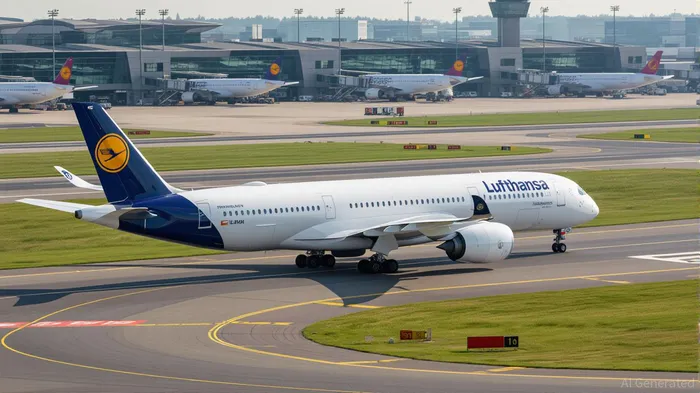
At the heart of Lufthansa's strategy is its fleet renewal program, which has accelerated since 2023. The airline is replacing aging aircraft with fuel-efficient models like the Airbus A350-900 and BoeingBA-- 777-9, . The A350-900, in particular, is a linchpin of Lufthansa's environmental and operational goals, .
Shorter-haul operations have also seen innovation. SWISS's integration of the Airbus A220 into its fleet since 2016 has reduced by 20% per seat, while Austrian Airlines' replacement of Fokker aircraft with EmbraerERJ-- 195s has improved by 18%. These moves not only cut costs but also align with ESG mandates, a critical factor for investors prioritizing sustainability.
Operational Efficiency: A 99% Network Reliability Benchmark
Lufthansa's 2025 operational performance underscores its focus on efficiency. , driven by AI-powered and streamlined crew scheduling. This reliability is a key differentiator in a sector plagued by delays and cancellations. The airline's cost rationalization efforts, , have also bolstered margins.
Financially, , , outpacing pre-pandemic levels. The airline's 2024 revenue of €37.6 billion and €1.6 billion in operating profit (Adjusted EBIT) reflect a recovery that, while uneven, is underpinned by strategic discipline.
Transatlantic Demand: Resilience Amid Volatility
The transatlantic market remains a double-edged sword. , economy-class bookings from Germany have lagged. . , .
Yet, Lufthansa's strategic recalibration—such as expanding to Israel and South Africa—demonstrates agility. .
Investment Implications: Balancing Risks and Rewards
For investors, Lufthansa's strategy offers both promise and caution. The airline's fleet modernization and route optimization are strong tailwinds for long-term efficiency, but —such as U.S.-Europe trade tensions and immigration policy shifts—remain headwinds. Additionally, the transatlantic market's near-term softness, as seen in directional booking declines, suggests caution in overestimating short-term growth.
However, Lufthansa's financial resilience—evidenced by its 2025 EBIT projections and strong premium yield capture—makes it a compelling long-term play. The airline's commitment to sustainability, operational reliability, and aligns with global aviation trends, including and digital transformation.
Conclusion: A Model for Post-Pandemic Aviation
Lufthansa's journey post-pandemic is a masterclass in balancing operational efficiency with strategic foresight. By modernizing its fleet, optimizing routes, and capitalizing on premium demand, the airline is navigating a complex landscape with discipline. For investors, the key takeaway is clear: Lufthansa's long-term value hinges on its ability to sustain these efficiencies while adapting to transatlantic demand shifts. In a sector where resilience is paramount, Lufthansa's strategic rebalancing offers a roadmap for enduring success.

Delivering real-time insights and analysis on emerging financial trends and market movements.
Latest Articles
Stay ahead of the market.
Get curated U.S. market news, insights and key dates delivered to your inbox.




Comments
No comments yet