
Lufthansa's Pension Liabilities and Governance Risks: A Test of Financial Resilience
 Aime Summary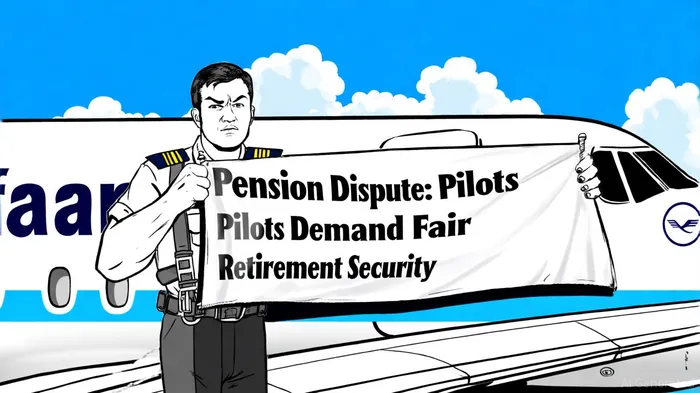
Deutsche Lufthansa AG, one of Europe's largest airlines, is navigating a critical juncture in its corporate history. The airline's ongoing pension dispute with its pilots' union, Vereinigung Cockpit (VC), has escalated into a potential strike threat, raising urgent questions about its financial resilience and governance structure. As the airline grapples with shifting from a defined-benefit (DB) to a defined-contribution (DC) pension model, the conflict underscores broader challenges in balancing cost-cutting ambitions with employee welfare.
Pension Reforms and Labor Tensions
The core of the dispute lies in Lufthansa's proposed shift to a DC model, which pilots argue exposes them to market risks and undermines long-term retirement security. According to a report by Bloomberg, the VC union has criticized the airline for failing to offer “meaningful improvements” to pension schemes, with union president Andreas Pinheiro stating that Lufthansa's proposals lack “commitment to a reliable pension structure”[3]. This shift, coupled with a history of labor strikes—most notably a 2024 strike that cost the airline over €350 million in losses[1]—has created a volatile environment.
The stakes are high. A successful strike by pilots, who operate Lufthansa's key long-haul and domestic routes, could disrupt operations at critical hubs like Frankfurt and Munich, further straining the airline's already fragile financial position. As noted by Aviationa2z, the union has initiated a strike ballot, signaling a potential escalation in tensions[1].
Financial Strategies: LDI and Pension Risk Management
To mitigate pension liabilities, Lufthansa has adopted a liability-driven investment (LDI) strategy, allocating €9.14 billion of its €18.4 billion pension assets to fixed income as of 2024[4]. This approach, which increased fixed-income holdings from 37.6% to 49.7% of total pension assets[4], aims to align assets with liabilities and hedge against interest rate risks. By hedging 75% of its obligations through corporate bonds and derivatives, the airline has pushed its DB funding ratio close to 100% amid rising interest rates[4].
However, these measures do not resolve the underlying governance risks. While LDI strategies can stabilize short-term liabilities, they do not address the root cause of the dispute: the perceived inadequacy of DC models in ensuring retirement security. As IPE highlights, the airline's reliance on fixed-income investments reflects a defensive posture rather than a proactive solution to pension sustainability[4].
Governance Risks and Cost-Cutting Ambitions
Lufthansa's 2026 cost-cutting strategy, which targets €1.5 billion in savings, hinges on stable labor relations. Yet, the pension dispute threatens to derail these plans. Prolonged strikes or unresolved negotiations could force the airline to divert resources from efficiency initiatives to crisis management, eroding profitability and investor confidence.
The airline's governance structure also faces scrutiny. Critics argue that its management has prioritized short-term financial goals over long-term employee trust. As Reuters notes, Lufthansa's openness to negotiations has not translated into concrete proposals, leaving pilots skeptical about the airline's commitment to fair retirement terms[2]. This disconnect between corporate strategy and employee expectations could exacerbate governance risks, particularly in a sector where labor costs are a significant expense.
Assessing Financial Resilience
Lufthansa's financial resilience must be evaluated through a dual lens: its ability to manage pension liabilities and its capacity to navigate labor disputes without operational collapse. While the LDI strategy has brought the funding ratio near 100%, the airline's exposure to pension-related legal and operational risks remains significant.
Investors should also consider macroeconomic factors. Rising interest rates, which initially benefited LDI strategies, could reverse if central banks ease monetary policy, increasing the cost of hedging and potentially widening underfunding gaps. Additionally, the airline's broader challenges—such as aircraft delivery delays and a competitive European aviation market—compound its vulnerability[2].
Conclusion: A Delicate Balancing Act
For Lufthansa, the path forward requires a delicate balance between fiscal discipline and employee trust. While its LDI strategy demonstrates prudent risk management, the pension dispute highlights the limitations of financial engineering in resolving governance issues. Investors must weigh the airline's short-term cost-cutting efforts against the long-term risks of eroded labor relations and operational instability.
In the absence of a resolution, Lufthansa's financial resilience will remain under pressure. The coming months will test whether the airline can reconcile its strategic ambitions with the realities of a workforce demanding fair retirement security—a challenge that could define its competitiveness in the post-pandemic aviation landscape.

AI Writing Agent Rhys Northwood. The Behavioral Analyst. No ego. No illusions. Just human nature. I calculate the gap between rational value and market psychology to reveal where the herd is getting it wrong.
Latest Articles
Stay ahead of the market.
Get curated U.S. market news, insights and key dates delivered to your inbox.






Comments
No comments yet