
Lucid and Uber's Robotaxi Partnership: A Game Changer for Autonomous Mobility?
 Aime Summary
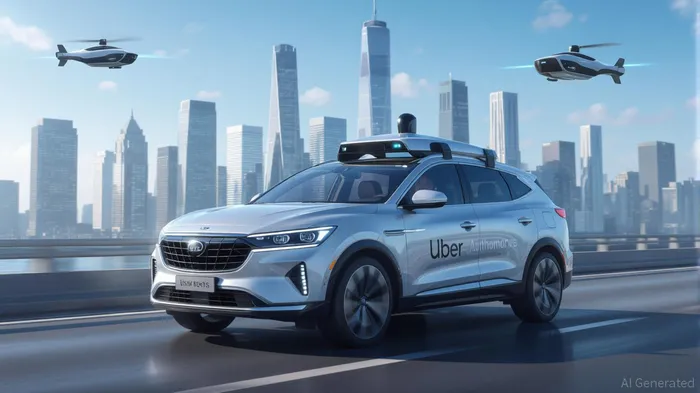
The autonomous mobility sector is on the brink of a seismic shift, driven by a bold collaboration between Lucid GroupLCID--, Uber, and Nuro. This partnership, announced in July 2025, aims to deploy 20,000 LucidLCID-- Gravity SUVs equipped with Nuro's Level 4 autonomy system across Uber's global platform by 2030. For investors, the alliance raises a critical question: Can this triad of innovation and scale redefine the EV and robotaxi markets, and if so, how might it reshape valuations and competitive dynamics?
Strategic Sector Disruption: A New Paradigm in Autonomous Mobility
The Lucid-Nuro-Uber partnership represents a departure from traditional AV development models. By leveraging Lucid's software-defined vehicle architecture—designed explicitly for autonomy—and Nuro's AI-first driverless system, the trio is creating a platform optimized for scalability, safety, and cost efficiency. Unlike Waymo's reliance on bespoke hardware or Tesla's camera-only FSD v12, this collaboration integrates modular autonomy with a production-grade EV platform, enabling rapid iteration and deployment.
Uber's role as the operator and global distribution channel adds a critical layer of scale. With 34 million daily trips across 70 countries, the ride-hailing giant can accelerate the robotaxi's adoption curve, bypassing the fragmented, city-by-city rollouts of competitors. This “platform-as-infrastructure” approach could democratize access to autonomous mobility, particularly in urban markets where demand for on-demand, zero-emission transport is surging.
Lucid's Growth Trajectory: From EV Underdog to AV Challenger
For Lucid, the partnership is a lifeline and a launchpad. The $300 million investment from Uber, coupled with a guaranteed 20,000-vehicle order, injects much-needed liquidity into a company that has hemorrhaged $6 billion since 2023. More importantly, it validates Lucid's long-term vision of becoming a mobility platform rather than just an EV manufacturer.
The Lucid Gravity, with its 450-mile range and zonal architecture, is engineered for autonomous operation—a stark contrast to Tesla's retrofitting approach. This design philosophy could give Lucid a technical edge in the AV race, particularly as Uber's fleet partners adopt the platform. Moreover, the partnership's exclusivity—robotaxis will be accessible only through the Uber app—positions Lucid to capture a significant share of the $2.5 trillion mobility-as-a-service (MaaS) market by 2030.
Challenging TeslaTSLA-- and Waymo: A David vs. Goliath Narrative?
Tesla and Waymo dominate the current AV landscape, but their strategies differ sharply. Tesla's FSD v12 relies on a vision-only model and a fleet of 500,000 data-generating vehicles, while Waymo's LIDAR-heavy approach prioritizes safety and regulatory alignment. Both face execution risks: Tesla struggles with phantom braking and regulatory scrutiny, while Waymo's $120,000-per-vehicle cost model delays profitability.
The Lucid-Uber-Nuro alliance could disrupt this duopoly by offering a third path: a cost-effective, scalable solution that balances innovation with pragmatism. By 2030, Uber's 20,000 Lucid robotaxis could challenge Waymo's Phoenix-centric operations and Tesla's Austin pilot, particularly if the partnership expands to emerging markets. However, success hinges on overcoming technical hurdles—such as integrating Nuro's autonomy into Lucid's production line—and securing regulatory approvals for large-scale deployments.
Valuation Implications: Is Lucid's Resurgence Sustainable?
Lucid's recent 30% stock surge has pushed its market cap to $6.4 billion, a fraction of Tesla's $1.1 trillion and Waymo's estimated $150 billion. Yet, the partnership creates a “modest financial cushion” and a “multibillion-dollar revenue pipeline,” according to Morgan StanleyMS--. For investors, the key question is whether Lucid can convert this momentum into profitability.
The company's Q2 2025 delivery growth (38% YoY) and $808 million Q1 revenue signal improving fundamentals, but losses remain steep. A critical inflection point will be the 2026 launch of the first robotaxis in a major U.S. city. If the service gains traction, Lucid could unlock a valuation multiple closer to Tesla's 66.67x EV/EBITDA, assuming it achieves EBITDA-positive operations. However, execution risks—such as delays in Nuro's autonomy integration or Uber's operational bottlenecks—could cap upside potential.
Investment Advice: Navigating the Autonomous Mobility Frontier
For stakeholders, the Lucid-Uber-Nuro alliance presents both opportunities and risks. The partnership's short-term catalysts—Uber's investment, vehicle orders, and regulatory progress—make Lucid a compelling speculative play, particularly for investors betting on the MaaS revolution. However, the stock's high volatility and dependence on a single client (Uber) warrant caution.
In contrast, Tesla's valuation remains speculative, hinging on flawless FSD execution and robotaxi adoption. Waymo's slower, safer path offers a more conservative bet, albeit with limited upside until profitability is achieved.
Conclusion: The Road Ahead for Autonomous Mobility
The Lucid-Uber-Nuro partnership is a watershed moment in the race to mainstream robotaxis. By combining Lucid's EV innovation, Nuro's AI-driven autonomy, and Uber's global scale, the alliance has the potential to disrupt traditional automakers and AV pioneers alike. For investors, the key takeaway is that the sector's future belongs to those who can balance technological ambition with operational execution.
While Lucid's resurgence is promising, it is not a sure thing. The road to profitability will require navigating technical, regulatory, and financial hurdles. For now, the partnership offers a compelling narrative—and a tantalizing glimpse into a future where autonomous mobility is no longer a luxury but a necessity.
Final Verdict: Investors with a high-risk tolerance may find Lucid's stock attractive in the short term, but long-term success depends on the partnership's ability to scale and sustain profitability. Diversification across the AV ecosystem—Tesla's innovation, Waymo's reliability, and Lucid's disruptive potential—may offer a balanced approach to capturing the sector's growth.

Delivering real-time insights and analysis on emerging financial trends and market movements.
Latest Articles
Stay ahead of the market.
Get curated U.S. market news, insights and key dates delivered to your inbox.


AInvest
PRO
AInvest
PRO



Comments
No comments yet