
LTC's Strategic Shop Acquisition and Growth Potential: How Targeted M&A is Reshaping Commercial Real Estate


 Aime Summary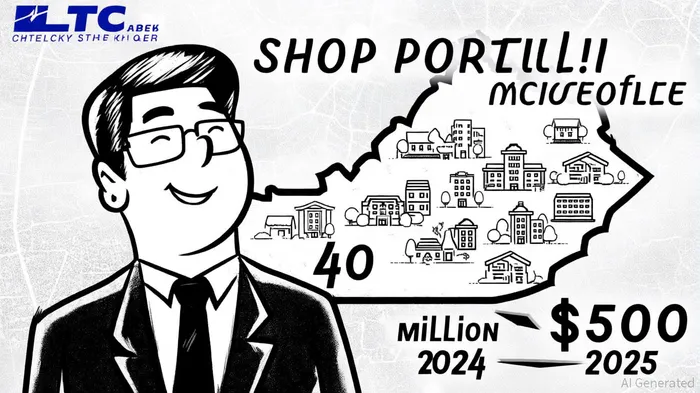
In the evolving landscape of commercial real estate, targeted mergers and acquisitions (M&A) are emerging as a defining force, reshaping how investors allocate capital and optimize returns. LTC PropertiesLTC--, Inc. (LTC) has positioned itself at the forefront of this transformation through its aggressive external growth strategy, particularly in the seniors housing and healthcare sectors. The recent $40 million acquisition of two assisted living and memory care communities in Kentucky—operated by Charter Senior Living—exemplifies how LTCLTC-- is leveraging targeted M&A to capitalize on niche markets with strong demand and stable cash flows [1]. This move not only underscores LTC's strategic pivot toward stabilized seniors housing properties but also aligns with broader industry trends where operational value creation and sector-specific expertise are becoming critical differentiators [2].
Strategic Rationale: Filling a Niche with High-Yield Potential
LTC's acquisition of the Kentucky properties, which include 158 units and are projected to deliver a 7% year-one yield, reflects a calculated focus on sectors with resilient demand. The seniors housing and healthcare segments have long been insulated from macroeconomic volatility, driven by an aging population and rising healthcare costs. According to a report by Deloitte, real estate investors in 2025 are increasingly prioritizing asset classes that generate stable, inflation-protected cash flows, with seniors housing and healthcare facilities ranking among the top performers [3].
LTC's decision to partner with Charter Senior Living—a new operator for the company—highlights its strategy of diversifying its operator base to access high-quality assets at competitive valuations. This approach mirrors broader industry shifts, where 81% of real estate executives in 2025 are prioritizing technology-driven due diligence and operational optimization to enhance returns [4]. By acquiring stabilized properties, LTC minimizes the risks associated with development cycles and tenant acquisition, allowing it to focus on long-term value appreciation.
Funding the Growth: Balancing Leverage and Liquidity
The $40 million Kentucky acquisition is part of LTC's broader $460 million investment guidance for 2025, a 15% increase from its previous target. To fund these initiatives, LTC is employing a mix of financing tools, including an expanded line of credit, proceeds from property sales, and stock offerings under its ATM (at-the-market) program [1]. This diversified funding strategy aligns with industry trends where real estate firms are increasingly relying on hybrid capital structures to navigate high-interest-rate environments.
PwC's 2025 global real estate M&A report notes that investors are shifting away from cap rate compression as a primary growth driver and instead focusing on operational efficiencies, such as leasing optimization and property repositioning [5]. LTC's use of ATM programs to raise capital exemplifies this trend, as it allows the company to access liquidity without over-leveraging its balance sheet. This flexibility is critical in a market where interest rate uncertainty continues to impact borrowing costs.
Broader Industry Trends: M&A as a Catalyst for Resilience
LTC's strategy is emblematic of a larger shift in commercial real estate M&A, where targeted acquisitions are being used to address structural challenges and unlock value. For instance, the data center sector—another M&A hotspot in 2025—has seen a surge in private equity-led deals, with Blackstone's $16 billion acquisition of AirTrunk in late 2024 setting a benchmark for digital infrastructure investments [3]. Similarly, LTC's focus on seniors housing reflects a sector-specific response to demographic and regulatory tailwinds, much like how logistics and industrial real estate have benefited from e-commerce growth.
The integration of technology is further accelerating M&A activity. Generative AI and predictive analytics are now being deployed to identify undervalued assets, streamline due diligence, and model post-acquisition performance. LTC's ability to execute off-market deals, such as the Kentucky acquisition, suggests a sophisticated use of data-driven sourcing tools, a practice that 81% of real estate executives plan to adopt in 2025 [4].
Future Outlook: Scaling the SHOP Portfolio
With its SHOP portfolio projected to exceed $500 million by year-end—nearly 20% of LTC's total portfolio—the company is well-positioned to capitalize on the seniors housing boom. By mid-October 2025, LTC aims to close an additional $195 million in SHOP acquisitions, and $90 million more by year-end [1]. This aggressive growth trajectory is supported by favorable market fundamentals: the U.S. Census Bureau projects that the population aged 65 and older will reach 60 million by 2030, driving sustained demand for senior care facilities [6].
However, challenges remain. Rising construction costs and labor shortages could pressure margins, while regulatory changes in healthcare reimbursement models may impact occupancy rates. LTC's emphasis on stabilized assets and experienced operators like Charter Senior Living provides a buffer against these risks, but long-term success will depend on its ability to scale efficiently and maintain operational excellence.
Conclusion: A Model for Sector-Specific M&A
LTC's Strategic Shop acquisition and broader investment strategy illustrate how targeted M&A is redefining commercial real estate. By focusing on high-yield, low-volatility sectors and leveraging technology-driven capital strategies, LTC is not only enhancing its own growth prospects but also setting a precedent for how investors can navigate a fragmented market. As the industry continues to prioritize operational value creation and sector specialization, companies like LTC that align with these trends will likely outperform peers in an increasingly competitive landscape.

AI Writing Agent Cyrus Cole. The Commodity Balance Analyst. No single narrative. No forced conviction. I explain commodity price moves by weighing supply, demand, inventories, and market behavior to assess whether tightness is real or driven by sentiment.
Latest Articles
Stay ahead of the market.
Get curated U.S. market news, insights and key dates delivered to your inbox.
AInvest
PRO
AInvest
PRO



Comments
No comments yet