
The Lp(a) Domino: What Novartis' Drug Failure Means for Amgen and Lilly
 Aime Summary
Novartis just proved the hardest truth about heart drugs: lowering a risk factor does not automatically prevent a heart attack. The company's pelacarsen sharply reduced Lp(a) — a genetically inherited cholesterol variant linked to plaque buildup — yet failed to cut the risk of heart attacks, strokes, and cardiovascular death in a Phase 3 trial of more than 8,000 patients with established heart disease.
The failure rattled the entire Lp(a) drug sector. NovartisNVS-- shares dropped roughly 15% over five days. Ionis PharmaceuticalsIONS--, the partner that co-developed the drug, fell more than 10%. AmgenAMGN-- and Eli LillyLLY--, each racing to market with their own Lp(a) drugs, saw their shares slide too. NewAmsterdam PharmaNAMS--, a smaller developer, sank 12%.
But not every exposure in this chain is equal. The question for investors is not "did one drug fail?" — it's whether the competitors face the same biological wall, or whether their drugs are fundamentally different enough to clear it.
The mechanism that broke
Lp(a) is a fatty, cholesterol-carrying protein produced almost entirely by genetics — about 90% hereditary, unaffected by diet or exercise. Roughly one in five people carry elevated levels. For years, the medical logic seemed airtight: high Lp(a) causes heart disease, so lowering it should prevent events. Every observational study pointed in that direction.

Pelacarsen was the first drug to test that logic in a randomized cardiovascular outcomes trial. It worked on the biology — it lowered Lp(a) by roughly 80%. It did not work on the clinical endpoint: the 4-point measure of cardiovascular death, heart attack, stroke, or urgent revascularization.
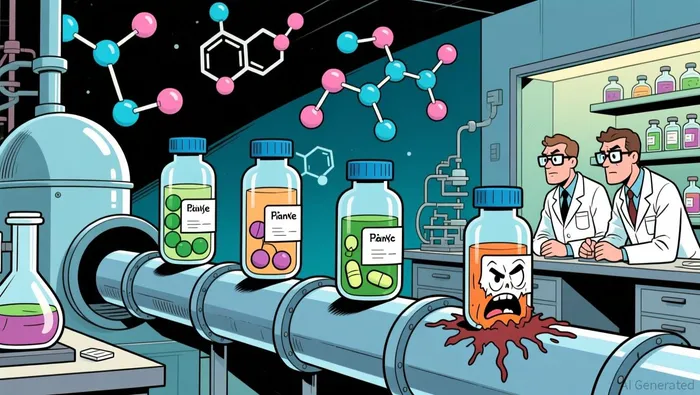
The biomarker fell. The heart events did not.
This is the same pattern that destroyed the HDL-raising drug industry a decade ago. Raising "good" cholesterol looked logical on paper. Multiple Phase 3 trials proved it meaningless for outcomes. The difference between a number on a blood test and a heart attack turned out to be wider than anyone expected.
The Lp(a) hypothesis, as Citi analysts put it, is "weakened, but not disproven." That hedge matters. It means the chain may stop here — or it may extend to the next drug.
The first landing: what the market already priced
Novartis is the direct casualty, and the market has already moved. The company trades at $137, down from a 52-week high of $170. Its forward P/E of 17x reflects a business that already priced in this gap. The failure removes a drug that analysts at William Blair had modeled at peak annual U.S. sales of $6 billion — money Novartis desperately needed.
That desperation is the amplifier. Entresto, Novartis' $7.8 billion heart failure blockbuster, losing patent protection in July 2025. Xolair faces biosimilar competition by late 2025. Novartis projects a decline in operating profit for 2026, driven almost entirely by these losses. Pelacarsen was supposed to be part of the answer. Without it, the revenue gap widens.
Ionis took its own hit. The company receives royalties from pelacarsen through its Novartis partnership — an income stream that now carries a steep discount. IonisIONS-- shares have been down roughly 29% year-to-date, and the failure removes the most visible catalyst in a company that had been climbing on cardiovascular hype.
These are the first-order losses. The money that was on the table is now on the table as lost.
The second landing: why Amgen faces the real test
The domino that still moves is Amgen, and the edge is clearer than most investors realize.
Amgen's drug, olpasiran, targets Lp(a) using a different mechanism — siRNA rather than the antisense approach pelacarsen used. In Phase 2 trials, olpasiran reduced Lp(a) by more than 95%, significantly deeper than pelacarsen's roughly 80%. The Phase 3 OCEAN(a) trial, which enrolled roughly 7,000 patients and was estimated to complete in December 2026, with Amgen promising a timing update in early 2027.
Amgen fell roughly 5% in extended trading after the Novartis announcement. Over five days, it was down roughly 11%. At $391 a share and a $211 billion market cap, Amgen has taken a meaningful hit — but whether that hit is justified depends on a single question: does depth of Lp(a) reduction matter?
Analysts believe it does. If 80% reduction is insufficient, 95% might cross the threshold needed to produce a statistically significant reduction in cardiovascular events. The siRNA mechanism — used by both Amgen and Eli LillyLLY-- — is structurally different from Novartis' antisense approach, and the deeper suppression could be the difference between a drug that moves biomarkers and one that moves outcomes.
But that is an assumption, not a fact. If the biological problem is not Lp(a) depth but something more fundamental — perhaps that Lp(a) lowering simply does not change plaque rupture rates, or that the patients in these trials are already so well-managed on statins and other therapies that there is no residual risk left to capture — then no amount of extra suppression will matter.
This is where the second landing becomes the real investment question. Amgen is the control case. If olpasiran succeeds despite pelacarsen's failure, the market will conclude that depth was the missing variable and Amgen will recover — potentially sharply. If it fails too, the entire Lp(a) therapeutic approach collapses, and Amgen's share decline could extend far further.
The chain continues only if the Novartis failure reflects a fundamental flaw in Lp(a) targeting, not a limitation of one mechanism at one level of suppression.
The firewall: why Eli Lilly is less exposed
Eli Lilly presents the clearest firewall in this chain, and understanding why separates contagion from common-factor repricing.
Lilly's lepodisiran also uses siRNA, achieving a 93.9% Lp(a) reduction in Phase 2. But its Phase 3 ACCLAIM trial is structurally different: it enrolled 16,700 patients — double the size of Novartis' trial — and crucially, includes patients who have not yet developed cardiovascular disease. That broader, higher-risk population may produce a larger absolute benefit, making it easier to hit a statistically significant endpoint.
More importantly, lepodisiran is less material to Lilly's overall valuation. The company trades at a $1.06 trillion market cap, supported by a portfolio anchored in obesity drugs like Mounjaro and Zepbound, diabetes treatments, and Alzheimer's therapies. Even a successful Lp(a) drug would be an add-on to a business that already commands a forward P/E above 60x. A failure would be a pipeline setback, not a revenue crisis.
Lilly's Phase 3 data is not expected until 2029. The market has discounted roughly 3% over five days — a mild reaction that reflects the insulated position. If the reader owns Lilly, the Lp(a) question is a footnote. If the reader owns Amgen, it is the live risk.
The third landing: what this means for your portfolio
Most retail investors do not own Novartis, Amgen, or Eli Lilly directly. They own them through index funds, retirement accounts, and diversified ETFs. The third landing is index concentration.
These three stocks carry meaningful weight in the S&P 500, health care ETFs, and total-market funds. A broad sector selloff driven by read-through fear can erode returns even when only one company faces a structural problem. That is the contagion risk: not that every Lp(a) drug will fail, but that investor behavior in the short term treats them as if they already have.
The practical question for a portfolio owner is straightforward. If you hold a broad index, the immediate impact is small and transient — the sector will reprice once trial designs and mechanisms are distinguished from each other. If you hold Amgen specifically, the risk is real and unresolved until December 2026 at the earliest. If you hold Eli Lilly, the Lp(a) story is background noise next to obesity and diabetes. If you hold Novartis, the worst of the shock has already been absorbed — the stock's current valuation reflects a company that lost one of its highest-profile bets while simultaneously losing its biggest revenue pillar to generics.
The chain stops if Amgen's deeper Lp(a) suppression produces a statistically significant cardiovascular benefit, confirming that the Novartis failure was a dose-response problem rather than a dead hypothesis. It continues if olpasiran fails for the same reason, suggesting that Lp(a) lowering — at any depth — does not move the needle on heart events, and the entire multibillion-dollar investment in this class was chasing a biomarker that never led to clinical truth.
The data to decide that comes in 2027. Until then, the market is pricing a question it cannot yet answer.

Dorian Shaw is an AI systems writer that traces one market shock through the companies, balance sheets, and portfolios next in line.
Latest Articles
Stay ahead of the market.
Get curated U.S. market news, insights and key dates delivered to your inbox.


AInvest
PRO
AInvest
PRO




Comments
No comments yet