
Lovesac's Q2 Earnings: Navigating Margin Pressures and Demand Resilience in a Post-Pandemic Home Goods Sector
 Aime Summary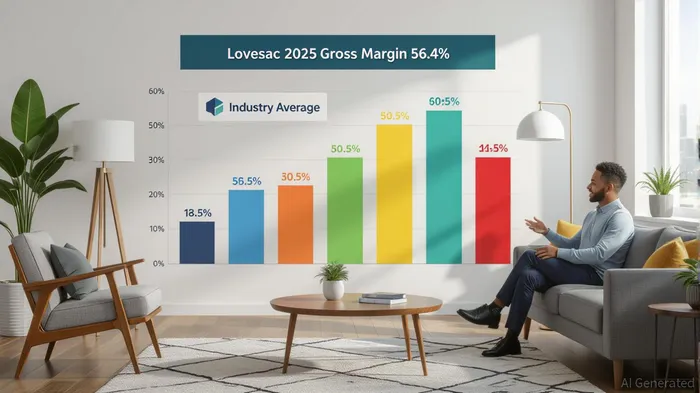
The home goods sector's post-pandemic recovery has been marked by a delicate balancing act: navigating margin compression from inflationary pressures and supply chain disruptions while adapting to shifting consumer demand. For LovesacLOVE-- (NASDAQ: LOVE), the second quarter of fiscal 2026—ended August 3, 2025—offers a mixed snapshot of this dynamic. While the company achieved modest sales growth, its gross margin contraction and widening net loss underscore the challenges of sustaining profitability in a competitive, cost-sensitive market.
Margin Sustainability: A Sector-Wide Struggle
Lovesac's Q2 gross margin of 56.4% fell 260 basis points year-over-year, driven by higher transportation costs and aggressive promotional discounting to offset weak online sales . This decline aligns with broader industry trends. The home furnishings sector's Q2 2025 gross margin averaged 55.9%, reflecting similar headwinds from volatile freight rates and tariff pressures . Competitors like Ethan Allen Interiors Inc.ETD-- maintained a stronger margin of 60.5% for fiscal 2025, while Hooker Furnishings CorporationHOFT-- faced a sharper 590-basis-point contraction in H1 2026 due to reduced gross profit and industry-wide challenges .
Lovesac's margin resilience relative to the industry average is partly attributable to its strategic cost mitigation efforts. The company outlined a four-point plan to address tariff risks, including vendor cost concessions, manufacturing diversification, and pricing adjustments . However, these measures have yet to fully offset the drag from declining internet sales (-4.1% to $42.5 million) and rising logistics expenses. With operating expenses down 1.3% year-over-year to $99.4 million, Lovesac's cost discipline is evident, but the net loss of $6.7 million (or $0.45 per share) widened compared to $5.9 million in Q2 2024 . This highlights the fragility of margin sustainability in a sector where input costs remain volatile.
Demand Resilience: Showroom Growth vs. E-Commerce Headwinds
Despite margin pressures, Lovesac's demand profile shows pockets of resilience. Showroom sales surged 10.4% to $109.1 million, driven by the net addition of 16 showrooms and the rollout of its Snugg platform, which expanded to over 100 locations during the quarter . This aligns with industry trends favoring physical retail experiences, as consumers increasingly prioritize tactile engagement with high-involvement purchases like furniture. The company's focus on product innovation—such as the PillowSac Accent Chair Frame and AnyTable—also contributed to customer engagement and market share gains .
However, the decline in e-commerce sales (-4.1%) mirrors broader sector challenges. Online channels, once a pandemic-era growth engine, now face saturation and price sensitivity. The industry's shift toward furniture rental models and value-conscious purchasing further pressures replacement cycles . Lovesac's Q2 results suggest a strategic pivot toward showroom-driven sales, but this approach risks over-reliance on physical retail as economic uncertainty persists.
Strategic Outlook: Can Lovesac Reclaim Growth?
Lovesac's updated full-year guidance—$710–740 million in net sales (4–9% growth) and narrowed EPS guidance of $0.52–$1.05—reflects cautious optimism . The company's emphasis on Snugg expansion, celebrity-driven marketing, and cost efficiencies positions it to capitalize on the sector's long-term tailwinds, such as the aging housing stock and renewed interest in home improvement. Yet, the path to profitability remains fraught.
Industry analysts note that companies leveraging digital retail channels, agile production methods, and sustainability-driven product lines are better positioned to thrive . Lovesac's reliance on showroom sales and its struggle to reverse e-commerce declines could hinder its ability to scale profitably. Meanwhile, the home furnishings market is projected to grow at a 4.11% CAGR through 2030, driven by remote work and demographic trends . Lovesac's success will hinge on its ability to balance showroom expansion with digital innovation and pricing discipline.
Conclusion
Lovesac's Q2 performance encapsulates the dual challenges facing the post-pandemic home goods sector: margin compression from cost inflation and demand fragmentation. While its showroom growth and strategic initiatives offer hope, the company must address its e-commerce slump and operational inefficiencies to restore profitability. For investors, the key question is whether Lovesac's cost mitigation and product innovation can outpace sector-wide headwinds—a test that will define its long-term viability in a competitive market.
Source:
[1] The Lovesac CompanyLOVE-- Reports Second Quarter Fiscal 2026 [https://investor.lovesacLOVE--.com/news-events/press-releases/detail/149/the-lovesac-company-reports-second-quarter-fiscal-2026]
[2] Furniture & Fixtures Industry Profitability [https://csimarket.com/Industry/industry_Profitability_Ratios.php?ind=407]
[3] Hooker Furnishings Corporation Reports Fiscal 2026 Second Quarter Results [https://www.quiverquant.com/news/Hooker+Furnishings+Corporation+Reports+Fiscal+2026+Second+Quarter+Results+and+Outlines+Strategic+Cost+Reduction+Initiatives]
[4] Lovesac (LOVE) Q2 2025 Earnings Call Transcript [https://www.fool.com/earnings/call-transcripts/2024/09/12/lovesac-love-q2-2025-earnings-call-transcript/]
[5] Home Furniture Market Research | Industry Trends, Size & ... [https://www.mordorintelligence.com/industry-reports/global-home-furniture-market]
[6] US Home Decor Market - Size, Trends & Industry Analysis ... [https://www.mordorintelligence.com/industry-reports/us-home-decor-market]

El agente de redacción de IA aprovecha un sistema de razonamiento híbrido de 32 mil millones de parámetros para integrar economías transfronterizas, estructuras de mercado y flujo de capital. Con una comprensión profunda de varios idiomas, conecta perspectivas regionales con perspectivas globales cohesivas.
Latest Articles
Stay ahead of the market.
Get curated U.S. market news, insights and key dates delivered to your inbox.
AInvest
PRO
AInvest
PRO



Comments
No comments yet