
Louisiana-Pacific's Q2 2026 Earnings Call: OSB Guidance, Siding EBITDA, and CapEx Plans Clash
 Aime Summary
Date of Call: Aug 5, 2026
Financials Results
- Revenue: $664 million, down $90 million from the prior year
- EPS: 40 cents of adjusted earnings per share
Guidance:
- Siding business expected to return to year-over-year growth in Q3, with revenue projected to be between $460 and $500 million, including a modest volume increase.
- Siding EBITDA margin expected to be about 25%, with full-year guidance for siding revenue, EBITDA, and margin affirmed.
- OSB EBITDA for Q3 expected to be between $110 and $120 million, with full-year EBITDA expected to be approximately $120 million.
- OSB price assumptions at current levels through year-end, with a negative $45 million impact in Q3.
- Full-year capital expenditure expected to be $700 million, with roughly three-quarters of the reduction in growth capex.
Business Commentary:
Siding Business Performance:
- LP Building Solutions reported
net salesof$664 millionfor Q2 2026, down$90 millionfrom the prior year, withEBITDAof$79 million, down$63 million. - Despite a challenging housing market, siding business achieved revenue above the midpoint of their guidance, driven by higher prices and operational efficiency improvements.
- The decline was impacted by constrained freight capacity and severe flooding in Manitoba, leading to higher freight costs and unplanned inventory movements.
OSB Market Challenges:
- OSB revenue was down
11%in volume, contributing to$67 millionlower revenue and$46 millionlower EBITDA. - OSB prices fell by
$12or6%due to soft demand, and raw material costs increased, affecting profitability. - The company plans to scale back or postpone non-essential projects to manage capital expenditures amidst OSB volatility.
Long-Term Growth and Strategic Investments:
- SmartSide volume grew at a compound annual rate of
10%and revenue at14%per year, indicating strong market share gains despite a decline in single-family housing starts. - LP is investing in capacity expansion, including a new line in Green Bay and a new facility in North Branch, Minnesota, to support long-term growth.
- The strategic investments aim to enhance capacity and operational efficiency to meet growing demand and improve margins.
Sentiment Analysis:
Overall Tone: Positive
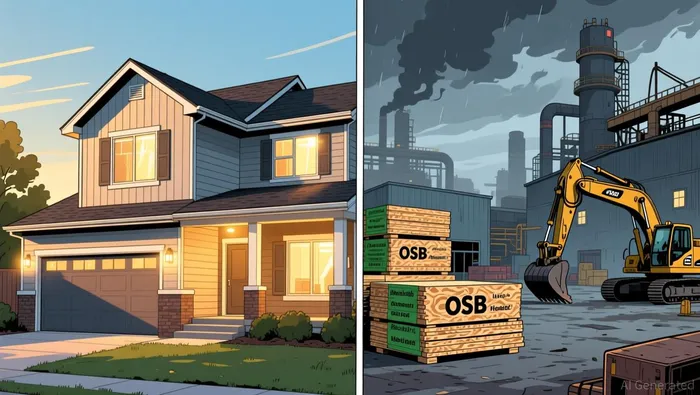
- Management highlighted 'siding business delivered revenue above the midpoint of our first finish,' 'SmartSide Volume is up 10%,' and 'we have a long runway for continued growth ahead of us.' Despite OSB challenges, the tone focused on operational improvements, capacity expansion, and confidence in future performance.
Q&A:
- Question from Katan Mumtora (BMO Capital Markets): Not specified in provided transcript.
Response: No specific question or answer provided for Katan Mumtora.
Contradiction Point 1
OSB Operating Rate Guidance
Contradiction on the stated operating rate for OSB in Q3.
Mike Rockslin (Truist Securities) - Mike Rockslin (Truist Securities)
2026Q2: For OSB, the operating rate in Q2 was in the mid-to-high 70s, and this is the plan for Q3 to balance supply with customer demand. - Jason Ringblom(CFO)
Are the Manitoba and Dawson Creek mills fully operational following the flooding and unexpected downtime, what was the OSB operating rate in 2Q and the planned rate for 3Q, and what factors are being evaluated to decide whether to continue current operations or consider downtime given the deteriorating supply-demand and pricing conditions? - Mike Rockslin (Truist Securities)
2026Q2: The operating rate in Q2 was in the mid-to-high 70s, and this is the plan for Q3 to balance supply with customer demand. - Jason Ringblom(CFO)
Contradiction Point 2
Share Gains Sustainability
Contradiction on the drivers and sustainability of recent siding market share gains.
Susan Maklari (Goldman Sachs) - Susan Maklari (Goldman Sachs)
2026Q2: Siding share gains are primarily from vinyl and traditional wood, with some from brick/stucco. Gains are considered sustainable due to ongoing product innovation... - Jason Ringblom(CFO)
Can you provide more details on the share gains in siding across retail, R&R, and builders, and how sustainable these gains are? - Adam Baumgarten (Vertical Research Partners)
2026Q2: The lack of incremental price actions is contributing to competitiveness and likely aiding volume gains, particularly in the back half... - Aaron Howald(CEO)
Contradiction Point 3
Siding Business Outlook and Full-Year Guidance
Guidance for siding volume and EBITDA appears more pessimistic in Q2 than Q1.
N/A (Prepared Remarks) - N/A (Prepared Remarks)
2026Q2: Q2 net sales were $664 million (down $90M YoY); EBITDA was $79M (down $63M YoY)... Expect volume growth in Q3; full-year guidance for siding revenue, EBITDA, and margin is affirmed. - Company Management
N/A (Summary of Key Points from Prepared Remarks) - Ketan Mamtora (BMO Capital Markets)
2026Q1: The ~$50 million drop is primarily driven by: 1. ~$35 million from volume declines... and 2. ~$15-$20 million from oil-based cost impacts... - Alan Haughie(CFO)
Contradiction Point 4
CapEx Reduction Scope
Contradiction on the specific projects targeted for deferral in the reduced CapEx plan.
Matthew McKellar (Barclays) - Matthew McKellar (Barclays)
2026Q2: The CapEx reduction targets lower-risk, non-essential maintenance projects (especially in OSB) that can be delayed without being eliminated. Growth investments continue. - Aaron Howald(CEO) and Jason Ringblom(CFO)
What specific areas are you scaling back or postponing in response to the $70 million CapEx reduction, and are there any changes to your medium-term market views influencing this outlook? - Matthew McKellar (Barclays)
2026Q2: The CapEx reduction targets lower-risk, non-essential maintenance projects (especially in OSB) that can be delayed without being eliminated. Growth investments (e.g., North Branch facility) continue. - Aaron Howald(CEO) and Jason Ringblom(CFO)

Discover what executives don't want to reveal in conference calls
Latest Articles
Stay ahead of the market.
Get curated U.S. market news, insights and key dates delivered to your inbox.


AInvest
PRO
AInvest
PRO




Comments
No comments yet