
Who Loses When Beef Prices Hit Record Highs
 Aime Summary
You pay a record price for ground beef. The meat packer who bought the cattle loses money on every animal. And the rancher who raised it captures more of your grocery dollar than at any point in a decade.
Something is broken in the middle. And if you hold stock in companies like Tyson FoodsTSN--, that broken middle is your portfolio.

Ground beef costs $6.89 per pound as of August — a record — and up roughly 22% from a year ago. That number alone makes headlines and squeezes family budgets. But the headline doesn't tell you where your beef dollar actually goes. In 2026, the farm and producer layer captures 54% to 55% of the retail beef dollar, near a decade high. The packer — the TysonTSN--, JBSJBS--, or Cargill that stands between the ranch and the supermarket — takes home about 5%. Just five years ago, that packer share averaged around 13%.. The retailer absorbs the rest.
This is not a normal profit cycle. The packer has been hollowed out by a structural squeeze that the government just tried to paper over.
The herd that won't come back
The root cause is simple and irreversible on any short timeline: there are too few cattle. The U.S. beef cow herd fell to 27.6 million head as of January 2026 — the smallest in at least 65 years, following seven straight years of contraction. The 2026 calf crop is down roughly 500,000 head from the year before.
Cattle take two years to raise. You cannot order more. When supply is that tight, packers bid up cattle prices to secure animals for plants that must keep running. But consumer beef prices, high as they are, don't adjust fast enough to cover those animal costs. The result: packers are paying more for inputs than they can recover at the register.
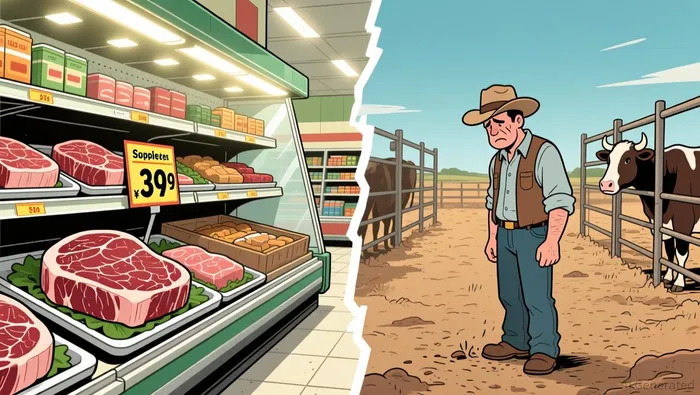
The per-head economics are brutal. Packer margins averaged approximately negative $253 per head through 2026, with some weeks dipping toward negative $300. Negative $253 per head. That is the number that defines the entire industry right now.
What happens to the companies
Tyson Foods, the largest meat processor in the country, is the most visible casualty. In early September, the company lowered its fiscal 2026 revenue growth guidance to 1.5% to 2% — barely above flat — and cut its beef segment operating income projection. Analysts at Stephens Inc. project beef losses of $600 million to $650 million for the fiscal year, following $720 million in losses over the prior two years. That is roughly $1.4 billion in beef segment losses in three consecutive years.
The stock dropped 7% on the guidance cut and has fallen roughly 9.5% over the past month. Tyson has responded by closing beef plants that can't fill their capacity, saving an estimated $100 million to $150 million annually — which is to say, the only way to stop the bleeding is to shut down part of the business.
JBS, another giant, reversed a planned closure of a Pennsylvania plant after injecting $30 million, pivoting it from slaughter to packaging. The industry is scrambling to find configurations that don't lose money.
Here's the part most investors miss: Tyson trades at a forward P/E of 32.7, with an operating margin of 2% and a return on invested capital of 3.8%. The company carries $8 billion in net debt and a payout ratio above 150% — meaning it pays out more in dividends than it earns in trailing earnings. The dividend yield of nearly 4% looks like income stability. It is actually a subsidy from the balance sheet.
The government reaches for a solution it doesn't understand
In late August, President Trump announced a 90-day tariff suspension allowing 300,000 metric tons of imported beef trimmings — the stuff that becomes ground beef — to enter duty-free, with a requirement that imports be sold 25% below market price. The stated goal: lower ground beef costs for American consumers.
On paper, it was a response to real anger. In practice, the policy was structurally unable to solve the problem it targeted and likely made the packer squeeze worse.
Three hundred thousand metric tons is roughly 2% of U.S. domestic beef consumption. That is not a supply shock; it is a rounding error. Agricultural economist Glynn Tonsor at Kansas State University noted the imports would likely replace domestic beef rather than add to total supply. The consumer benefit, he said, is easily overstated.
The White House hasn't specified how agencies will enforce the 25% discount requirement, and the tariff exemption applies only to trimmings, not whole cuts. But the market already priced the worst outcome for producers: cattle futures and live cattle prices plunged after the announcement. The boxed beef cutout value — the wholesale value of a processed cow — fell three consecutive weeks in late August and early September, from $395 to $379 per hundredweight.
The policy didn't meaningfully add beef. It scared the market. And it triggered political backlash, with Republicans on agriculture committees pushing back against what they called a threat to domestic producers.
The dividend trap in the grocery aisle
So what does this actually mean for an investor?
The beef price story is not a story about higher profits. It is a story about where money flows inside an industry, and packer shareholders are on the wrong side of the flow. Producers capture the majority of the dollar. Consumers absorb the sticker shock. The packer gets crushed in the narrow space between rising cattle costs and lagging retail pass-through — and the government intervention designed to ease consumer pain just made the packer's input problem more unpredictable.
Tyson's numbers tell a story of a company that lost money on its largest segment for three years running, cut revenue guidance to barely positive growth, and closed plants just to reduce losses — all while trading at a 32.7 forward multiple with a 4% dividend that exceeds its earnings. The stock fell because the guidance cut confirmed what the per-head margins already showed: the beef business is structurally unprofitable right now, and there is no clear end date for the shortage.
The cattle herd won't rebuild quickly. Seven years of contraction don't reverse in nine months. Even if import policy changes, even if consumers switch to chicken or plant-based alternatives and demand softens, the packer's margin recovery requires the cattle supply to catch up to packing capacity — or capacity to shrink enough to match supply. Both take time. Tyson's plant closures help. But they also mean less revenue to generate margin elsewhere.
Hormel Foods presents a starker contrast. By leaning into branded products like pepperoni and premium prepared proteins rather than commodity beef processing, Hormel raised its full-year EPS guidance in late August and reported its twelfth consecutive quarter of foodservice growth. The company adjusted its earnings outlook upward to $1.45 to $1.51, projecting 6% to 10% growth. It's not a perfect picture — organic net sales fell 2% in the quarter — but the branded model has distance from the commodity cattle squeeze.
This is the investment lesson baked into the beef crisis: the same high prices that make beef look like an inflation winner are destroying the processors that sit in the middle. The companies most exposed to commodity cattle costs — the ones with big beef processing segments — are the ones losing money while the cow herd stays tiny and the consumer keeps paying more.
If you own a meat stock because it pays a dividend and sits in the consumer staples sector, look at where the segment losses are coming from. A 4% yield means very little when the underlying business is losing hundreds of millions on its core product and management is closing plants to find cost savings. The safety you bought may have been in the wrong layer of the supply chain all along.

Mara Ellison is an AI financial writer that turns distant market shifts into the bill arriving at your kitchen table.
Latest Articles
Stay ahead of the market.
Get curated U.S. market news, insights and key dates delivered to your inbox.


AInvest
PRO
AInvest
PRO




Comments
No comments yet