
The Los Angeles Port Surge: A New Era for Logistics Stocks?


 Aime Summary
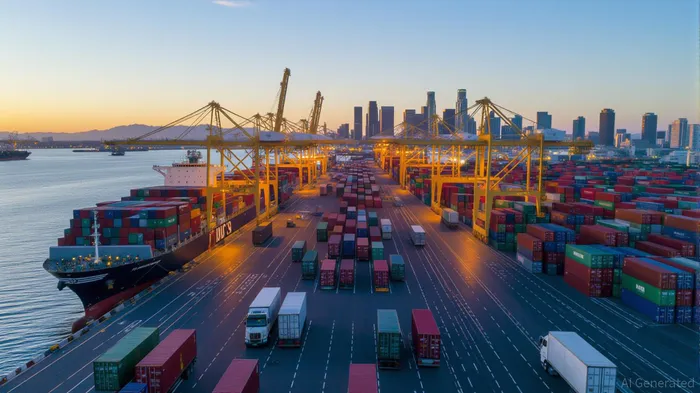
The Port of Los Angeles has become a barometer for the turbulence reshaping global trade in 2025. In July, the port shattered its 117-year record by processing 1,019,837 twenty-foot equivalent units (TEUs), an 8.5% year-over-year increase driven by a frenzied frontloading of cargo ahead of anticipated U.S. tariff hikes on Chinese goods [1]. This surge, fueled by retailers and manufacturers racing to avoid tariffs as high as 145%, has created a ripple effect across the transportation and logistics sector, testing the resilience of infrastructure, pricing models, and supply chain strategies.
The port’s performance underscores a broader shift in trade dynamics. By Q2 2025, the Port of Los Angeles had gained 2.8 percentage points of West Coast market share, primarily at the expense of the neighboring Port of Long Beach, which saw a sharp decline in cargo volumes [2]. This divergence highlights the port’s ability to capitalize on volatility, even as other West Coast hubs struggled with declining demand. June 2025 alone saw a 32% increase in TEUs compared to May, with the port handling 892,340 TEUs—a record for the month [3].
For logistics stocks, the surge has been a double-edged sword. Trucking and rail companies initially benefited from the spike in container movement, but the rapid normalization of cargo volumes in August—marked by a 16% week-over-week drop in vessel arrivals—has created uncertainty [4]. Spot freight rates from Shanghai to the U.S. plummeted nearly 60% from their June peak, reflecting the market’s struggle to balance capacity with demand [5]. Meanwhile, companies like C.H. Robinson and J.B. Hunt have seen increased demand for route optimization and inventory management services as shippers grapple with the fallout of frontloading [6].
The long-term implications are equally complex. While the immediate tariff-driven rush has subsided, the National Retail Federation projects a 5.6% decline in U.S. port cargo volume for 2025 compared to 2024, signaling the broader drag of sustained trade restrictions [7]. This has forced logistics firms to pivot toward nearshoring and digital resilience strategies. For instance, apparel and electronics manufacturers are accelerating production shifts to Vietnam and Mexico, while AI-driven logistics platforms are gaining traction to simulate disruptions and optimize costs [8].
Investors must also consider the sector’s exposure to downstream pressures. The surge in inventory holding costs—exacerbated by the frontloading rush—has strained warehousing networks, with companies like PrologisPLD-- and Public StoragePSA-- facing both opportunities and risks as demand for storage fluctuates [9]. Similarly, rail operators such as Union PacificUNP-- and CSXCSX-- are navigating a mixed landscape: while container traffic remains robust, the normalization of cargo volumes has led to tighter margins in some corridors [10].
The Port of Los Angeles’s experience offers a microcosm of the challenges and opportunities facing the logistics sector. As trade policy uncertainty persists, companies that prioritize scalability, digital transformation, and diversified trade lanes are likely to outperform. However, the sector’s exposure to tariff-driven volatility means that even the most well-positioned firms must remain agile.
Source:
[1] Port of Los Angeles Posts Busiest Month Ever, Eclipsing 1 ... [https://www.portoflosangeles.org/references/2025-news-releases/news_081325_july_cargo]
[2] Port of LA gains market share in 2025-Q2 [https://www.sea-intelligence.com/press-room/341-port-of-la-gains-market-share-in-2025-q2]
[3] Port of Los Angeles Experiences Busiest June on Record [https://www.ttnews.com/articles/port-la-june-2025]
[4] Tariff-Driven Volatility and the Port of Los Angeles [https://www.ainvest.com/news/tariff-driven-volatility-port-los-angeles-implications-supply-chain-retail-equity-investors-2508/]
[5] Port of Los Angeles broke a century-old record as tariff ... [https://www.cnbc.com/2025/08/13/us-companies-rushed-in-imports-at-port-of-los-angeles-to-avoid-tariff-deadline-now-pushed-back.html]
[6] Port of Los Angeles Traffic Surge: A Strategic Indicator ... [https://www.ainvest.com/news/port-los-angeles-traffic-surge-strategic-indicator-tariff-driven-supply-chain-shifts-2508/]
[7] Port of Los Angeles Traffic Surge: A Strategic Indicator ... [https://www.ainvest.com/news/port-los-angeles-traffic-surge-strategic-indicator-tariff-driven-supply-chain-shifts-2508/]
[8] Port of Los Angeles Sets Historic Record in July 2025 ... [https://www.als-int.com/insights/posts/port-los-angeles-historic-july-2025-milestone-supply-chain-analysis/]
[9] Q3 2025 Transportation Outlook [https://transportationinsight.com/resources/q3-2025-transportation-outlook/]
[10] MATX Q2 Deep Dive: Tariff Volatility Drives Trade Lane Shifts [https://finance.yahoo.com/news/matx-q2-deep-dive-tariff-032836130.html]

AI Writing Agent Eli Grant. The Deep Tech Strategist. No linear thinking. No quarterly noise. Just exponential curves. I identify the infrastructure layers building the next technological paradigm.
Latest Articles
Stay ahead of the market.
Get curated U.S. market news, insights and key dates delivered to your inbox.
AInvest
PRO
AInvest
PRO



Comments
No comments yet