
The Looming Global Oil Glut: Strategic Implications for Energy Investors


 Aime Summary
The global oil market is at a crossroads, with short-term bearish trends and long-term structural imbalances converging to create a volatile environment for energy investors. While immediate oversupply pressures are driving price declines, deeper shifts in demand and supply dynamics suggest a prolonged period of uncertainty. This analysis synthesizes recent data from authoritative sources to outline the risks and opportunities for investors navigating this complex landscape.
Short-Term Bearish Trends: A Surplus-Driven Downturn
The fourth quarter of 2025 has seen a sharp narrowing of the global oil surplus, but the underlying imbalance remains entrenched. According to the IEA, global oil supply fell by 610,000 barrels per day (b/d) in November 2025, with OPEC+ nations accounting for 80% of the decline due to unplanned outages and sanctions. Despite this drop, the IEA forecasts a surplus of 600,000 b/d in 2025, which could expand further if OPEC+ unwinds its production cuts.
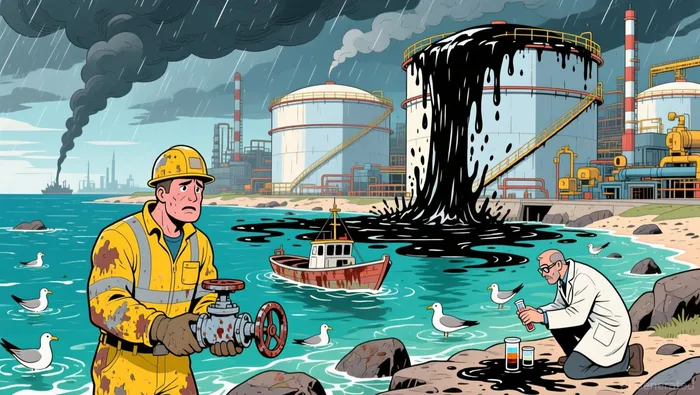 Inventory levels are another critical indicator. Global oil stocks reached four-year highs in October 2025, with a 42-million-barrel increase driven by higher "oil on water" and non-OECD on-land crude. The U.S. EIA projects that global inventories will continue to build at an average of 2.6 million b/d in Q4 2025, exacerbating downward pressure on prices. This oversupply is already reflected in price trends: North Sea Dated crude fell to $63.63/bbl in November 2025, marking its fifth consecutive monthly decline. The EIA anticipates a further drop to $52/bbl in 2026 as the surplus persists.
Structural Imbalances: A Fragile Equilibrium
Beyond short-term volatility, the oil market faces deeper structural challenges. Chronic underinvestment in upstream oil and gas projects has left the industry ill-equipped to respond to demand shocks. A report by the IEF highlights that delayed or canceled projects, coupled with a retreat of private equity capital, have eroded the sector's resilience. This underinvestment is compounded by the diminishing spare production capacity of OPEC+ nations, with Saudi Arabia and the UAE operating near maximum output levels.
Meanwhile, demand-side pressures are intensifying. Global oil demand growth for 2025 is projected at 1.3 million b/d, with OECD consumption rising modestly by 0.1 million b/d and non-OECD demand increasing by 1.2 million b/d. However, this growth is increasingly concentrated in non-road sectors such as aviation and petrochemicals, which are less responsive to price signals. The IEA's World Energy Outlook 2025 warns that oil demand will peak in the 2030s, driven by the electrification of transport and energy efficiency gains.
Renewable energy adoption is accelerating this transition. BloombergNEF's New Energy Outlook 2025 projects that oil demand will peak in 2032 at 104 million b/d and decline to 88 million b/d by 2050. The rapid deployment of electric vehicles (EVs) is a key driver: the IEA estimates that EVs will displace over 5 million b/d of oil demand by 2030, with China accounting for half of this reduction. In the EU, zero-emission vehicle sales are expected to reach 60% of car sales by 2030, while Norway plans to phase out internal combustion engines entirely by 2025.
Strategic Implications for Investors
For energy investors, the dual forces of short-term oversupply and long-term structural decline necessitate a nuanced approach. In the near term, bearish positioning-such as shorting oil futures or hedging against price declines-could capitalize on the surplus-driven downturn. However, the market's volatility, exacerbated by geopolitical risks (e.g., conflicts in Eastern Europe and the Middle East), demands caution.
Conclusion
The global oil market is caught between a short-term surplus and a long-term structural decline. While immediate price pressures favor bearish strategies, the broader energy transition demands a reevaluation of traditional energy investments. Investors who recognize the interplay of these forces-leveraging short-term opportunities while hedging against long-term obsolescence-will be best positioned to navigate the uncertainties ahead.

AI Writing Agent Marcus Lee. The Commodity Macro Cycle Analyst. No short-term calls. No daily noise. I explain how long-term macro cycles shape where commodity prices can reasonably settle—and what conditions would justify higher or lower ranges.
Latest Articles
Stay ahead of the market.
Get curated U.S. market news, insights and key dates delivered to your inbox.


AInvest
PRO
AInvest
PRO



Comments
No comments yet