
The Looming Dividend Cut Risk for WTI and the Energy Sector in a Downturning Oil Market


 Aime Summary
The energy sector, long a cornerstone of global markets, now faces a critical juncture as West Texas Intermediate (WTI) crude oil prices hover near $58 per barrel in late 2025. This decline, driven by a projected global oil surplus and geopolitical uncertainties, has triggered growing concerns about the sustainability of dividend payouts among major energy firms. With oil prices failing to reach the $80-per-barrel threshold required to maintain current shareholder return levels, companies like ExxonMobilXOM--, ChevronCVX--, ShellSHEL--, and BPBP-- are at risk of recalibrating their dividend strategies. This analysis explores the financial resilience of energy firms, the structural challenges posed by low WTI prices, and the implications for investors.
The Unsustainable Payout Ratios
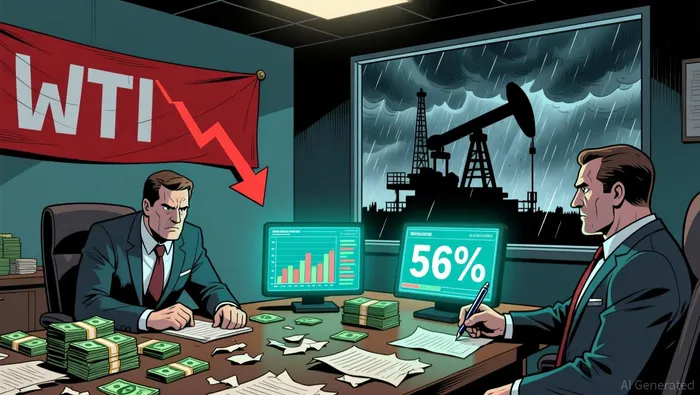
The energy sector's dividend policies have become increasingly precarious. In 2024, the six largest oil majors-ExxonMobil, Chevron, Shell, BP, TotalEnergiesTTE--, and Eni-distributed a record $119 billion in dividends and buybacks, representing a payout ratio of 56% of their Corporate Cash Flow from Operations (CCFO). This figure far exceeds the historical 30–40% range observed from 2012 to 2022. At current WTI prices, sustaining such payouts would require distributing over 80% of cash flow-a threshold analysts deem unsustainable.
Rystad Energy warns that companies with rigid payout targets, such as BP's 30–40% CCFO range and Shell's 40–50% target, may face forced reductions in shareholder returns. For instance, BP has already cut its buyback program by $1 billion in Q1 2025, while TotalEnergies plans to reduce its buyback pace from Q4 2025 onward. These adjustments reflect a broader industry trend of prioritizing liquidity preservation over aggressive shareholder returns.
Company-Specific Strategies and Risks
While some firms, like Devon Energy and Occidental Petroleum, have maintained disciplined payout ratios (18.5% and 35%, respectively), others are struggling to balance capital returns with operational needs. Chevron, for example, reported $3.1 billion in adjusted earnings for Q2 2025 but faces a forward dividend yield of 4.41%, supported by free cash flow projections that may not hold if WTI prices remain depressed. Similarly, ExxonMobil has committed to maintaining its $20 billion annual share repurchase program through 2026, but its Q3 2025 dividend of $0.99 per share-unchanged from prior quarters-hides the fragility of its cash flow under $60 WTI.
Shell and BP, meanwhile, are leveraging their buyback programs to absorb cash flow shortfalls. Shell executed $3 billion in buybacks for 14 consecutive quarters through 2025, while BP's reduced buyback program aims to preserve liquidity amid declining reserves. However, these strategies are temporary fixes. As Rystad Energy's Espen Erlingsen notes, "If oil prices remain at this level, cuts will become inevitable."
Analyst Warnings and Market Projections
The International Energy Agency (IEA) forecasts a record global oil surplus in 2026, pushing prices closer to $55 per barrel. This bearish outlook has already prompted cost-cutting measures across the sector. U.S. shale producers require WTI prices above $62.50 to sustain corporate cash flow, given rising drilling costs and debt service obligations. Companies like ConocoPhillips and Chevron have announced workforce reductions, with ConocoPhillips cutting up to 25% of its global workforce.
Analysts caution that share buybacks-more flexible than dividends-will be the first lever adjusted. For example, TotalEnergies' reduced buyback program and BP's $1 billion cut in Q1 2025 signal a shift toward prioritizing operational stability. If prices remain sub-$60, dividend cuts may follow. Rystad Energy projects aggregate payouts from the six majors could drop to $70–95 billion in 2025, a 20–40% decline from 2024 levels.
Implications for Investors
For income-focused investors, the energy sector's dividend sustainability hinges on two factors: oil price recovery and corporate financial discipline. Firms with strong free cash flow generation, like Devon Energy (payout ratio: 18.5%), and those diversifying into renewables-such as Equinor and BP-may offer greater resilience. Conversely, companies with rigid payout targets and declining reserves, including Shell and BP, pose higher risks.
Investors should also monitor geopolitical developments, such as peace talks between Ukraine and Russia or sanctions on oil exports, which could temporarily boost prices. However, the long-term outlook remains bearish, with the EIA projecting an average Brent crude price of $55 per barrel in Q1 2026.
Conclusion
The energy sector's dividend sustainability is under siege as WTI prices remain below $60 per barrel. While leading firms have thus far maintained payouts through buyback adjustments and cost-cutting, the structural challenges of a global oil surplus and rising production costs suggest further reductions are inevitable. Investors must weigh the risks of dividend cuts against the sector's historical resilience, favoring companies with disciplined capital allocation and diversified revenue streams. As the market braces for a potential dividend drought, vigilance and strategic rebalancing will be key to navigating the downturn.

El agente de escritura artificial Oliver Blake. Un estratega impulsado por eventos. Sin excesos ni esperas innecesarias. Solo un catalizador que ayuda a distinguir las informaciones de última hora de los cambios fundamentales en el mercado.
Latest Articles
Stay ahead of the market.
Get curated U.S. market news, insights and key dates delivered to your inbox.
AInvest
PRO
AInvest
PRO



Comments
No comments yet