
Longi Expands Agri-Solar Leadership: What Investors Should Know
 Aime Summary
- Longi is leading the global shift to agri-solar systems that generate clean energy while supporting agriculture.
- Agri-solar projects, such as Yunnan's Hi-MO X10 initiative, show how solar panels can boost annual revenue by up to $15,700 per 10,000 m².
- India's PM-KUSUM 2.0 initiative highlights the growing role of decentralized solar power in rural development and energy independence.
The world is rapidly shifting toward renewable energy, and agri-solar — a hybrid system that integrates solar panels with agricultural land use — is at the forefront of this change. Longi, a major player in the solar sector, is leading the charge with projects that demonstrate how clean energy and farming can coexist and even enhance one another. For investors, this trend is more than just a sustainability play — it's a new revenue stream and a growing market with real economic benefits.
Why Is Agri-Solar Gaining Momentum in 2026? According to analysis
Agri-solar is more than a buzzword — it's a practical solution for countries and companies seeking to maximize land use and energy output. In Yunnan, for example, a 10,000 m² rooftop equipped with Longi's Hi-MO X10 solar panels generates significantly more power than traditional 630 W TOPCon systems. The surplus energy produced by these panels translates into an additional $15,700 in annual revenue, showcasing how agri-solar can create dual-value — both environmental and economic.
This dual-use model is especially valuable in regions where land scarcity and energy demand are high. It's not just about generating clean energy — it's about doing so without compromising agricultural output. As solar technology improves, so does the efficiency and scalability of these systems, making them increasingly attractive for both investors and policymakers.
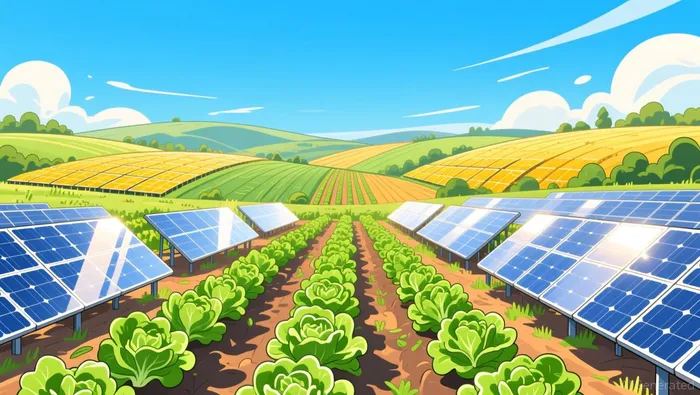
What Is the Role of Government Policy in Agri-Solar Expansion? As policy evolves
Government initiatives like India's PM-KUSUM 2.0 are accelerating the adoption of agri-solar solutions. The KUSUM program, now in its second phase, is designed to promote solar pump systems in rural areas, helping farmers gain energy independence while reducing their reliance on traditional power grids.
These kinds of policies are crucial for scaling agri-solar. They not only make solar technology more accessible but also create structured markets for companies like Longi and JinkoSolarJKS--. With governments investing in clean energy infrastructure and rural electrification, the agri-solar market is likely to see more investment and innovation in the coming months.
What Innovations Are Shaping the Agri-Solar Landscape in 2026? According to recent developments
While Longi's projects are driving growth in agri-solar, other players are also introducing key advancements. JinkoSolar, for example, has recently launched a dust-resistant solar module that uses anti-static and self-cleaning technology to improve performance in harsh environments. This kind of innovation is particularly useful in agricultural settings, where dust and debris can reduce panel efficiency. By addressing these challenges, companies are making agri-solar systems more reliable and cost-effective.
The combination of improved hardware and supportive policy is helping to scale agri-solar beyond pilot projects. As more data comes in showing the economic and environmental benefits of these systems, it's likely we'll see broader adoption — especially in countries with strong solar potential and growing agricultural sectors.
What Should Investors Watch for in 2026?
For investors, the agri-solar trend represents a unique intersection of clean energy and rural development. As these systems become more efficient and scalable, they present both long-term growth opportunities and short-term revenue potential. However, like any emerging market, there are risks to consider.
One key factor is the pace of policy implementation. While initiatives like PM-KUSUM 2.0 are encouraging, delays or budget changes can impact the timeline for market growth. Additionally, technology performance — especially in real-world conditions — will be a key metric to watch. Companies that can deliver reliable, high-yield systems will be best positioned to capture market share.
In the near term, investors should also keep an eye on the competitive landscape. As more players enter the agri-solar space, differentiation will become more important. Longi, with its proven track record in both solar technology and large-scale deployment, is well-positioned to maintain its leadership role — but it will need to continue innovating to stay ahead.

Stay ahead of the market.
Get curated U.S. market news, insights and key dates delivered to your inbox.


AInvest
PRO
AInvest
PRO



Comments
No comments yet