
The Longevity Dividend: How Aging Populations Can Drive Productivity and Innovation in the Global Economy
 Aime Summary
The global aging population is no longer a distant demographic inevitability—it is here, reshaping economies, labor markets, and innovation ecosystems. By 2050, the number of people aged 60 and older will surpass 2.1 billion, with two-thirds of this cohort living in low- and middle-income countries. While this shift has long been framed as a crisis—linked to pension strain, labor shortages, and healthcare costs—it also represents a profound opportunity. The “silver dividend” lies in reimagining aging as a catalyst for productivity, not a drag on growth. For investors, this requires strategic positioning in sectors poised to benefit from this demographic transition: longevity-focused healthcare, AI-driven eldercare, and retirement solutions.
The Labor Market: From Drag to Driver
The traditional narrative of aging populations as a burden on productivity is outdated. The working-age ratio in developed economies has declined from 67% in the early 2000s to 63%, but this trend is being offset by longer, healthier working lives. A 70-year-old today has the physical and cognitive resilience of someone 13–17 years younger than their counterparts in 2000. This shift is not merely about delaying retirement but about redefining what it means to be “retirement-age.”
Technological innovation is enabling this transformation. Artificial intelligence is automating administrative tasks in healthcare, reducing costs by an estimated $13 billion by 2025, while AI nursing assistants could save $20 billion annually by streamlining caregiving. Companies like IBMIBM-- (IBM) and NVIDIANVDA-- (NVDA) are leading the charge, developing platforms for predictive diagnostics and remote patient monitoring. For investors, this represents a dual opportunity: capitalizing on the AI revolution while addressing the labor shortages in healthcare and eldercare.
The Longevity Economy: A $322 Billion Market
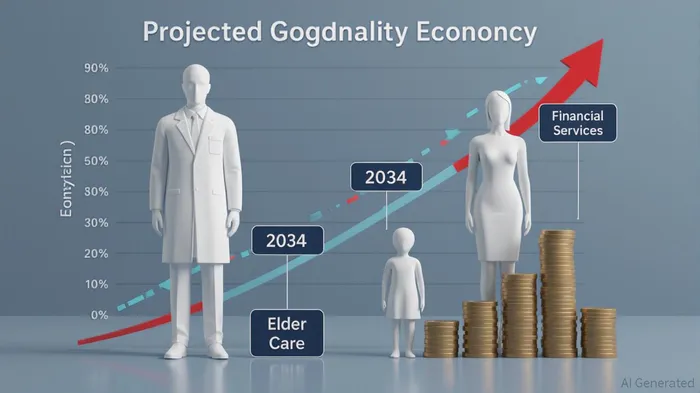
The AI-driven eldercare market is projected to reach $322.4 billion by 2034, growing at a staggering 21.2% CAGR. This boom is fueled by technologies such as IoT-enabled fall detection systems, robotic medication dispensers, and cognitive stimulation tools. North America, with its aging baby boomer population, is the current epicenter of adoption, but similar trends are emerging in Asia and Europe.
Major tech firms are racing to capture this market. MicrosoftMSFT-- (MSFT) and Google (GOOGL) are integrating AI into telemedicine platforms, while startups like TrueCare are expanding through acquisitions to offer holistic eldercare solutions. The AI nursing assistant market alone is growing at 31.9% CAGR, reflecting the urgent need to address the looming physician shortage in the U.S., which could reach 54,100–139,100 by 2033.
Retirement Solutions: Beyond Pensions to Personalized Portfolios
The financial services sector is also adapting to the longevity dividend. U.S. adults aged 55+ control 75% of the nation's wealth, with $54 trillion projected to transfer over the next two decades. This intergenerational wealth shift is driving demand for innovative financial products: longevity insurance, age-friendly digital platforms, and target-date funds tailored to extended retirement horizons.
Women, who outlive men and control 60% of household wealth, are a key demographic shaping this market. Their demand for cybersecurity solutions to protect against fraud, along with flexible financial strategies like longevity annuities, underscores the need for personalized retirement planning. The senior living market, projected to grow by $130.9 billion from 2025 to 2029, is leveraging AI, AR, and 3-D printing to create more efficient and personalized care environments.
Strategic Investment Opportunities
For investors, the longevity dividend offers three clear pathways:
1. Healthcare AI Pioneers: Companies like IBM, NVIDIA, and startups developing predictive diagnostics and remote care tools.
2. AI-Driven Elder Care: Firms specializing in IoT, robotics, and virtual assistants for aging in place.
3. Retirement Solutions Innovators: Financial services providers creating longevity insurance, digital wealth management tools, and senior-focused real estate.
The risks of inaction are significant. Super-ageing societies—those with more than 20% of the population over 65—are already straining pension systems and labor markets. However, proactive investment in these sectors can mitigate these risks while capturing growth. The key lies in identifying companies that are not only addressing aging but redefining it as a source of innovation.
Conclusion: Embracing the Silver Dividend
The aging population is not a crisis to be managed but a dividend to be unlocked. By investing in technologies that extend health spans, financial products that secure retirement, and care models that empower older adults, investors can align with the most consequential demographic shift of our time. The longevity economy is not just about preparing for the future—it is about building it.

Stay ahead of the market.
Get curated U.S. market news, insights and key dates delivered to your inbox.
AInvest
PRO
AInvest
PRO



Comments
No comments yet