
Long-Term Wealth Creation: The 15% Rule and the Power of Compounding


 Aime Summary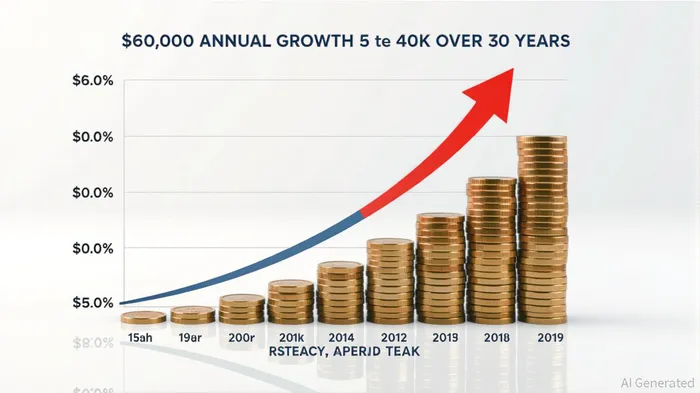
Kevin O'Leary's 15% 401(k) strategy is more than a number—it is a philosophy rooted in the mathematics of compounding and the psychology of disciplined saving. By advocating for 15% of annual income to be allocated to retirement accounts, O'Leary taps into two fundamental truths: the exponential power of time and the human tendency to undervalue the future. This approach, while seemingly simple, mirrors the mental models of high-achieving leaders like Chung Ju-Yung, whose legacy at Hyundai demonstrates how resilience, consistency, and long-term vision can compound into extraordinary outcomes.
The 15% Rule: A Behavioral Finance Breakthrough
O'Leary's strategy addresses a critical flaw in human decision-making: present bias. Behavioral finance reveals that individuals often prioritize immediate gratification over long-term gains, a tendency exacerbated by the abstract nature of retirement planning. By framing 15% as a non-negotiable “wealth tax,” O'Leary reframes savings as a mandatory expense, akin to rent or utilities. This mental shift combats the illusion of infinite time and the false belief that retirement savings can be deferred indefinitely.
The 15% target is also mathematically sound. For an average earner with a $60,000 salary, contributing $9,000 annually to a 401(k) at a 7% average annual return would yield approximately $1.5 million over 30 years. This outcome hinges on two factors: consistency and time. Even modest adjustments—such as increasing contributions by 1% annually—amplify results exponentially.
Chung Ju-Yung's Blueprint: Resilience and Long-Term Vision
Chung Ju-Yung, the founder of Hyundai, operated under a similar ethos. During the 1997 Asian Financial Crisis, while many companies slashed R&D budgets, Chung reinvested in advanced machinery and talent, ensuring Hyundai's long-term competitiveness. His mantra—“shortening the time”—emphasized execution discipline, a principle that aligns with O'Leary's emphasis on automating savings. Both leaders understood that compounding is not just a financial tool but a mindset: small, consistent actions yield outsized results over time.
Chung's strategic frugality—repurposing scrap materials and rejecting ostentation—parallels O'Leary's warnings against lifestyle inflation. By prioritizing reinvestment over short-term consumption, both models counteract the behavioral bias toward immediate rewards. Chung's people-centric culture, which fostered loyalty and innovation, further underscores the importance of aligning personal and organizational goals—a lesson for investors to prioritize employer-matching contributions and employee-centric companies.
The Role of Compounding in Wealth Accumulation
Compounding is often described as the “eighth wonder of the world,” but its true power lies in its ability to transform ordinary savings into extraordinary wealth. Consider an individual who begins saving 15% of a $60,000 salary at age 25. By age 65, with a 7% annual return, their portfolio would grow to approximately $1.5 million. If they delay starting until age 35, the total drops to $750,000—a 50% reduction. This illustrates the critical role of time in compounding, a principle Chung Ju-Yung applied to Hyundai's global expansion.
Investment Advice: Discipline Over Timing
For investors, the 15% strategy offers a blueprint for long-term success. First, prioritize employer-matching contributions in 401(k)s, as this effectively doubles your savings. Second, automate contributions to eliminate the temptation to divert funds to discretionary spending. Third, adopt a “buy and hold” mindset, resisting the urge to time the market—a common pitfall that undermines compounding.
Chung Ju-Yung's legacy also highlights the importance of investing in companies with resilient leadership. Firms like Delta AirlinesDAL-- and Edison InternationalEIX--, which maintain conservative balance sheets and reinvest in innovation, exemplify the principles of strategic frugality and long-term vision. For retirement portfolios, consider allocations to such companies, which are better positioned to navigate economic cycles.
Conclusion: The 15% Rule as a Legacy Strategy
O'Leary's 15% strategy and Chung Ju-Yung's leadership principles converge on a single truth: wealth is not built in a day but through decades of disciplined, consistent action. By embracing compounding, resisting present bias, and aligning with resilient leaders, investors can transform modest savings into generational wealth. In an era of economic uncertainty, the 15% rule remains a timeless guide to financial independence—a testament to the power of patience, discipline, and the compounding of both money and ideas.

Stay ahead of the market.
Get curated U.S. market news, insights and key dates delivered to your inbox.






Comments
No comments yet