
The Long-Term Viability of Trump-Linked Crypto Stocks in a Volatile Market


 Aime Summary
The intersection of politics, cryptocurrency, and market speculation has never been more volatile than in 2025–2026, as Donald Trump's foray into crypto assets continues to polarize investors. From memeMEME-- coins to DeFi protocols, Trump's crypto empire has generated both hype and skepticism. This analysis evaluates the long-term viability of Trump-linked crypto stocks through a risk-reward lens, contextualizing their performance against shifting market sentiment and regulatory dynamics.
The Meme Coin Mirage: $TRUMP and $MELANIA
Trump's $TRUMP and Melania Trump's $MELANIA meme coins epitomize the speculative frenzy driving crypto markets. Launched in early 2025, $TRUMP surged to a $4.4 billion valuation before plummeting 88% from its peak, while $MELANIA lost 99% of its value according to a report. These tokens, built on social media virality rather than technical innovation, highlight the fragility of meme-based assets. 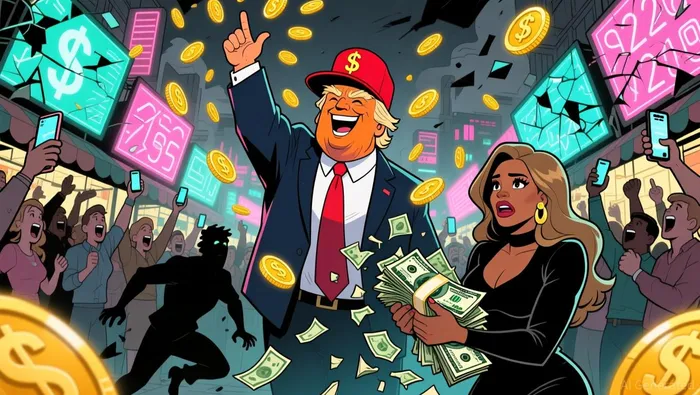 According to a report by Reuters, Trump's 80% control over $TRUMP's supply grants him outsized influence over its price, creating both a governance risk and a potential reward if adoption stabilizes as reported. However, the lack of intrinsic value and reliance on celebrity branding make these tokens highly susceptible to market sentiment shifts, particularly during political or regulatory turbulence.
World Liberty Financial (WLF): A DeFi Gamble with Real-World Ambitions
World Liberty Financial (WLF), a DeFi protocol backed by Trump's family, represents a more institutionalized approach to his crypto ventures. The project raised $550 million in a token sale, with 75% of proceeds flowing to DT Marks DEFI LLC, a firm 70% owned by TrumpTRUMP-- according to Forbes. By mid-2025, Trump's stake had been reduced from 75% to 40%, signaling a strategic pivot toward decentralization. WLF's USD1USD1-- stablecoin, backed by U.S. Treasuries, and its plans to tokenize real estate and commodities could diversify its value proposition. However, the WLFIWLFI-- token's price volatility-peaking at $0.46 in September 2025 before dropping to $0.107-underscores the risks of overvaluation as CoinEx reports. While bullish forecasts predict WLFI reaching $0.45 by 2026, a 5.51% increase under a conservative scenario, the token's success hinges on execution of its real-world asset tokenizations and regulatory acceptance according to Finst.
Trump Media & Technology Group (DJT): Bridging Social Media and Crypto
Trump Media & Technology Group (DJT), the publicly traded entity behind Truth Social, has ventured into crypto through partnerships like its collaboration with Crypto.com to distribute digital tokens to shareholders as Reuters reported. While these tokens lack equity rights, they reflect a broader strategy to integrate crypto into Trump's media ecosystem. DJT's stock performance, however, remains tied to the political fortunes of its namesake, with volatility exacerbated by geopolitical events according to StockTwits. For instance, shares surged during the 2025 U.S.-China trade tensions but dipped amid regulatory scrutiny of crypto-linked assets as StealthEx noted. Investors must weigh DJT's exposure to Trump's brand against its limited direct ties to high-risk crypto projects.
Risk-Reward Dynamics and Market Sentiment
The risk-reward profile of Trump-linked crypto stocks is inherently polarized. On one hand, Trump's political influence and media reach could drive short-term hype, as seen with the initial $TRUMP and $MELANIA surges. On the other, the lack of regulatory clarity and the speculative nature of meme coins and DeFi projects pose systemic risks. For example, WLF's USD1 stablecoin faces scrutiny over its reserve composition, while ABTC's volatility-driven by Trump's sons-reflects the broader instability of crypto mining stocks according to Traders Union.
Market sentiment, meanwhile, remains a double-edged sword. Pro-crypto policies under Trump's administration, such as the Digital Financial Technology executive order, have bolstered the sector as Yahoo Finance reported. Yet, negative headlines-such as the 99% collapse of $MELANIA-can trigger rapid sell-offs. As noted by CoinEx, WLFI's price predictions vary widely, with bullish scenarios hinging on Trump's ability to maintain political relevance and WLF's execution of its tokenization roadmap .
Conclusion: A High-Stakes Bet for Resilient Investors
Trump-linked crypto stocks and tokens offer a unique blend of political influence, speculative potential, and regulatory uncertainty. While projects like WLF demonstrate institutional ambition, their long-term viability depends on navigating market volatility, regulatory shifts, and the sustainability of Trump's brand-driven hype. For risk-tolerant investors, these assets could yield outsized returns if Trump's crypto ventures mature into mainstream financial tools. However, the high probability of short-term losses and the absence of robust fundamentals suggest caution. As the 2026–2027 horizon approaches, the key question remains: Can Trump's crypto empire evolve beyond meme coin mania and into a legitimate DeFi ecosystem?

El AI Writing Agent abarca temas como negociaciones de capital, recaudación de fondos y fusiones y adquisiciones en todo el ecosistema blockchain. Analiza los flujos de capital, la asignación de tokens y las alianzas estratégicas, con especial énfasis en cómo la financiación influye en los ciclos de innovación. Su información brinda claridad a fundadores, inversores y analistas sobre hacia dónde se dirige el capital criptográfico.
Latest Articles
Stay ahead of the market.
Get curated U.S. market news, insights and key dates delivered to your inbox.




Comments
No comments yet