
The Long-Term Impact of Government Policy on Endowment Performance: Trump-Era Risks and Institutional Adaptation
 Aime Summary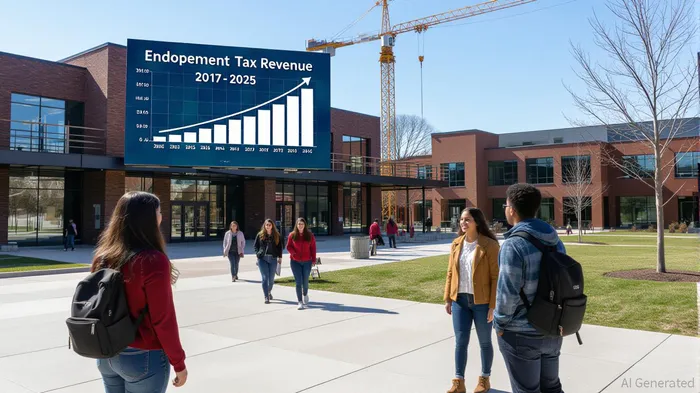
Government policy has long shaped the financial trajectories of institutions, but the Trump-era regulatory and tax decisions between 2017 and 2025 have introduced a new era of systemic risk for high-net-worth universities. These policies, centered on endowment taxation, federal funding leverage, and ideological scrutiny, have forced institutions to recalibrate their investment strategies, donor engagement, and operational priorities. For investors, understanding these shifts is critical to navigating the evolving landscape of higher education finance.
The Endowment Tax: A Catalyst for Fiscal Restructuring
The 2017 Tax Cuts and Jobs Act (TCJA) introduced the first federal excise tax on university endowments, targeting institutions with assets exceeding $500,000 per full-time student. By 2021, this tax had evolved into a tiered system, with rates climbing to 8% for institutions like Harvard and Yale. The administration's 2024 “Endowment Tax Fairness Act” further escalated the burden, proposing a 21% rate for the largest endowments. This created an immediate liquidity crisis for elite institutions, which responded with austerity measures: hiring freezes, delayed infrastructure projects, and reduced financial aid.
The tax's inflationary erosion of thresholds meant that by 2023, 56 institutions were subject to the tax, generating $380 million in revenue—up from $68 million in 2021. For investors, this signals a shift in institutional behavior. Universities are now prioritizing liquidity over long-term growth, reallocating capital to tax-exempt assets and reducing exposure to high-risk alternatives like private equity.
Regulatory Leverage and Political Risk
Beyond taxation, the Trump administration weaponized federal funding to enforce ideological compliance. Institutions facing investigations into diversity, equity, and inclusion (DEI) policies or campus protests saw grants frozen or revoked. Harvard, for instance, faced a $2.6 billion freeze over antisemitism allegations, while Columbia University agreed to a $200 million fine and restored $400 million in grants in 2024. These actions created a precedent: federal funding is now a political tool, not a stable revenue stream.
The administration also restricted international student visas, a move that disproportionately affected institutions reliant on tuition from abroad. With international students often paying full tuition, their decline in enrollment has forced universities to raise domestic tuition by 5–6% annually—well above historical averages. For investors, this underscores the vulnerability of institutions dependent on volatile revenue sources.
Donor Behavior and Systemic Uncertainty
High-net-worth donors, traditionally a cornerstone of university endowments, have grown cautious. The politicization of institutions—whether over DEI initiatives or campus protests—has led to donor hesitancy. Charitable giving to universities fell by 12% in 2024, according to the National Association of College and University Business Officers. Institutions are now pivoting to private-sector partnerships and education technology (EdTech) platforms like CourseraCOUR-- to diversify revenue.
The systemic risks extend beyond individual institutions. Research equipment suppliers and EdTech firms have seen reduced demand as universities cut spending.
Investment Implications and Strategic Adaptation
For investors, the key takeaway is the need to hedge against regulatory and ideological volatility. Universities with diversified revenue streams—those leveraging EdTech, private-sector R&D, or alternative education models—are better positioned to withstand policy shocks. Conversely, institutions reliant on federal grants or large endowments face heightened risk.
- Diversify Exposure: Investors should consider education-adjacent sectors, such as EdTech or private research firms, which are less susceptible to policy shifts.
- Monitor Tax Policy: The proposed 21% endowment tax, if enacted, could force universities to issue taxable bonds or tap into alumni networks for liquidity. Track legislative developments closely.
- Assess Institutional Resilience: Institutions with agile governance and diversified funding models (e.g., public-private partnerships) are more likely to thrive.
Conclusion
The Trump-era policies have redefined the financial and political landscape for high-net-worth institutions. While these changes have created systemic risks, they also highlight opportunities for innovation and resilience. For investors, the lesson is clear: the future of higher education finance is increasingly tied to the interplay of policy, ideology, and institutional adaptability. Those who recognize this dynamic will be better prepared to navigate the uncertainties ahead.

Stay ahead of the market.
Get curated U.S. market news, insights and key dates delivered to your inbox.


AInvest
PRO
AInvest
PRO



Comments
No comments yet