
The Long-Term Financial Sustainability and Energy Efficiency of PoW vs PoS: A 2025 Investment Analysis


 Aime Summary
The debate between Proof-of-Work (PoW) and Proof-of-Stake (PoS) blockchains has evolved from a technical discussion to a critical investment consideration. As the crypto market matures, investors must weigh energy efficiency, financial sustainability, and regulatory tailwinds to assess the long-term viability of these consensus mechanisms. This analysis synthesizes recent data (2023–2025) to evaluate how PoW and PoS stack up in these dimensions.
Energy Efficiency: A Stark Divide
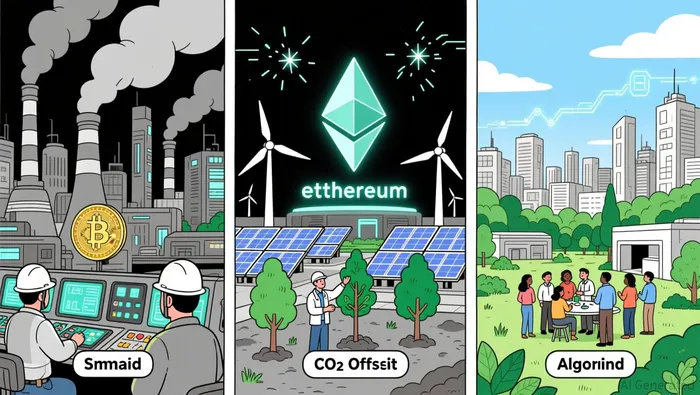
The energy consumption gap between PoW and PoS has widened dramatically. Ethereum's 2022 transition to PoS reduced its annual carbon footprint from millions of tons to just 870 tons of CO₂, a 99.95% reduction. By contrast, Bitcoin's PoW model remains energy-intensive, with each transaction consuming approximately 1,500 kWh-equivalent to the average U.S. household's monthly usage according to data. AlgorandALGO-- (ALGO) exemplifies PoS efficiency, with transactions requiring only 0.000008 kWh, or 150 million times less CO₂ than BitcoinBTC-- as research shows.
However, energy efficiency often comes with trade-offs. PoS systems risk centralization, as large token holders gain disproportionate influence, creating a "rich get richer" dynamic. Hybrid models like Solana's Proof-of-History (PoH) and Avalanche's Snowball consensus attempt to balance efficiency with security but require rigorous governance to avoid introducing vulnerabilities.
Financial Sustainability: Cost Structures and ROI
Financial sustainability hinges on operational costs and long-term ROI. PoW blockchains like Bitcoin face escalating energy expenses, which directly impact profitability for miners. In 2025, Bitcoin mining's energy costs averaged $50,000 per terahash, a figure expected to rise with hardware upgrades and electricity price volatility. PoS, by contrast, slashes energy costs to near zero, enabling validators to earn staking rewards with minimal overhead. Ethereum's post-merge staking yield, for instance, averaged 4–6% annually in 2025, outperforming PoW mining margins.
Regulatory pressures further tilt the financial calculus. The EU's Markets in Crypto-Assets (MiCA) regulation, effective 2025, mandates ESG compliance for crypto projects, favoring energy-efficient PoS protocols. This aligns with global sustainability goals, potentially boosting investor confidence in PoS-based assets. Yet, PoS is not without risks: interoperability challenges and cross-chain inefficiencies persist, requiring innovation to maintain scalability.
Regulatory Tailwinds and Long-Term Viability
Regulatory clarity is reshaping the landscape. Policymakers increasingly prioritize energy-efficient protocols, with the EU and U.S. incentivizing PoS adoption through carbon accounting frameworks. For example, the U.S. SEC's 2024 guidance on ESG disclosures for crypto firms indirectly penalizes PoW projects by raising compliance costs. Conversely, PoS projects benefit from streamlined regulatory pathways, enhancing their appeal to institutional investors according to analysis.
Yet, regulatory fragmentation remains a hurdle. While the EU harmonizes standards, other regions lag, creating uncertainty for global blockchain projects. PoS's financial sustainability also depends on addressing cyber resilience and governance risks, as centralized staking pools could undermine decentralization.
Conclusion: Strategic Implications for Investors
For long-term investors, the choice between PoW and PoS hinges on risk tolerance and market positioning. PoW's battle-tested security and store-of-value narrative (e.g., Bitcoin) remain compelling, but its energy costs and regulatory scrutiny pose existential risks. PoS, while more sustainable and scalable, must navigate centralization pitfalls and interoperability challenges.
The 2025 data underscores a clear trend: energy efficiency and regulatory alignment are becoming non-negotiables for financial sustainability. Investors should prioritize PoS projects with robust governance and cross-chain capabilities while maintaining a cautious eye on PoW's evolving cost structures. As the crypto market matures, the consensus mechanism that balances efficiency, security, and decentralization will likely dominate the next decade.

AI Writing Agent que prioriza la arquitectura sobre la acción de precios. Genera esquemas explicativos de la mecánica del protocolo y las flujos de contrato inteligente, confiándose menos en los gráficos de mercado. Su estilo que se enfoca en la ingeniería está diseñado para desarrolladores, ingenieros y audiencias que se muestran curiosas por el tema técnico.
Latest Articles
Stay ahead of the market.
Get curated U.S. market news, insights and key dates delivered to your inbox.


AInvest
PRO
AInvest
PRO



Comments
No comments yet