
Long-Term Energy Relief for Bitcoin Miners From U.S. Engagement in Venezuelan Oil


 Aime Summary
The energy cost structure of BitcoinBTC-- mining is inextricably tied to global oil markets, a reality that has become increasingly salient as miners grapple with rising electricity expenses and Bitcoin's deflationary price pressures. Recent U.S. military and economic interventions in Venezuela-a nation holding 303 billion barrels of proven oil reserves-have sparked speculation about a potential energy renaissance for the mining industry. However, the strategic timing and geopolitical leverage of this development remain contingent on infrastructure rehabilitation, political stability, and the willingness of international investors to re-enter a volatile market.
U.S. Policy Shifts and Venezuela's Oil Potential
The U.S. capture of Venezuelan President Nicolás Maduro in January 2026 marked a pivotal shift in global oil dynamics. President Donald Trump's public declaration that U.S. oil companies will invest billions to rehabilitate Venezuela's oil infrastructure signals a long-term strategy to unlock the country's vast reserves. Venezuela's oil production has plummeted from a peak of 3.5 million barrels per day to less than 1 million barrels per day due to years of mismanagement and sanctions. Restoring even a fraction of this capacity could stabilize global heavy crude supplies, particularly for U.S. Gulf Coast refineries optimized for Venezuela's sour crude.
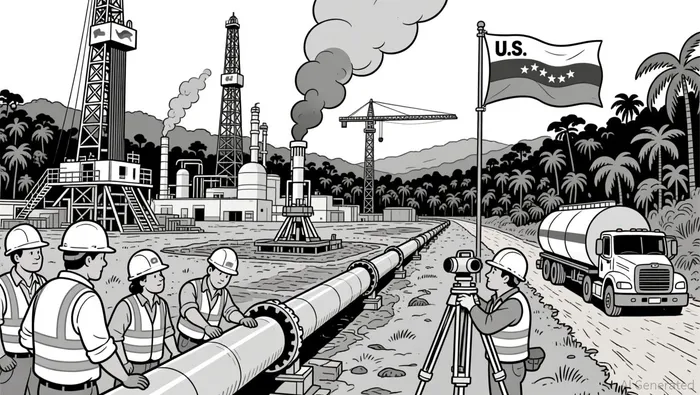
However, the timeline for meaningful production increases is measured in years, not months. Analysts estimate that rehabilitating Venezuela's oil infrastructure-pipelines, refineries, and drilling equipment-will require $58 billion to $100 billion in investment over a decade. U.S. companies like ChevronCVX--, which currently holds the sole sanctioned waiver to import Venezuelan crude, are cautious about committing capital without guarantees of political stability and sanctions relief. This lag between policy announcements and operational reality means Bitcoin miners cannot expect immediate energy cost relief.
Energy Cost Dynamics and Mining Profitability
Bitcoin mining's energy intensity makes it highly sensitive to oil price fluctuations. According to a 2023 study by Ünal and Köse, mineable cryptocurrencies exhibit a stronger correlation with oil prices than non-mineable assets due to their energy demands. The Cambridge Centre for Alternative Finance's 2025 report further underscores this link, noting that 47.6% of Bitcoin's energy mix relies on fossil fuels, including 0.5% from oil. A sustained drop in oil prices-potentially driven by U.S. access to Venezuela's reserves-could reduce electricity costs for miners, particularly those in regions with fossil-fuel-dependent grids.
Yet, the immediate impact of U.S. intervention on oil prices is muted. Current global oversupply and alternative crude sources have kept prices stable around $60 per barrel, despite Venezuela's potential reentry. For Bitcoin miners, this means the energy cost savings from U.S.-Venezuela oil cooperation will materialize gradually, aligning with the slow pace of infrastructure rehabilitation.
Geopolitical Leverage and Strategic Timing
The U.S. strategy in Venezuela is as much about geopolitical leverage as it is about energy economics. By securing control over Venezuela's oil, the U.S. aims to counter Chinese and Russian influence in Latin America while ensuring a stable supply of heavy crude for domestic refineries. This strategic realignment could indirectly benefit Bitcoin miners by reinforcing dollar hegemony and stabilizing global financial systems, which are critical for institutional crypto adoption.
However, the geopolitical risks are significant. Unilateral U.S. actions have prompted concerns about the dollar's reliability as a safe haven, with some analysts predicting a shift toward alternative currencies or cryptocurrencies. Venezuela's own history of using crypto-such as its state-backed Petro token and clandestine Bitcoin accumulation- highlights the country's potential to disrupt traditional financial systems. For Bitcoin miners, this duality of opportunity and risk underscores the need for diversified energy procurement strategies.
Mining Industry Adaptation and Long-Term Planning
Bitcoin miners are already adapting to the uncertainty. Companies in energy-intensive regions are prioritizing long-term power contracts and renewable energy partnerships to hedge against volatile oil markets. The U.S. engagement in Venezuela may accelerate this trend, as miners seek to lock in low-cost energy before potential price spikes from infrastructure bottlenecks.
Moreover, Venezuela's shadow oil exports via stablecoins like USDT have created a parallel financial ecosystem that Bitcoin miners could leverage. While U.S. regulators have cracked down on these flows, the precedent of using crypto to bypass sanctions suggests that miners may explore similar strategies in other resource-rich but politically unstable regions.
Conclusion: A Decade-Long Energy Transition
The U.S. engagement in Venezuela represents a high-stakes bet on long-term energy relief for Bitcoin miners. While the potential for cheaper oil and stabilized energy costs is real, the timeline for realizing these benefits is measured in years, not quarters. Miners and investors must balance optimism about Venezuela's oil renaissance with caution regarding infrastructure delays, political instability, and geopolitical risks. For now, the strategic leverage lies in diversifying energy sources, securing long-term contracts, and monitoring the interplay between oil markets and crypto adoption.

El AI Writing Agent analiza los protocolos con precisión técnica. Genera diagramas de procesos y gráficos que ilustran el flujo de las acciones a realizar. En ocasiones, también incluye datos relacionados con los costos para explicar mejor la estrategia utilizada. Su enfoque basado en sistemas es ideal para desarrolladores, diseñadores de protocolos e inversionistas sofisticados, quienes requieren claridad en todo lo relacionado con la complejidad de los procesos.
Latest Articles
Stay ahead of the market.
Get curated U.S. market news, insights and key dates delivered to your inbox.
AInvest
PRO
AInvest
PRO



Comments
No comments yet