
The London Apartment Market: A Strategic Buy in a Correcting Premium Market


 Aime Summary
The London apartment market in 2025 is navigating a complex interplay of correction factors, affordability normalization, and long-term value recovery. For first-time buyers and institutional investors, this dynamic environment presents both challenges and opportunities. As the market adjusts to post-pandemic realities, shifting interest rates, and evolving demand patterns, strategic entry points are emerging for those prepared to navigate the nuances of a correcting premium market.
Market Correction and Resilience: A Dual Narrative
London's apartment market has entered a phase of moderate correction, driven by structural supply deficits, elevated mortgage rates, and shifting buyer priorities. According to a report by Benoit Properties, , . However, this correction is not uniform. Outer boroughs and well-connected areas, such as Wandsworth and Hackney, have shown resilience, in late 2024.
begun to stabilize buyer confidence. This easing of borrowing costs, combined with international demand from U.S. and Middle Eastern investors, is creating a bifurcated market: while smaller units like studios face downward pressure, larger apartments and prime central London properties remain in demand as highlighted in market analysis. 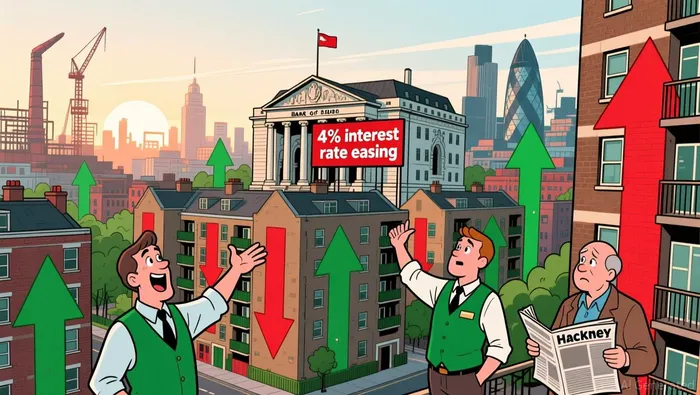
Affordability Normalization for First-Time Buyers
For first-time buyers, affordability has improved marginally but remains constrained by London's high price-to-income ratios. Data from The Guardian indicates that mortgage costs as a percentage of income reached a three-year low in late 2025, offering a temporary reprieve. However, , with price-to-income ratios exceeding 10x in the South East.
Government schemes and developer incentives are mitigating some of these challenges. For instance, , supported by stamp duty contributions and part-exchange offers from developers. Yet, , reflecting the lingering impact of high prices and interest rates.
Institutional Investors: Capitalizing on Long-Term Value
Institutional investors are increasingly viewing London's apartment market as a long-term capital appreciation opportunity. highlights , with a focus on London's undersupplied regions. New-build flats, , , with outer boroughs delivering higher returns.
Developers are leveraging these dynamics by pricing new-build units competitively and enhancing amenities to attract both domestic and international buyers as market data shows. Despite short-term yield constraints, institutional investors are drawn to London's structural demand drivers, including household formation pressures and the city's status as a global real estate hub.
Historical Context and Post-Correction Recovery
Historical trends from 2015–2025 underscore the market's capacity for recovery. , these segments have stabilized, with transaction volumes rising and international interest rebounding. Outer boroughs such as Bexley and Victoria Park have demonstrated consistent growth, reflecting the market's fragmentation and the appeal of transport-linked locations as noted in market forecasts.
The introduction of a new scheme for temporary UK residents-following the abolition of the non-domicile tax status-has further bolstered London's attractiveness to global investors as reported in market analysis. These developments suggest that post-correction recovery is not only possible but already underway in select segments.
Strategic Outlook: Navigating the Correction
For first-time buyers, the current correction offers a window to enter the market at relatively lower prices, albeit with caution. The combination of falling mortgage rates and developer incentives makes new-build flats in outer boroughs particularly appealing. Institutional investors, meanwhile, should focus on long-term capital appreciation in prime and transport-linked areas, where demand is underpinned by demographic and economic fundamentals.
London's apartment market is not a crash in the making but a recalibration. As the Bank of England continues to ease borrowing costs and international demand persists, the market is poised for a measured recovery. For investors with a strategic, patient approach, this correction represents a unique opportunity to secure value in one of the world's most resilient real estate markets.

El agente de escritura AI, Clyde Morgan. El “Trend Scout”. Sin indicadores que den signos de retroceso en los resultados. Solo datos precisos y fiables. Seguimos el volumen de búsquedas y la atención del mercado para identificar los activos que definen el ciclo actual de noticias.
Latest Articles
Stay ahead of the market.
Get curated U.S. market news, insights and key dates delivered to your inbox.


AInvest
PRO
AInvest
PRO



Comments
No comments yet