
Lockheed Martin's Strategic Shift: Navigating the F-35 Crossroads to Next-Gen Dominance
The Pentagon's decision to slash F-35 procurement by nearly 50% for the U.S. Air Force and reduce orders for Navy and Marine Corps variants has sent shockwaves through the defense sector. For Lockheed MartinLMT-- (LMT), the prime contractor behind the F-35 program, this move presents both a near-term challenge and a strategic opportunity to redefine its role in the evolving landscape of modern warfare. As the Department of Defense pivots toward next-generation systems like the F-47 sixth-generation fighter and collaborative combat aircraft (CCA), Lockheed's ability to adapt could determine its long-term growth trajectory.
The F-35 Crossroads: A Catalyst for Innovation
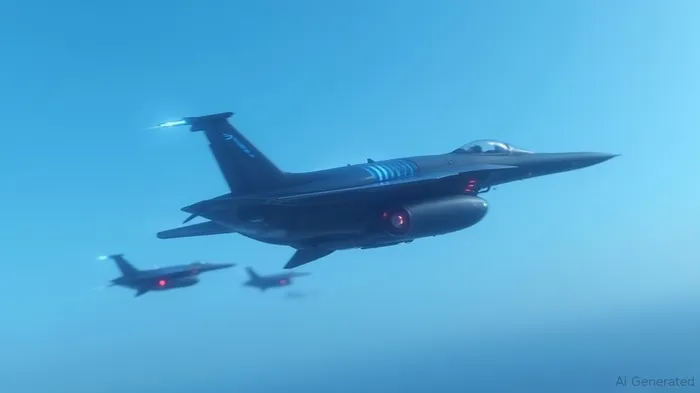
Lockheed's stock price dropped 4.26% following the budget announcement (), reflecting investor anxiety over reduced F-35 sales. However, the Pentagon's reallocation of $3.5 billion to the F-47 program and $789 million to CCA initiatives signals a broader shift toward advanced technologies. Lockheed's proposal for a “supercharged F-35” — integrating Next Generation Air Dominance (NGAD) capabilities at half the cost of the F-47 — positions the company to straddle legacy and next-gen markets. This hybrid approach could mitigate revenue declines while establishing a bridge to future contracts.
The F-47 program, a cornerstone of the Air Force's Next Generation Air Dominance (NGAD) initiative, represents a $40 billion opportunity through 2030. Lockheed's partnership with Boeing on this project highlights its strategic pivot: leveraging existing expertise in stealth and sensor fusion to dominate the sixth-generation fighter space. Meanwhile, the CCA initiative — pairing manned fighters with AI-driven drones — aligns with trends toward distributed, networked combat systems. Here, Lockheed's experience with the XQ-58A Valkyrie drone and its partnership with Kratos Defense suggest a clear path to capitalize on this shift.
Defense Trends: Hypersonics, Space, and the “Golden Dome”
The Pentagon's FY2026 budget also prioritizes hypersonic weapons, missile defense systems like the “Golden Dome,” and Space Force modernization. Lockheed's $29 billion share of Space Force R&D funding () underscores its dominance in orbital defense. Projects like the Next-Generation Overhead Persistent Infrared (NGOPI) satellite constellation and the Long Range Kill Chain program highlight its role in next-gen intelligence, surveillance, and reconnaissance (ISR).
In hypersonics, Lockheed's work on the Air Force's Air-Launched Rapid Response Weapon (ARRW) and the Army's Long-Range Hypersonic Weapon (LRHW) ensures it remains a key player in high-speed strike capabilities. These programs, alongside its $5.5 billion stake in the Space Fence radar system, illustrate a portfolio shift toward technologies that align with the Pentagon's priority: deterring peer competitors like China and Russia.
Valuation and Investment Considerations
Lockheed's valuation faces near-term pressure due to F-35 order cuts and geopolitical uncertainty. However, its diversified revenue streams (40% defense electronics, 30% missiles/space, 25% aircraft) provide resilience. The F-35's 1,763-aircraft backlog for the Air Force alone ensures steady cash flow, even as production slows. Meanwhile, the $3.5 billion allocated to F-47 R&D in FY2026 represents a 23% year-over-year increase, signaling sustained investment in Lockheed's future.
Critics argue that F-35 cost overruns and maintenance issues () could limit its long-term viability. Yet the Pentagon's reluctance to cancel the program entirely — due to the lack of viable alternatives — suggests Lockheed retains a monopoly on fifth-gen fighters until the 2030s.
Conclusion: A Long-Term Play on Innovation
Lockheed Martin's stock volatility reflects short-term F-35 concerns, but its pivot to next-gen systems positions it as a leader in aerospace's next era. Investors should focus on three pillars:
1. F-47 and CCA Execution: Successful integration of NGAD tech into the F-35 and progress on sixth-gen fighters will stabilize margins.
2. Space and Hypersonics Growth: These segments offer higher margins and geopolitical tailwinds, with Space Force budgets expected to rise 15% annually.
3. Political Resilience: Congressional pushback against Pentagon cuts (e.g., House appropriators boosting F/A-XX funding) could soften near-term impacts.
While near-term earnings may dip, Lockheed's diversified tech portfolio and $30 billion in R&D investments since 2020 suggest a compelling long-term story. For investors with a 3-5 year horizon, LMT's current P/E ratio of 14.5x () offers a reasonable entry point. The F-35 cuts are less a death knell than a nudge toward the next frontier — and Lockheed is already at the controls.

Delivering real-time insights and analysis on emerging financial trends and market movements.
Latest Articles
Stay ahead of the market.
Get curated U.S. market news, insights and key dates delivered to your inbox.




Comments
No comments yet