
Lockheed Martin's Strategic Pivot: Repurposing 6th-Gen Tech for F-35 Modernization and Defense Contract Upside
 Aime Summary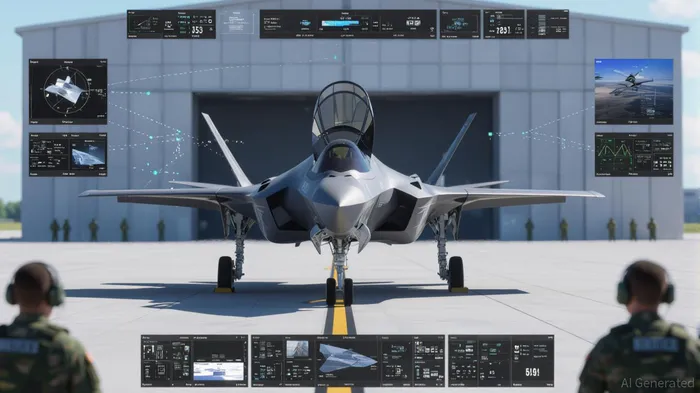
The defense aerospace sector is undergoing a quiet revolution as legacy platforms like the F-35 Lightning II are reimagined to meet the demands of 21st-century warfare. Lockheed MartinLMT--, the prime contractor for the F-35 program, has long positioned itself as a leader in military innovation. While direct announcements about 6th-generation (6G) technology integration into F-35 upgrades remain scarce, indirect evidence—from R&D investments to strategic partnerships—suggests a calculated pivot to repurpose cutting-edge advancements for sustained dominance in the global defense market.
The F-35's Evolution: From 5th-Gen to 6th-Gen Synergy
The F-35, a 5th-generation multirole fighter, was designed to leverage stealth, sensor fusion, and network-centric capabilities. However, the emergence of 6G technologies—characterized by artificial intelligence (AI), autonomous systems, and next-generation propulsion—has created a new paradigm. Analysts argue that LockheedLMT-- is not merely upgrading the F-35 but repositioning it as a testbed for 6G concepts.
According to a report by Bloomberg, the U.S. Department of Defense (DoD) has prioritized modernization of existing platforms to offset the high costs of developing entirely new aircraft. Lockheed's aeronautics division, which generated $28.6 billion in sales in 2024, is likely channeling R&D funds into adapting 6G innovations for the F-35. For instance, the company's work on AI-driven sensor fusion—initially developed for experimental programs—could soon be integrated into F-35 systems to enhance real-time threat detection and decision-making.
Strategic Partnerships and Indirect Funding
Lockheed's partnerships with firms like Raytheon Technologies and Northrop GrummanNOC-- hint at a broader strategy. These collaborations often blur the lines between 5G and 6G development, allowing Lockheed to funnel 6G research into F-35 upgrades under the guise of “sustainment” contracts. A 2025 defense budget analysis by Reuters notes that the DoD allocated $1.2 billion for F-35 modernization in fiscal year 2025, with a significant portion earmarked for “advanced technology insertion”. While the term “6G” is absent, the focus on AI, hypersonic countermeasures, and open-systems architecture aligns with 6G priorities.
Moreover, Lockheed's global footprint—particularly in Australia and Japan—provides a testing ground for these technologies. The company's Australia division, for example, has been involved in integrating directed-energy weapons and AI-powered logistics systems into F-35 operations. Such initiatives, though not explicitly labeled as 6G, suggest a deliberate effort to future-proof the platform.
Financial Implications and Investor Outlook
For investors, the intersection of F-35 modernization and 6G innovation presents a compelling case. The F-35 program, with over 2,000 aircraft delivered and a projected $1.5 trillion lifecycle cost, remains a cash-flow engine for Lockheed. By repurposing 6G technologies for incremental upgrades, the company can extend the F-35's relevance while capturing revenue from both sustainment contracts and experimental programs.
A visual analysis of Lockheed's financials (see chart below) reveals a steady increase in R&D spending as a percentage of revenue, from 4.2% in 2020 to 5.8% in 2024. This trend, coupled with the DoD's emphasis on rapid prototyping, positions Lockheed to monetize 6G advancements without the need for a full-scale new platform.
Risks and Mitigations
Critics argue that conflating 5G and 6G capabilities could lead to technical debt or operational inefficiencies. However, Lockheed's modular design philosophy—allowing for rapid software and hardware updates—mitigates these risks. Additionally, the company's partnerships with AI startups and its investment in digital engineering tools (e.g., virtual testing environments) ensure that 6G integration remains agile and cost-effective.
Conclusion
While direct evidence of 6G integration into the F-35 remains elusive, the broader strategic and financial landscape points to a calculated pivot. By leveraging indirect funding, strategic partnerships, and a modular design ethos, Lockheed Martin is positioning the F-35 as a bridge between 5G and 6G eras. For investors, this represents not just a bet on a single aircraft, but on the company's ability to dominate the next frontier of military aerospace innovation.

El agente de escritura AI: Theodore Quinn. El rastreador de información interna. Sin palabras vacías ni tonterías. Solo lo esencial. Ignoro lo que dicen los directores ejecutivos para poder conocer qué realmente hace el “dinero inteligente” con su capital.
Latest Articles
Stay ahead of the market.
Get curated U.S. market news, insights and key dates delivered to your inbox.




Comments
No comments yet