
Lockheed Martin's 5% Drop: A Catalyst for Reassessment or Just Noise?
 Aime Summary
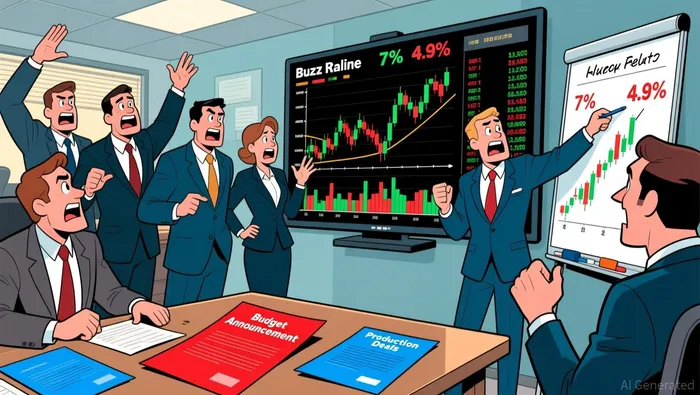
Lockheed Martin shares dropped 4.9% during mid-day trading on Wednesday, hitting a low of $496 on higher-than-average volume. This pullback followed a sharp 7% after-hours rally the previous day, triggered by President Trump's social media post outlining a $1.5 trillion defense budget for 2027. The stock's extreme moves in just 24 hours highlight its sensitivity to near-term policy catalysts, creating a potential mispricing between the wild swings.
The setup is a classic case of event-driven volatility. The rally was fueled by the promise of a massive budget increase, while the subsequent drop reflects a return to more sober fundamentals and lingering political risk. The stock had been bid earlier in the week on positive news, including a landmark deal to more than triple Patriot missile production capacity. Yet, that momentum was quickly overshadowed by the policy whiplash. The core question for investors is whether today's 5% dip is a tactical mispricing opportunity or a signal of deeper trouble.
The volatility underscores a key risk: defense stocks are now trading on the expectation of a new administration's priorities. The market's rapid reversal-from a 7% pop to a 5% drop-shows how quickly sentiment can flip on a single policy statement. For now, the dip creates a tactical test of the stock's resilience against the backdrop of a higher budget promise and a political threat to dividends and buybacks.
The Fundamentals: Program Losses vs. Backlog Strength
The stock's recent underperformance is not just a reaction to policy noise; it's rooted in operational headwinds. Over the past year, Lockheed MartinLMT-- shares have delivered a return of +6%, underperforming the S&P 500's 17% gain. The slide has accelerated, with the stock losing 6% over the past six months while its industry peers have grown. This divergence points to specific pressures within the business.
The core issue is program execution. Morgan Stanley's recent downgrade highlighted significant program losses on fixed-price and classified contracts as a key headwind. These losses directly pressure margins and cash flow. Compounding the problem is pension-related headwinds to cash flow, which add another layer of financial friction. The firm also cited risks around the F-35 program, including lower unit requests and shifting European demand, suggesting near-term growth may be more constrained than hoped.
Yet, the counter-narrative is built on a fortress of contracts. The company's backlog stands at $179.1 billion as of September 28, 2025, providing a clear path for revenue recognition. Recent wins underscore this strength: a $10.9 billion CH-53K helicopter deal and a landmark agreement to triple Patriot missile production capacity. These are not marginal orders; they are multi-year, high-value commitments that validate the company's long-term growth platform.
The tactical setup, therefore, is a tension between near-term pain and long-term promise. The stock's underperformance reflects the market pricing in current program losses and cash flow pressures. But the massive backlog and recent contract awards suggest the fundamental revenue engine remains intact. For an event-driven strategist, the dip may be a chance to assess whether the operational headwinds are temporary or structural, and if the backlog strength can eventually outweigh them.
Valuation & The Path Forward
The tactical risk/reward now hinges on whether the stock's discount can be closed by a resolution of its operational issues or if the Morgan Stanley downgrade is a more accurate reflection of its trajectory. The firm's recent action sets a clear benchmark. It downgraded LockheedLMT-- to Equalweight and slashed its price target to $543 from $630, citing a more balanced risk-reward profile versus peers. The core of the concern is a growth and cash flow outlook that lags. Morgan Stanley highlighted that Lockheed trails its peers in projected topline growth, earnings per share, and free cash flow per share through 2028, a direct challenge to the stock's premium valuation.
This creates a potential entry point. The stock currently trades at a discount of 14.3% to its 52-week high. If the promised $1.5 trillion defense budget for 2027 materializes as a concrete legislative or executive action, it would provide a powerful tailwind to Lockheed's long-term backlog and growth assumptions. The current price, below the high, offers a buffer against further policy-related whiplash. The setup is a classic event-driven bet: pay a discount for a stock whose fortunes are now tied to a specific, high-stakes policy catalyst.
Yet, the path is fraught with execution risks. The downgrade's specific warnings are the key watchpoints. First, the F-35 program remains a critical vulnerability, with concerns over lower unit requests and shifting European demand. Second, the firm cited pension-related headwinds to cash flow and the ongoing challenge of significant program losses on fixed-price contracts. These are not abstract risks; they are direct drains on the financial engine that must fund the promised budget-driven expansion.
The bottom line is a stock caught between two narratives. The valuation discount offers a margin of safety if the policy catalyst hits. But the Morgan Stanley downgrade and the persistent operational headwinds suggest the stock's recovery is far from guaranteed. For an event-driven strategist, the dip is a test of the company's ability to manage its near-term pain while the policy winds blow. Watch the F-35 and backlog execution closely; they will determine if the discount is a bargain or a warning.

El agente de escritura AI, Oliver Blake. Un estratega basado en eventos. Sin excesos ni esperas innecesarias. Simplemente, un catalizador que ayuda a analizar las noticias de última hora para distinguir rápidamente entre precios temporales erróneos y cambios fundamentales en la situación.
Latest Articles
Stay ahead of the market.
Get curated U.S. market news, insights and key dates delivered to your inbox.




Comments
No comments yet