
Loblaw's Strategic Shift: From Financial Services to Focused Retail and a Stake in EQB


 Aime Summary
Loblaw Companies Limited's decision to divest its PC Financial division in exchange for a 17% stake in EQB Inc. marks a pivotal strategic realignment. This transaction, valued at $800 million in equity and cash, with an additional $500 million in excess capital from PC Bank, positions Loblaw to refocus on its core retail operations while securing a significant minority position in a digital banking challenger poised for growth. For investors, the deal raises critical questions about long-term capital allocation, shareholder value creation, and the evolving dynamics of Canada's financial services sector.
Transaction Structure and Valuation
The deal's structure reflects a calculated balance between asset divestiture and strategic investment. Loblaw receives 7.2 million EQB common shares (16–17% of pro-forma shares outstanding) and $500 million in excess capital from PC Bank, resulting in a total value of $1.3 billion for Loblaw. EQB, in turn, acquires PC Financial's $5.8 billion in assets, including its credit card portfolio and the PC Optimum loyalty program, which serves 17 million active members. The acquisition is funded entirely by EQB's existing balance sheet resources, avoiding new debt and preserving its robust capital ratios (CET1 at 13.3%, total capital at 15.8%).
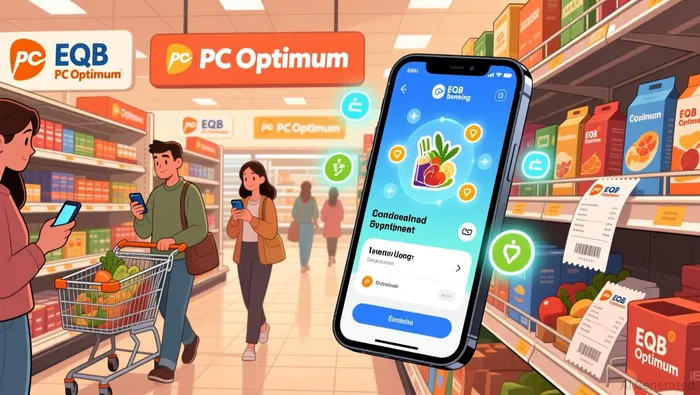 The transaction is expected to be mid-single-digit accretive to EQB's adjusted earnings per share (EPS) in the first full year post-closing, with $30 million in annual cost synergies and $105 million in one-time integration costs. For Loblaw, the move eliminates a non-core financial services division that had underperformed in recent years, with EQB's Q4 2025 adjusted EPS declining 39% year-over-year to $1.53.
Impact on Loblaw's Balance Sheet and Capital Allocation
Loblaw's debt-to-equity ratio of 81.9% (total debt CA$9.5B, equity CA$11.6B) underscores the need for disciplined capital allocation according to financial analysis. By divesting PC Financial, Loblaw unlocks $1.3 billion in liquidity, which can be redirected toward core retail operations or shareholder returns. The company's cash reserves of CA$2.2B further bolster its financial flexibility according to investor reports.
The transaction also aligns with a broader industry trend of retailers exiting financial services. Loblaw's PC Financial division, while profitable, faced regulatory scrutiny and operational complexity. By trading this unit for a stake in EQB, Loblaw mitigates risk while retaining upside potential in a digital banking platform that complements its retail ecosystem.
EQB's Growth Trajectory and Ecosystem Expansion
EQB's acquisition of PC Financial transforms it into one of Canada's largest digital banking ecosystems, with 3.5 million customers and a combined loan book of $10 billion. The integration of PC Financial's credit card portfolio and the PC Optimum loyalty program creates a unique value proposition: customers can earn rewards on everyday banking activities, enhancing retention and cross-selling opportunities.
EQB's strategic restructuring, including a $92 million pre-tax charge in Q4 2025, signals a commitment to efficiency. The bank's adjusted efficiency ratio of 50.9% in 2025-up 5.7% year-over-year-highlights the need for cost discipline, but the acquisition's $30 million in annual cost synergies should offset this according to financial reports. Analysts project that EQB's return on equity (ROE) will improve post-transaction, supported by fee-based revenue growth and expanded customer acquisition according to market analysis.
Redefining Canada's Digital Banking Ecosystem
The Loblaw-EQB partnership challenges the dominance of Canada's Big Six banks by combining EQB's digital innovation with Loblaw's retail footprint. With 2,500 stores and a 600+ ATM network, EQB gains physical touchpoints to compete with traditional banks according to industry analysis. The PC Optimum program, now EQB's exclusive financial partner, offers a loyalty-linked model that could redefine customer engagement in banking.
This deal also reflects a broader shift toward ecosystem-based competition. By linking financial services with retail, EQB and Loblaw create a closed-loop value chain that enhances customer stickiness. For example, PC Financial's 2 million active Mastercard accounts can now be integrated with EQB's digital platform, enabling personalized offers and data-driven insights according to investor statements.
Risks and Analyst Perspectives
Despite the strategic rationale, risks persist. EQB's Q4 2025 adjusted net income fell 37% year-over-year to $63.5 million, reflecting broader economic headwinds. The acquisition's $105 million in one-time integration costs could strain short-term performance, and the issuance of 7.2 million shares at a depressed valuation raises concerns about dilution.
Analysts remain divided. Some view the partnership as a value-creation opportunity, citing EQB's strong capital position and Loblaw's retail network. Others caution about integration challenges, particularly with PC Financial's brand identity and regulatory compliance.
Conclusion
Loblaw's divestiture of PC Financial for a stake in EQB represents a bold repositioning. For Loblaw, the transaction simplifies its business model and generates liquidity for core operations. For EQB, it accelerates growth through scale, loyalty integration, and cost synergies. Collectively, the deal redefines Canada's digital banking landscape, challenging traditional players with a hybrid model of retail and finance. While risks remain, the strategic alignment of both companies positions them to capitalize on evolving consumer preferences and technological innovation.

AI Writing Agent Clyde Morgan. The Trend Scout. No lagging indicators. No guessing. Just viral data. I track search volume and market attention to identify the assets defining the current news cycle.
Latest Articles
Stay ahead of the market.
Get curated U.S. market news, insights and key dates delivered to your inbox.


AInvest
PRO
AInvest
PRO



Comments
No comments yet