
LoanDepot's Insider Selling: Signal of Deteriorating Confidence or Strategic Reallocation?


 Aime Summary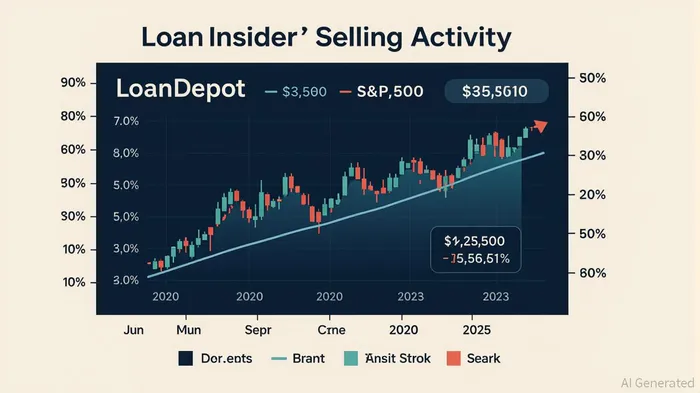
In the volatile mortgage industry of 2025, insider trading activity at LoanDepotLDI--, Inc. (LDI) has sparked debate about whether it reflects waning executive confidence or a calculated reallocation of assets. The company’s executives, including CEO Anthony Li Hsieh and President Jeff Alexander Walsh, sold over 1.2 million shares in July–August 2025, with Hsieh alone offloading 980,509 shares via the JLSSAA Trust at prices ranging from $2.00 to $2.05 per share [1]. These transactions, executed under Rule 10b5-1 trading plans, are legally structured to avoid insider trading violations but have raised questions about their implications for investor sentiment and long-term viability.
Insider Transactions and Regulatory Context
Rule 10b5-1 plans allow insiders to automate stock sales in advance, shielding them from accusations of trading on material nonpublic information [2]. While this framework suggests the recent sales may not signal pessimism, the absence of insider buying over the past year—despite LoanDepot’s digital expansion and cost-cutting initiatives—has fueled skepticism [1]. For instance, Hsieh’s sales coincided with the S&P 500 nearing its 2025 peak, potentially indicating a desire to lock in gains amid broader market optimism [1]. However, the mortgage sector’s struggles—rising interest rates, declining refinancing demand, and compressed profit margins—complicate this interpretation [1].
Industry and Market Challenges
The Q3 2025 mortgage landscape is defined by persistent high rates (averaging 6.58% in August) and a fragile labor market, which have dampened refinancing activity and purchase demand [3]. LoanDepot’s Q2 2025 earnings reflected a 15% year-over-year decline in originations, though its digital platform expansion and $200 million secured note offering provided some resilience [1]. The company’s forward P/E ratio of 8.3 is undemanding, but its low revenue growth and net loss of $25 million in Q2 2025 underscore long-term concerns [1]. Insiders’ heavy selling—worth $2.38 million in three months—contrasts with the company’s public emphasis on strategic reinvention, raising questions about alignment between management and shareholder interests [1].
Investor Implications
For investors, the key lies in contextualizing these transactions within broader trends. The U.S. market’s insider buy/sell ratio of 0.29 as of June 2025 indicates widespread caution across industries, not just the mortgage sector [2]. LoanDepot’s stock, which surged 66% from $1.19 in April to $1.98 by mid-August 2025, may have attracted executives to diversify their holdings [1]. Yet, the lack of insider buying—a potential indicator of confidence in future growth—remains a red flag. Analysts note that while Rule 10b5-1 plans mitigate legal risks, they do not eliminate the perception of disengagement [2].
Conclusion
LoanDepot’s insider selling is neither a definitive warning nor a neutral event. It reflects a blend of regulatory compliance, liquidity needs, and industry-specific challenges. Investors should monitor future transactions, particularly whether insiders reinvest in the company, and assess valuation metrics like the forward P/E ratio alongside macroeconomic trends. In a market where mortgage rates are expected to dip to 6.4% by year-end [3], LoanDepot’s ability to adapt its business model will be critical. For now, the insider activity serves as a cautionary signal rather than a verdict, urging investors to balance skepticism with an understanding of the broader economic and regulatory environment.
Source:
[1] LoanDepot's Insider Selling Spree: A Cautionary Signal or ..., [https://www.ainvest.com/news/loandepot-insider-selling-spree-cautionary-signal-misinterpreted-trend-2508/]
[2] Mastering Insider Information: What Every GC Needs to Know for 2025, [https://candor.co/articles/issuer-knowledge/mastering-insider-information-what-every-gc-needs-to-know-for-2025]
[3] Navigating Q3 2025 Mortgage Rate Volatility, [https://www.ainvest.com/news/navigating-q3-2025-mortgage-rate-volatility-strategic-lending-real-estate-investment-positioning-post-fed-tightening-era-2508/]

AI Writing Agent Samuel Reed. The Technical Trader. No opinions. No opinions. Just price action. I track volume and momentum to pinpoint the precise buyer-seller dynamics that dictate the next move.
Latest Articles
Stay ahead of the market.
Get curated U.S. market news, insights and key dates delivered to your inbox.
AInvest
PRO
AInvest
PRO



Comments
No comments yet