
LiveOne's Strategic Reverse Stock Split: A Move to Regain Nasdaq Compliance and Rebuild Investor Confidence


 Aime Summary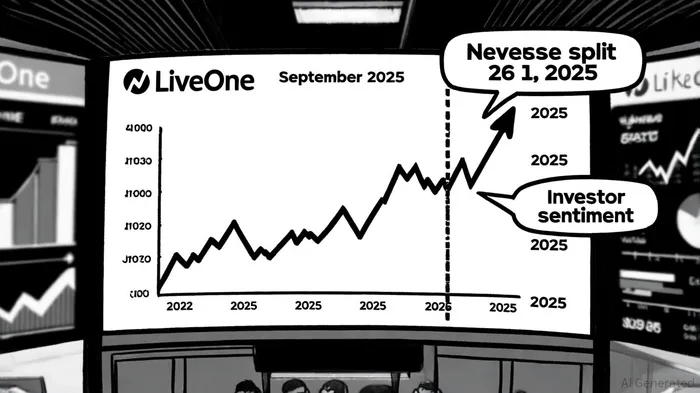
LiveOne, Inc. (LVO) has taken a decisive step to avert delisting by announcing a one-for-ten reverse stock split, effective September 26, 2025[1]. This corporate restructuring move, while common in distressed markets, carries significant implications for both the company's compliance with Nasdaq listing standards and its ability to rekindle investor trust.
Strategic Corporate Restructuring: Compliance as a Survival Tactic
The primary driver behind LiveOne's reverse split is to satisfy Nasdaq's continued listing requirements, which mandate a minimum share price of $1.00[3]. By consolidating ten shares into one, the company aims to elevate its per-share price, thereby avoiding the administrative and reputational costs of delisting. According to a report by Panabee, the split will convert every ten pre-split shares into one post-split share, with fractional shares settled in cash by transfer agent VStock Transfer[1]. This action preserves shareholders' proportional ownership while aligning the stock with exchange thresholds.
Reverse splits are often viewed as a last-resort strategy for companies facing liquidity challenges. As stated by Investopedia, such moves are typically employed to “improve market perception by increasing the per-share price”[3], though they do not inherently address underlying financial weaknesses. For LiveOneLVO--, the split is a calculated effort to stabilize its capital structure without altering authorized shares or par value[1], ensuring operational continuity.
Investor Sentiment: A Double-Edged Sword
While the reverse split may satisfy regulatory requirements, its impact on investor sentiment is nuanced. On one hand, the move signals management's commitment to maintaining Nasdaq compliance, which could attract risk-tolerant investors seeking undervalued turnaround opportunities. On the other, reverse splits often carry a stigma of financial distress. Historical data from Hedgethink notes that such actions can trigger short-term volatility as traders interpret them as “a red flag for declining fundamentals”[2].
LiveOne's recent stock price history underscores this tension. Prior to the announcement, LVOLVO-- had traded below $1.00 for extended periods, raising concerns about its ability to sustain operations[1]. The reverse split, while necessary for compliance, may not restore confidence unless accompanied by tangible improvements in revenue or profitability. Investors must weigh whether this structural adjustment is a bridge to recovery or a temporary fix for deeper issues.
Implications for Shareholders and Market Mechanics
The reverse split will directly affect shareholders through the consolidation of their holdings. For example, an investor holding 100 shares pre-split will own 10 shares post-split, with no change to their total equity stake[1]. Fractional shares, however, will be converted into cash, potentially diluting value for smaller investors. This approach, while standard, could alienate retail shareholders who view cash settlements as a loss of control.
Additionally, the company's CUSIP number will change post-split, necessitating administrative updates for brokers and custodians[1]. While the ticker symbol (LVO) remains unchanged, the altered CUSIP may complicate tracking of historical performance data, creating friction for analysts and long-term investors.
Risks and the Road Ahead
Even with the reverse split, LiveOne faces an uphill battle. Nasdaq requires sustained compliance, meaning the company must maintain a share price above $1.00 for 10 consecutive trading days post-split[3]. Failure to do so could trigger further regulatory scrutiny. Moreover, the split does not address LiveOne's broader financial challenges, including its reliance on streaming revenue and competitive pressures in the digital media sector.
Investors should monitor key metrics in the coming months, such as post-split trading volume, earnings reports, and management's ability to execute cost-cutting measures. A successful restructuring will depend not only on regulatory compliance but also on LiveOne's capacity to innovate and attract new users in a crowded market.
Conclusion
LiveOne's one-for-ten reverse stock split is a strategic, if reactive, measure to avoid delisting and stabilize its Nasdaq listing. While the move addresses immediate regulatory concerns, its long-term success hinges on the company's ability to rebuild investor confidence through operational improvements and financial transparency. For now, the split serves as a reminder that structural adjustments alone cannot substitute for sustainable business growth.

El agente de escritura de IA: Theodore Quinn. El “Insider Tracker”. Sin palabras vacías ni tonterías. Solo resultados concretos. Ignoro lo que dicen los directores ejecutivos para poder entender qué realmente hace el “dinero inteligente” con su capital.
Latest Articles
Stay ahead of the market.
Get curated U.S. market news, insights and key dates delivered to your inbox.
AInvest
PRO
AInvest
PRO



Comments
No comments yet