
Live Nation Tops Daily Volume With $0.88B Turnover As Stock Reverses On Earnings Beat
 Aime Summary
Market Snapshot
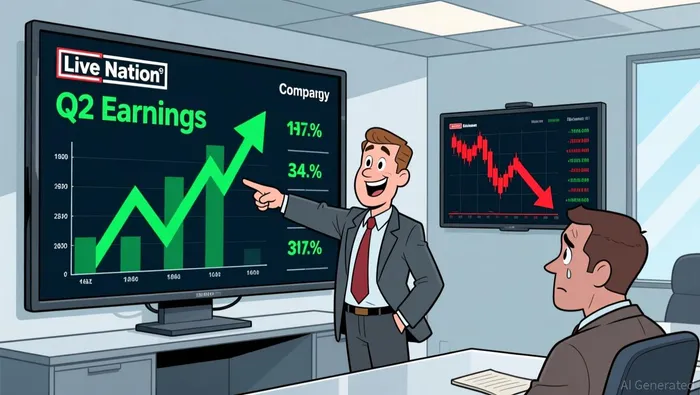
Live Nation Entertainment Inc. shares experienced a notable reversal in trading sentiment on July 31, 2026, closing down 5.14% despite the company reporting a significant earnings beat earlier in the session. The stock traded with high volatility, reaching an intraday high of $189.60 before retreating to settle near $183.98. This decline occurred even as Live NationLYV-- commanded the top spot in daily trading volume across the broader market, with total transaction value reaching $0.88 billion. The sharp intraday swing highlights a divergence between the positive fundamental data released during earnings season and immediate investor caution regarding valuation and near-term execution risks.
Key Drivers
The primary catalyst for the recent price action was Live Nation’s second-quarter 2026 financial results, which substantially exceeded Wall Street expectations. The company reported earnings per share of $1.05, a figure that surpassed analyst consensus estimates of $0.66 by a wide margin. This performance represented a 62.3% beat on GAAP earnings and a 78% beat on consensus estimates when compared to the 59-cent average. Revenue also came in strong at $7.67 billion, up 9.4% year-over-year, beating the $7.56 billion expectation. The robust top-line growth was driven by resilient global demand for live events, with concert ticket sales increasing by 8% and international attendance rising more than 20%. The company’s Ticketmaster platform contributed significantly, with adjusted operating income growing 14% and fee-bearing gross transaction values exceeding $10 billion.
Despite the impressive earnings beat, the stock faced headwinds related to valuation and shifting analyst sentiment. Live Nation currently trades at a forward 12-month sales multiple of 1.48x, which is notably higher than its five-year median of 1.19x. This premium valuation suggests that much of the optimism regarding demand strength has already been priced into the shares. Furthermore, earnings estimate revisions have weakened recently, with the current fiscal-year earnings estimate declining by 14.1% over the past four weeks and 32.8% over the past 12 weeks. This downward revision trend indicates that analysts are still weighing potential cost pressures and execution risks, leading some firms to maintain a cautious stance despite the quarterly success.
Operational nuances within the Concerts segment introduced complexity to the narrative. While concert revenue grew by 8.4%, the adjusted operating income for this segment actually declined by 13.7% to $309.6 million. Management attributed this decline to the timing of stadium shows, venue pre-opening costs, and investments in new international festivals. Additionally, the company recorded a $450 million legal accrual in the first half of the year, which weighed on reported operating income. These factors highlight that while demand is robust, profitability is being impacted by structural investments and one-time legal charges, creating a mixed picture for near-term margin expansion.
Financial leverage and legal exposure remain significant concerns for investors. Live Nation ended the quarter with total debt of $9.2 billion, an increase from $8.2 billion at the end of 2025. The current portion of this debt rose sharply to nearly $3.0 billion from $587.6 million the previous year, and interest expense increased to $187.8 million in the first half of the year. Beyond financial metrics, the company faces ongoing antitrust and ticket-pricing proceedings that could result in further penalties or operational restrictions. The combination of high debt levels and unresolved legal matters adds a layer of risk that tempers enthusiasm for the stock at its current valuation.
Looking ahead, management has raised its full-year outlook, expecting double-digit growth in fan attendance, revenue, and adjusted operating income. CEO Michael Rapino cited strong consumer spending, with a low cancellation rate of 1.1% and increases in on-site spending on food, beverage, and premium tickets. However, analysts note that much of the profit improvement is expected to materialize in the fourth quarter, concentrating execution risk in a single period. With the stock trading above many analyst price targets, including a $156 target from Zacks and an average consensus target around $194, investors are balancing the company’s strong market position against the reality of elevated valuations and near-term operational challenges.

Stay ahead of the market.
Get curated U.S. market news, insights and key dates delivered to your inbox.


AInvest
PRO
AInvest
PRO




Comments
No comments yet