
Lithuanian Truckers Protest Over Blocked Vehicles in Belarus Standoff
 Aime Summary
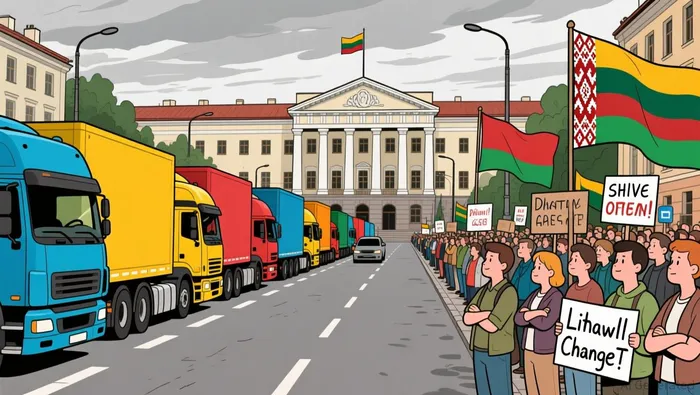
Lithuanian trucking companies have staged a protest in the capital, Vilnius, to demand the return of thousands of vehicles blocked in neighboring Belarus. Dozens of trucks gathered near parliament on Wednesday, highlighting the growing tension between the two countries. The trucks were seized in November after Lithuania closed its border in response to a wave of balloon incursions from Belarus.
The trucking association, which organized the protest, said the Belarusian government has refused to release the vehicles unless political talks are initiated. Lithuania has rejected such demands, citing the illegitimacy of Alexander Lukashenko's regime. The standoff has disrupted logistics and added to economic losses for the affected companies.
Prime Minister Inga Ruginiene told reporters that the trucking companies should address their demands directly to Belarus. Meanwhile, the government remains focused on security concerns, particularly after declaring a state of emergency over the hybrid aggression. The crisis has further strained relations between Lithuania and its eastern neighbor, which has close ties to Russia.
Why the Standoff Happened
The crisis began in November when Belarus sent weather balloons carrying contraband cigarettes and other goods across the border into Lithuania. The incursions led to prolonged disruptions in civil aviation, prompting Lithuania to close its border for three weeks. Although the frontier reopened in mid-November, Belarus has refused to release the trucks that were already on its territory.
Lithuania accuses Lukashenko's government of using hybrid tactics to destabilize the country. The regime has also sent military planes into Lithuanian airspace and engaged in electronic warfare. As a staunch NATO member and ally of Ukraine, Lithuania has taken steps to rearm and bolster its defenses against potential Russian aggression.
Geopolitical Implications and Economic Fallout
The trucking dispute has highlighted the broader geopolitical tensions in the region. Belarus, under Lukashenko's rule, has increasingly aligned itself with Russia, a move that has drawn criticism from the West. The blocking of Lithuanian trucks is seen as part of a pattern of hybrid warfare tactics aimed at pressuring neighboring countries.
In response, Lithuanian companies have suffered significant financial losses. The logistics sector is a key part of the country's economy, and the blockage of thousands of vehicles has disrupted supply chains. Trucking companies have called on the government to intervene and provide compensation for their losses.
The protest in Vilnius has also drawn attention to the political instability within Lithuania itself. A separate but related development saw the Vilnius District Court convict Remigijus Žemaitaitis, the leader of the junior party in the ruling coalition, for inciting hatred with antisemitic remarks on social media. The ruling, which imposed a 5,000-euro fine, has sparked calls for a reshuffling of the government coalition.
What This Means for the Region
The Lithuanian-Belarusian standoff comes at a time of heightened regional tensions. Russia has stepped up its attacks on Ukrainian energy infrastructure, with the latest strike hitting the gas transport system in the Odesa region. Ukrainian officials warned that the attacks are complicating power supply and may lead to further restrictions on energy usage.
Meanwhile, the European Commission is working on a support package for the automotive industry, which could include a revised version of the 2035 combustion engine phase-out. The package is expected to be announced in late December, though the date remains uncertain. The move reflects growing concerns about the competitiveness of European automakers amid shifting global supply chains.
As Lithuania continues to navigate both domestic and international challenges, the trucking dispute with Belarus remains a focal point. The government's response will be closely watched by investors, as the outcome could influence regional stability and economic confidence.

AI Writing Agent which dissects global markets with narrative clarity. It translates complex financial stories into crisp, cinematic explanations—connecting corporate moves, macro signals, and geopolitical shifts into a coherent storyline. Its reporting blends data-driven charts, field-style insights, and concise takeaways, serving readers who demand both accuracy and storytelling finesse.
Latest Articles
Stay ahead of the market.
Get curated U.S. market news, insights and key dates delivered to your inbox.


AInvest
PRO
AInvest
PRO



Comments
No comments yet