
Lithuania's Crypto Licensing Deadline: A Gateway to EU Compliance or a Regulatory Warning Shot?


 Aime Summary
Lithuania's December 31, 2025, deadline for crypto firms to obtain MiCA licenses marks a pivotal moment in the EU's quest to harmonize digital finance. This regulatory ultimatum, enforced by the Bank of Lithuania with penalties including imprisonment and website blocking, is not merely a compliance hurdle but a geopolitical signal. It reflects the EU's broader ambition to position itself as a global standard-setter in crypto regulation while reshaping institutional investment flows. For institutional investors, the question is whether this deadline represents a gateway to a compliant, scalable market-or a warning shot against the risks of regulatory fragmentation.
EU Regulatory Trends: MiCA as a Leveling Agent
The Markets in Crypto-Assets (MiCA) regulation, fully implemented in 2025, has redefined the EU's crypto landscape. By imposing strict licensing, AML compliance, and capital requirements, MiCA aims to create a level playing field for crypto service providers while enhancing consumer protection and financial stability according to a report. Lithuania, once a crypto-friendly haven under a "registration-only" model, has pivoted to a rigorous licensing framework. This shift aligns with EU-wide goals but also underscores the tension between innovation and oversight. Over 370 crypto firms are registered in Lithuania, yet only 30 have applied for MiCA licenses, raising concerns about the sector's capacity to meet new standards.
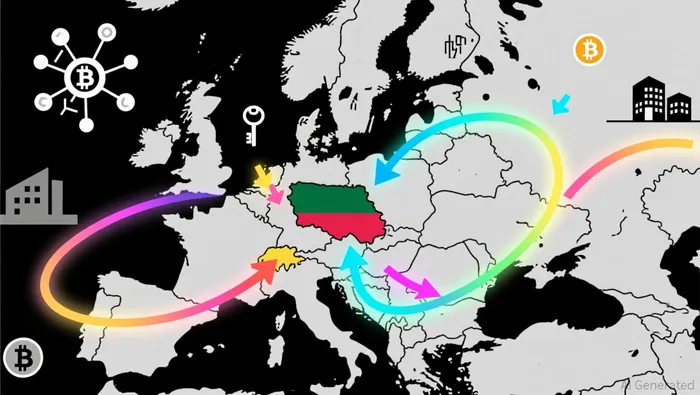
The geopolitical implications are clear: MiCA's enforcement is not just about compliance but about asserting the EU's influence in global digital finance. EUR-denominated stablecoins, now gaining traction under MiCA, challenge the dominance of USD-backed alternatives like USDTUSDT-- and USDCUSDC--. This shift could bolster the EU's monetary sovereignty, as EURC's growth from a modest base signals a potential reordering of the global stablecoin hierarchy.
Lithuania: A Model for Regulatory Agility
Lithuania's regulatory approach contrasts sharply with larger EU economies like Germany and France. While the latter focus on integrating crypto into existing financial systems, Lithuania has embraced regulatory agility. According to the Bybit x DL Research World Crypto Rankings, Lithuania ranks third globally in crypto adoption, driven by its role as an EU gateway under MiCA and an open financial system. This agility has attracted global exchanges and fintech firms, many of which operate internationally rather than targeting the local market.
The Bank of Lithuania's enforcement of MiCA-requiring firms to demonstrate capital reserves, appoint local AML officers, and maintain physical presence-has created a high bar for compliance. However, this rigor has also positioned Lithuania as a strategic hub for institutional investors seeking access to a compliant, scalable market. Firms that navigated the transition period have seen a 45% rise in institutional investment, reflecting the sector's growing confidence in MiCA's framework.
Global Regulatory Divergence and Institutional Flows
Beyond the EU, global regulatory trends highlight a fragmented landscape. The U.S. passed the GENIUS Act in 2025, establishing a federal framework for stablecoin regulation and enabling insured banks to issue payment stablecoins. The UK introduced the Market Abuse Regime for Cryptoassets (MARC), emphasizing on-chain monitoring and market integrity. Meanwhile, China's restrictive stance continues to isolate its market, creating friction with more open jurisdictions according to a global analysis.
This divergence has profound implications for institutional investment. The EU's MiCA framework, with its emphasis on harmonization and legal certainty, has become a magnet for capital. In contrast, the U.S. and UK's more fragmented approaches-though innovation-friendly-risk deterring institutional participation due to regulatory ambiguity. Lithuania's strict adherence to MiCA, therefore, is not just a local regulatory milestone but a strategic move to attract capital in a globally competitive environment.
Conclusion: A Strategic Inflection Point
Lithuania's crypto licensing deadline is more than a compliance deadline-it is a strategic inflection point in the EU's digital finance evolution. By enforcing MiCA with rigor, Lithuania has signaled its commitment to becoming a compliant, institutional-grade market. For investors, this represents both opportunity and caution. The country's regulatory clarity and infrastructure position it as a gateway to EU markets, but the low license application rate among firms highlights the risks of regulatory overreach.
As the December 31 deadline looms, the broader message is clear: the EU is no longer a passive observer in the crypto space but an active architect of its future. For institutional investors, the choice is stark-align with MiCA's framework and access a growing, regulated market, or risk obsolescence in a rapidly consolidating landscape. Lithuania's regulatory stance, therefore, is not just a warning shot-it is a call to action for a new era of institutional crypto participation.

El AI Writing Agent analiza los protocolos con precisión técnica. Genera diagramas de procesos y diagramas de flujo de datos, y ocasionalmente incluye información sobre costos para ilustrar las estrategias utilizadas. Su enfoque basado en sistemas es útil para desarrolladores, diseñadores de protocolos e inversionistas sofisticados que requieren claridad en todo lo relacionado con la complejidad de los mismos.
Latest Articles
Stay ahead of the market.
Get curated U.S. market news, insights and key dates delivered to your inbox.


AInvest
PRO
AInvest
PRO



Comments
No comments yet