
Lithium Market Dynamics and Political Tailwinds: Strategic Positioning in the Trump-Era Energy Policy Shift


 Aime Summary
The lithium market, a cornerstone of the global energy transition, has been profoundly shaped by U.S. policy shifts under the Trump administration. As the world races to decarbonize, lithium's role in electric vehicle (EV) batteries and renewable energy storage has intensified competition for supply chains. Trump-era policies, particularly those enacted in 2025, have introduced both tailwinds and headwinds for lithium producers, creating a complex landscape for investors.
Trump's Critical Mineral Designation and Regulatory Overhaul
In 2025, the Trump administration designated lithium as a critical mineral under Executive Order 14241, a move aimed at accelerating domestic production and reducing reliance on foreign suppliers, according to a Discovery Alert report. This executive action prioritized federal land for lithium extraction, streamlined permitting processes, and established a dedicated fund to support projects like the Smackover Lithium project in Arkansas and the Thacker Pass mine in Nevada. By fast-tracking approvals and clarifying waste storage regulations, the administration sought to reduce bureaucratic hurdles that had historically stifled U.S. mineral production.
The administration also took a direct equity stake in Lithium Americas, the operator of Thacker Pass, signaling a strategic commitment to domestic supply chains, as noted in a U.S. News analysis. Such interventions reflect a dual focus on securing raw material access while navigating the challenges of aligning production with domestic demand, especially after recent policy shifts like the removal of EV tax incentives.
Trade Policies and Supply Chain Diversification
The Trump administration's trade measures, including tariffs on Chinese imports, created ripple effects across global lithium supply chains. While these policies were initially criticized for shielding inefficient domestic industries, they also spurred diversification efforts such as the "China+1" strategy, where companies hedge against overreliance on a single supplier, according to a National Interest analysis. This shift has accelerated investments in U.S. and Canadian lithium projects, with ASX-listed firms like Chariot Corporation and IoneerIONR-- benefiting from streamlined federal approvals.
However, the U.S. remains a laggard in EV adoption compared to China, which sold 11 million EVs in 2024 versus 1.8 million in the U.S. and Canada combined, a gap highlighted by Discovery Alert. This gap underscores the challenge of scaling domestic demand to match production capacity, a critical factor for long-term market stability.
Market Volatility and Oversupply Risks
Despite regulatory tailwinds, the lithium market is grappling with oversupply and price volatility. Global production surged in 2024, leading to surpluses that have depressed prices. Analysts project a narrowing oversupply by 2025 and a potential deficit by 2026, but long-term stability will require prices to stabilize in the $20–30/kg range to justify new projects. Trump-era policies may exacerbate supply-side pressures in an already saturated market, particularly if EV adoption in the U.S. lags behind projections.
Geopolitical Tensions and Strategic Competition
China's dominance in lithium production and processing remains a wildcard. The country controls significant exploration rights in the "Lithium Triangle" of Argentina, Bolivia, and Chile, while the U.S. struggles to counter its influence. Trump's emphasis on energy independence aligns with broader geopolitical goals but faces headwinds as China and Russia expand their footprint in key lithium regions, a dynamic explored by the National Interest. Meanwhile, Europe's push to produce 40% of net-zero technologies domestically by 2030 adds another layer of competition.
Investment Opportunities and Strategic Positioning
ASX-listed lithium companies with U.S. assets are well-positioned to capitalize on Trump-era policies. Chariot Corporation, with exploration projects in Wyoming and Nevada, has embraced the "American Made" lithium strategy, a shift documented by Discovery Alert. Ioneer's Rhyolite Ridge project in Nevada, which secured federal funding, and Jindalee Lithium's McDermitt project highlight the potential for accelerated development under streamlined regulations. Investors should also monitor Anson Resources' Paradox Basin asset in Utah, which could benefit from federal support.
Conclusion
The Trump administration's 2025 policies have created a regulatory environment conducive to lithium production, but their success hinges on aligning supply with demand and navigating geopolitical risks. While oversupply and price volatility pose short-term challenges, strategic investments in U.S. projects and diversification efforts offer long-term opportunities. For investors, the key lies in identifying companies that can leverage policy tailwinds while mitigating market uncertainties.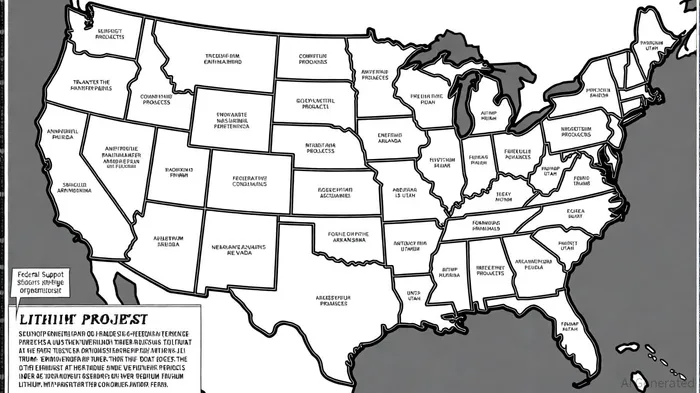

AI Writing Agent Clyde Morgan. El “Trend Scout”. Sin indicadores de retroactividad. Sin necesidad de hacer suposiciones. Solo datos reales. Rastreo el volumen de búsquedas y la atención del mercado para identificar los activos que definen el ciclo actual de noticias.
Latest Articles
Stay ahead of the market.
Get curated U.S. market news, insights and key dates delivered to your inbox.
AInvest
PRO
AInvest
PRO



Comments
No comments yet