
Litecoin (LTC) Sees Surge in Whale Activity and Derivatives Trading Amid Volatile Price Action
 Aime Summary
- Litecoin's whale transaction count has spiked to a five-week high, indicating increased activity among large investors on the blockchain. This metric measures the number of large transfers (over $100,000) and is often seen as a signal of significant market movement or interest according to on-chain data.
- Open interest in LTCLTO-- derivatives has surged, rising by over 54% to 8.25 million LTC, reaching its highest level since a significant leverage flush in October. This increase suggests renewed risk appetite among derivatives traders, even as the price struggles near key technical levels like the 20-day and 50-day EMAs as reported.
- On-chain data suggests heightened bearish momentum, with technical indicators like the RSI and MACD indicating continued downward pressure. The price of LitecoinLTC-- has dropped to $75 before rebounding to $78, with investors closely monitoring whether this whale activity will lead to a price reversal or consolidation according to analysis.
What Is Driving Litecoin's Whale Activity and Market Volatility?
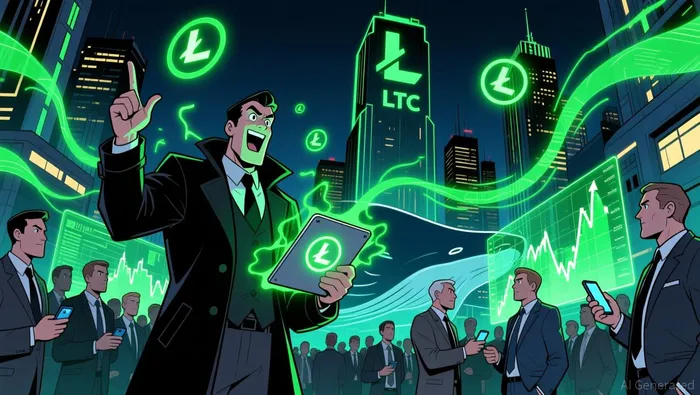
Litecoin's whale activity has reached a five-week high, coinciding with a price drawdown that suggests large investors may be reacting to market volatility according to market data. This surge in whale transactions is often attributed to large investors and can indicate potential shifts in market sentiment as observed. Historical patterns show that such whale spikes are often followed by price reversals, although it is unclear whether this is indicative of a buying or selling bias at this time according to analysis.
How Are Derivatives and On-Chain Indicators Influencing Litecoin's Price Action?
Open interest in LTC derivatives has surged, reflecting increased risk appetite among traders despite weak price performance. This increase indicates that more traders are increasing exposure to Litecoin than before as reported. However, technical indicators like the RSI and Stochastic Oscillator remain below neutral levels, suggesting that bearish momentum remains dominant according to technical analysis. On-chain data also shows a spike in dormant wallet activity, historically correlating with price corrections and contributing to downward pressure according to on-chain data.
What Role Do Institutional Investors and ETFs Play in Litecoin's Outlook?
Institutional interest in Litecoin ETFs remains low, with negative inflows observed for five consecutive days, exacerbating bearish sentiment according to trading data. The Canary Capital Litecoin ETF has seen negative inflows for five consecutive days, despite a 90–95% approval probability for ETFs by October 2025 as noted. Institutional apathy is evident, with the ETF failing to attract significant interest despite the potential for regulatory clarity. Litecoin's 60-day return is -25%, discouraging institutional investors and further contributing to the bearish outlook according to market analysis.
What Are the Key Technical Levels and Market Outlook for Litecoin in 2026?
Litecoin is currently consolidating near the $72 support level, a key area for determining its near-term direction according to technical analysis. A sustained rebound above $78 could target $87–$95, but this would require overcoming bearish on-chain signals and broader market skepticism. A breakdown below $72 risks a decline toward $68 or $54 according to market analysis. Technical indicators such as the RSI and MACD show bearish momentum, with traders closely watching the $72.76 swing low for potential support according to technical indicators. If Litecoin continues its downward trend, it could extend the decline toward the April 9 low of $66.51 as reported.
What Is the Long-Term Outlook for Litecoin Based on On-Chain Activity and Market Conditions?
Whale activity has dominated Litecoin trading since Q4 2024, indicating accumulation at low prices and potential for a price reversal according to trading data. A surge in whale transactions and increased open interest in derivatives markets further support this bullish outlook. On-chain data from Coinglass shows the LTC Whale vs. Retail Delta has remained mostly positive during this period, suggesting strong whale participation and accumulation according to on-chain data. Short-term data from Santiment shows a surge in Litecoin network activity, with whale transactions reaching a five-week high according to network analysis. This suggests LTC could recover or reverse at any time, even if the price experiences a deeper decline. The combination of whale activity, both long-term and short-term, along with renewed momentum in derivatives markets, may indicate a potential recovery for LTC according to market analysis.
What Factors Could Influence Litecoin's Price Trajectory From 2026 to 2030?
Litecoin's potential price trajectory from 2026 through 2030 is based on technological adoption, macroeconomic conditions, and regulatory clarity according to market analysis. Litecoin's foundational role as a fast, low-fee alternative to BitcoinBTC-- has helped it maintain a reputation as a reliable payment cryptocurrency. Historical trends show Litecoin often mirrors Bitcoin's behavior during major market events like halving cycles according to historical data. The next Bitcoin halving is expected to occur in 2024, and Litecoin's price response could reflect market sentiment around that event. Regulatory clarity, particularly concerning payment-focused cryptocurrencies, will also significantly impact utility and demand according to market analysis. Technological advancements within the Litecoin ecosystem, such as further scaling solutions and integration with Layer-2 networks, could enhance its competitive edge according to industry reports.

Mezclando la sabiduría tradicional en el comercio con las perspectivas más avanzadas sobre las criptomonedas.
Latest Articles
Stay ahead of the market.
Get curated U.S. market news, insights and key dates delivered to your inbox.


AInvest
PRO
AInvest
PRO



Comments
No comments yet