
LIT Struggles Amid Declining Volume and Mixed Market Signals
 Aime Summary
Lighter's LITLIT-- token has fallen 20% in 24 hours and 31% over the past week, trading at $2.07, 73% below its all-time high.
Lighter launched a buyback program using protocol fees, repurchasing 180,000 tokens worth $550,000, but volume remains low at $1.73 billion.
Whale activity, including a $4.86M WBTC conversion and a $4M USDCUSDC-- deposit, suggests institutional confidence, but leveraged shorts and early holder sell-offs add uncertainty.
Lighter's LIT token has experienced significant volatility following the launch of its treasury buyback program in early January 2026. While initial whale activity and institutional investments briefly boosted the price by up to 37%, broader market participation has been weak. The token traded at $2.07 at press time, down 20% in 24 hours and 31% in the past week.
The buyback initiative, which uses 50% of protocol fees to repurchase LIT tokens, has reduced supply by 3% at a cost of $550,000. Despite this, daily trading volume has declined to $1.73 billion from previous peaks of $7 billion–$12 billion.
Whale activity has been mixed, with some investors accumulating large quantities of LIT while others are liquidating leveraged short positions. A $4.86M WBTC conversion and a $4M USDC deposit to purchase LIT highlight institutional confidence, but a $7.18M coordinated sell-off by five linked wallets has raised concerns about transparency and equitable distribution in DeFi.
What Drives LIT's Recent Volatility?
LIT's recent volatility reflects a mix of whale behavior, institutional interest, and broader market conditions. A $1.8M whale loss and Lighter's $8,450 daily revenue have highlighted downward pressure on the token. Meanwhile, Lighter's buyback program and whale accumulation suggest deflationary support for LIT's long-term value. However, 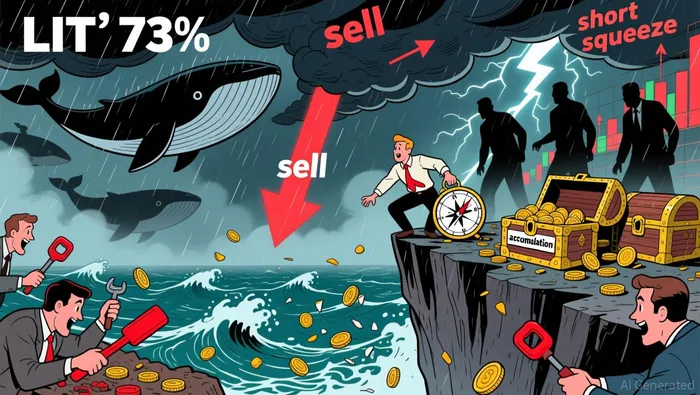 indicate bearish sentiment.
The token has also faced competition from platforms offering airdrop incentives, which have drawn liquidity away from Lighter. Protocols like Aster and Hyperliquid have reclaimed top rankings in perpetuals volume, while Lighter now ranks fifth but remains the third-largest perpetual DEX by open interest.
What Are the Risks and Opportunities for LIT Holders?
For LIT holders, risks include stagnant revenue and competition from other DeFi platforms. Lighter's daily revenue of $8,450 raises questions about the sustainability of its buyback program. Additionally, LIT's price has remained 73% below its $7.86 all-time high, and spot trading volume has dropped 64% to $15 million.
Despite these challenges, opportunities remain. Institutional investors, including large holders and Tron founder Justin Sun, are accumulating LIT, signaling potential long-term confidence. Lighter has also expanded its product line to include tokenized stock offerings and multi-signature wallet support, which could enhance its utility and attract new users.
The mixed signals from whale activity—both bullish and bearish—add to the token's uncertainty. While some whales are buying in, others are shorting LIT, indicating a lack of consensus on its future trajectory.
What Do Technical Indicators Suggest About LIT's Outlook?
Technical analysis suggests a bearish structure for LIT. The token has broken below key support at $2.30 and is now leaning on support between $2.00 and $2.05. The RSI is in oversold territory, and price action shows lower highs and lower lows on the 1-hour chart.
Derivatives trading volume and open interest have increased, pointing to active short-term positioning but no sign of long-term bullish sentiment. The token remains 73% below its all-time high, and spot trading volume has dropped, suggesting reduced demand.
While the buyback program and whale activity provide some deflationary support, the token's performance will depend on broader market trends, including liquidity shifts and competition from other decentralized exchanges.
In summary, LIT faces a challenging market environment. While institutional confidence and buyback initiatives offer some support, weak volume, bearish sentiment, and competition from other platforms present significant risks. Investors will need to closely monitor on-chain activity and broader market conditions to assess LIT's trajectory.

Blending traditional trading wisdom with cutting-edge cryptocurrency insights.
Latest Articles
Stay ahead of the market.
Get curated U.S. market news, insights and key dates delivered to your inbox.






Comments
No comments yet