
LIT Introduces Mandatory Staking for Liquidity Pool Access
 Aime Summary
- Lighter has introduced a mandatory staking model for its native LIT tokenLIT-- to access the Lighter Liquidity Pool (LLP), requiring users to stake 1 LITLIT-- to unlock up to 10 USDC according to reports.
- The initiative aims to align token holders with liquidity providers, enhancing liquidity and long-term engagement in the platform's ecosystem as documented.
- Existing users have a two-week grace period until January 28 to adjust their positions without staking according to announcements.
Lighter's mandatory staking model for LIT requires a 1:10 ratio to access the Lighter Liquidity Pool (LLP), which is designed to align the interests of token holders and liquidity participants according to Bitget.
This model enhances risk-adjusted returns and supports a more sustainable ecosystem by tying LIT staking to platform engagement 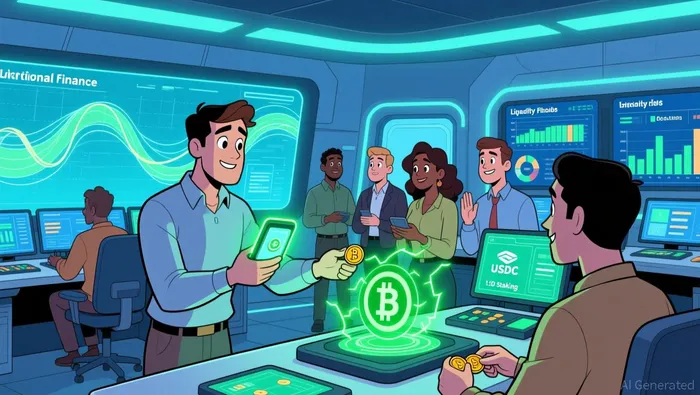 as reported.
Stakers with at least 100 LIT coins are exempt from withdrawal and transfer fees and can earn yield according to data.
Lighter has made staking mandatory for everyone, unlocking a 1:10 deposit ratio for users as stated.
Existing LIT holders have a two-week grace period (until January 28) to begin staking without the requirement according to Binance.
After the grace period, all participants will be required to stake their LIT tokens in the liquidity pools as confirmed.
What is the Impact on LIT Token Price?
Lighter's LIT token has dropped nearly 15% in the past 24 hours, despite the launch of a staking program offering liquidity rewards and fee discounts according to analysis.
This decline is attributed to post-launch selling, token distribution patterns, and broader market sentiment as reported.
Despite these measures, LIT has seen a 27% decline over the past week, reflecting competitive pressures from platforms like AsterASTER-- and Hyperliquid according to Bitget.
The staking mechanism is part of a broader strategy to enhance liquidity and promote sustainable growth on the decentralized exchange as detailed.
Lighter's buyback program aims to reduce the circulating supply of LIT by up to 3% and has driven short-term price growth according to reports.
However, broader market dynamics and competition continue to weigh on long-term price stability as noted.
How Does LIT's Staking Model Compare to Other PerpPERP-- DEXs?
Perp DEXs are systematically gaining market share from centralized exchanges due to lower fees, self-custody, and transparency according to industry analysis.
Delphi Digital projects Perp DEXs could capture over 25% of the derivatives market by 2025, with platforms evolving into integrated financial hubs as projected.
Lighter's mandatory staking model is a strategic move to align with this trend by enhancing liquidity and token holder engagement according to analysis.
Hyperliquid, a decentralized crypto exchange cofounded by Jeff Yan, has grown to compete with industry leaders like Binance and Bybit according to Yahoo Finance.
Hyperliquid has processed billions in derivative trades and attracted major crypto investors and institutional interest as reported.
Yan emphasizes the platform's focus on speed, transparency, and innovation in the decentralized finance space according to coverage.
What Are the Risks of LIT's Staking Model?
Lighter's LIT token collapse exposed systemic risks in Perp DEXs, highlighting the fragility of speculative incentives and architectural overreach according to analysis.
In contrast, platforms like Hyperliquid and EdgeX demonstrate sustainable models through technical innovation and institutional-grade infrastructure as documented.
Lighter's struggles are not an isolated incident but a harbinger of systemic risks in a sector where innovation often outpaces operational resilience according to reports.
Lighter's failure to scale its custom ZK Rollup architecture—optimized for high-frequency trading (HFT)—highlighted the inherent trade-offs between specialization and general-purpose scalability according to analysis.
Zero-knowledge proofs, while secure, introduced latency and gas cost inefficiencies that deterred users accustomed to centralized exchanges' speed as noted.
The market impact was immediate, with Lighter's market share plummeting and the LIT token's price dropping according to reports.

Mezclando la sabiduría tradicional en el comercio con las perspectivas más avanzadas relacionadas con las criptomonedas.
Latest Articles
Stay ahead of the market.
Get curated U.S. market news, insights and key dates delivered to your inbox.






Comments
No comments yet