
LIT Faces Conflicting Signals: Leveraged Shorts and Whale Accumulation Highlight Market Divergence
 Aime Summary
- Leveraged short positions in LITLIT-- surged in Q4 2025, signaling heightened bearish sentiment, while whales accumulated near key support levels, suggesting potential long-term undervaluation according to analysis.
- Lighter's treasury buyback program, which uses 50% of DEX fees for LIT repurchases, aims to reduce supply by up to 3%, aligning token value with protocol growth and attracting institutional investments as reported.
- Whale activity, including a $10M USDCUSDC-- deposit with a 5x leveraged short position and a 1.059M LIT spot purchase, reflects a calculated hedge against further price depreciation and long-term bullish sentiment according to on-chain data.
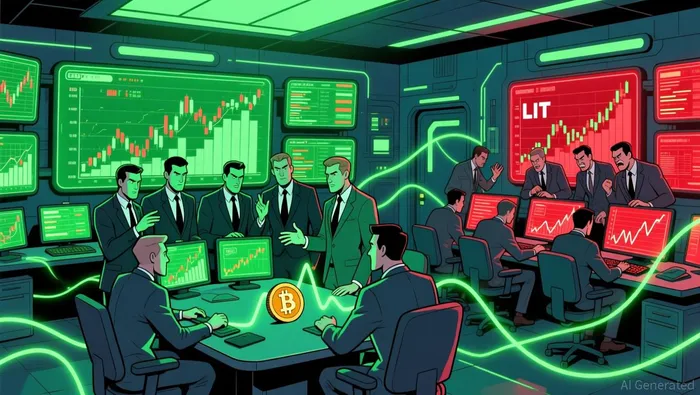
Lighter's LIT token is caught in a tug-of-war between bearish leveraged shorting and bullish whale accumulation. In Q4 2025, leveraged shorts surged, with whales depositing significant amounts in USDC to short LIT. This reflects a broader trend in the crypto market where whales are increasingly leveraging bearish bets, particularly in assets perceived as volatile and unanchored from fundamentals according to market analysis.
At the same time, LIT whales have been accumulating near key support levels. These purchases are methodical and clustered, suggesting deliberate positioning rather than impulsive buying. Such activity has helped stabilize the token's price, creating a floor that contradicts the narrative of a freefall. Whale accumulation patterns mirror broader trends in BitcoinBTC-- and EthereumETH-- markets, where institutional players are prioritizing long-term value over short-term volatility as market data shows.
Lighter has further supported LIT's market position by launching a treasury buyback program. The initiative allocates 50% of DEX fees and future revenue for LIT repurchases, aiming to reduce circulating supply and align token value with protocol growth. As of early January 2026, the program had repurchased over 180,000 LIT tokens at a cost of around $550,000. This deflationary mechanism ties token value directly to protocol usage and is part of broader DeFi trends of using tokenomics to enhance token value according to reports.
Institutional confidence in LIT is also reflected in whale activity. A $4.86M WBTC-to-LIT conversion and a $4M USDC deposit to purchase LIT highlight bullish sentiment. These transactions absorbed potential selling pressure and signaled institutional confidence in the token's long-term potential. Additionally, Lighter secured $68 million in funding at a $1.5 billion valuation, providing further financial backing for the buyback program as announced.
Despite these positive signals, LIT faces conflicting market dynamics. Leveraged short positions, including a $2.2 million 5x leveraged short, indicate bearish sentiment and potential for price declines. Traders are shifting focus to alternative platforms with airdrop incentives, contributing to declining volume and platform activity. The presence of both bullish and bearish whale activity adds to the uncertainty and highlights the token's susceptibility to concentrated market behavior according to market observations.
The future of LIT's buyback program and market confidence will depend on continued protocol revenue and market participation. Whale accumulation and institutional investments suggest confidence in LIT's long-term potential. However, the token's performance will also be influenced by broader market trends, including liquidity shifts and competition from other decentralized exchanges. Investors will need to closely monitor both on-chain activity and market conditions to assess the token's trajectory as market analysis indicates.
What Drives LIT's Volatility and Investor Sentiment?
LIT's volatility is driven by a combination of leveraged short positions and whale accumulation. Leveraged shorts amplify downward pressure, particularly in assets like LIT, which lack liquidity and institutional backing. On-chain data from Q4 2025 shows that these shorts often reflect a market psychology steeped in fear, further compounding downward momentum according to analysis.
Conversely, whale accumulation near key support levels suggests that institutional players are seeing potential in LIT as a long-term investment. These purchases, which are often clustered around similar price ranges, indicate deliberate positioning rather than impulsive trading. Such activity has helped stabilize LIT's price, creating a floor that contradicts the narrative of a freefall as market data shows.
What Are the Key Risks and Limitations for LIT Investors?
While the buyback program and whale accumulation suggest a positive outlook for LIT, the token is not without its risks. The success of the program depends on maintaining high protocol fees and continued demand. If the buyback fails to sustain investor confidence, LIT could face downward pressure from selling or reduced trading activity according to market analysis.
Additionally, large whale holdings may introduce volatility. A single wallet is estimated to hold 13.2 million LIT tokens, worth $40 million, which could drive price swings if sold. Market observers are tracking price dynamics above the $3.00 threshold, which has become a key level of interest. If the price drops below $2.97, it could trigger additional selling pressure and weaken the bullish momentum according to on-chain data.
Investors must also consider the broader market context. While Bitcoin settled $6.9 trillion in value over 90 days in Q4 2025, much of this activity shifted to ETFs and brokerage platforms, reducing direct on-chain visibility. This shift complicates the interpretation of accumulation signals, as traditional metrics may understate institutional interest according to market analysis.
What Is the Future Outlook for LIT in 2026?
The resolution of the tension between leveraged shorts and whale accumulators will define LIT's next chapter in 2026. For those with a contrarian outlook, LIT's whale-driven stabilization and lack of mainstream exposure could present a compelling case for a long-term buy. However, the presence of leveraged shorts means volatility is likely to persist, requiring a disciplined approach to risk management according to market analysis.
The success of Lighter's buyback program and institutional confidence in LIT will also play a critical role in shaping the token's trajectory. If whale activity continues to signal institutional confidence and the buyback program reduces supply effectively, LIT could see a more stable and bullish trend in the coming months. Investors will need to closely monitor both on-chain activity and market conditions to assess the token's potential for growth as market data shows.

Blending traditional trading wisdom with cutting-edge cryptocurrency insights.
Latest Articles
Stay ahead of the market.
Get curated U.S. market news, insights and key dates delivered to your inbox.
AInvest
PRO
AInvest
PRO



Comments
No comments yet