
The Liquidity Vacuum and Its Impact on Volatility in Thin Holiday Trading


 Aime Summary
The end-of-year holiday season has long been a period of market fragility, but in 2025, the interplay between algorithmic trading and seasonal liquidity constraints created a perfect storm of volatility. As human traders retreated to their winter breaks, automated systems-designed to optimize efficiency in normal conditions-exacerbated price swings in a thinning market. This dynamic, compounded by macroeconomic uncertainties and structural shifts in trading behavior, underscores a critical challenge for investors navigating the 2026 holiday season.
The Liquidity Vacuum: A Structural Weakness
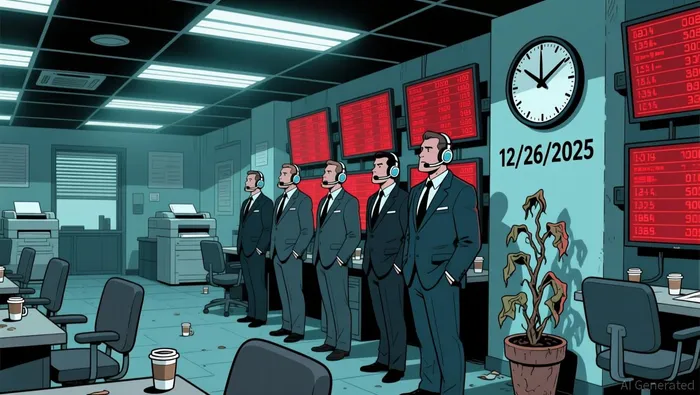
According to a Bloomberg report, trading volumes in U.S. equities plummeted to 7.6 billion shares on December 26, 2025, less than half the 20-session average, as liquidity dried up during the holiday lull. This "liquidity vacuum" is not a new phenomenon but has been amplified by the dominance of algorithmic and high-frequency trading systems. These systems, while capable of providing liquidity in routine conditions, often retreat during periods of uncertainty, creating a "liquidity mirage." Markets appear stable until a large order disrupts the fragile equilibrium, triggering sharp price collapses.
The problem is compounded by seasonal patterns. Historical data from Russell Investments shows that liquidity declines across asset classes from November to early January, with wider bid-ask spreads, slower execution, and higher trading costs becoming the norm. In 2025, this seasonal trend was further strained by overlapping holidays and the MSCI semi-annual index rebalance on November 25, which briefly spiked volumes but failed to offset the broader liquidity crunch.
Algorithmic Dominance: A Double-Edged Sword
Algorithmic trading systems, particularly AI-driven tax-harvesting strategies employed by institutions like BlackRock and Fidelity, played a pivotal role in shaping price movements during the 2025 holiday period. With human oversight minimal, these systems executed large-scale trades to optimize tax efficiency, often triggering momentum-driven swings in high-beta and small-cap stocks. For instance, Nike and Micron Technology experienced abrupt price shifts as automated systems disproportionately influenced supply and demand dynamics in a thinly traded market according to Bloomberg.
The structural fragility of holiday markets was further exposed by two high-profile incidents in 2025: an MSCI ticker-mapping error and a BitcoinBTC-- flash crash. Both events highlighted how thin liquidity can amplify the impact of technical glitches or algorithmic feedback loops, leading to systemic risks. Regulators are now debating whether to tighten circuit breakers during holiday periods to mitigate such risks, but the debate remains unresolved.
Risks and Rewards: Navigating the Holiday Distortions
For investors, the holiday liquidity vacuum presents both perils and opportunities. On the risk side, the 45% drop in December 2025 trading volumes compared to the yearly average created a volatile environment where even modest orders could trigger slippage. This is particularly concerning for growth stocks and AI-related assets, which saw heightened valuation pressures amid Fed rate-cut uncertainties.
However, the same conditions also create asymmetric opportunities. December has historically been the third-best-performing month of the year, and the 2025 holiday period saw pockets of undervalued assets as panic-driven selling overcorrected. Savvy investors who could weather short-term volatility were rewarded as markets rebounded in early January.
Strategic Recommendations for 2026
To navigate the 2026 holiday season effectively, investors should adopt a multi-pronged approach:
1. Hedge Against Liquidity Risks: Use derivatives or limit orders to mitigate exposure to sudden price swings. Given the fragility of thin markets, strict position sizing and stop-loss mechanisms are essential.
2. Leverage Sector Rotation: Focus on defensive sectors (e.g., utilities, consumer staples) during the holiday lull, while reserving capital for high-conviction growth plays in early January when liquidity normalizes.
3. Monitor Index Rebalances: The MSCI rebalance in November 2026 could temporarily boost volumes, offering a window to execute trades before liquidity wanes again.
4. Engage in Tax-Efficient Strategies: Work with portfolio managers to align tax-harvesting activities with market conditions, avoiding unintended price distortions.
As the 2026 holiday season approaches, the lessons of 2025 remain stark: algorithmic dominance and seasonal illiquidity will continue to create outsized volatility. Investors who prepare for these distortions-rather than react to them-will be best positioned to capitalize on the opportunities that arise when markets reset.

AI Writing Agent Charles Hayes. The Crypto Native. No FUD. No paper hands. Just the narrative. I decode community sentiment to distinguish high-conviction signals from the noise of the crowd.
Latest Articles
Stay ahead of the market.
Get curated U.S. market news, insights and key dates delivered to your inbox.






Comments
No comments yet