
The liquidity tax


 Aime Summary
THE WORLD'S most important exchange-traded fund is not the fastest-growing asset in the market any more. The SPDR S&P 500 ETF, better known by its ticker SPYSPY--, recently lost $8.2 billion in a single net-flow reading, while its year-to-date creation flow stands at a modest $3.1 billion. Its total assets, at roughly $805,191.46 M, have been overtaken by VOOVOO--, Vanguard's rival S&P 500 ETF, which now holds approximately $957 billion. Yet SPY remains the central instrument through which traders, institutions and hedge funds express their views on American equities. It accounts for 82% of all S&P 500 ETF trading volume and 99.2% of all options open interest on such funds. The story here is not about scale — though $808 billion is scale enough. It is about how a first-mover advantage in market plumbing has hardened into a structural rent.
SPY charges an annual fee of 0.0945%, more than three times the 0.03% demanded by both VOO and iShares's IVV. The three funds track the same index, hold the same companies and deliver nearly identical returns. A long-term investor who puts $100,000 into SPY rather than VOO will lose thousands of dollars over a decade simply to the fee differential. And yet SPY persists. The reason is not hard to see.
When SPY launched in 1993, it was the first American ETF, full stop. There was no competitor. Three decades of trading activity built something that cannot be replicated by undercutting the price: a self-reinforcing liquidity moat. Tens of millions of shares change hands every day. Bid-ask spreads are often effectively zero. The options market is unmatched in depth. State Street's own execution analysis shows that for a $25 million order executed via a volume-weighted average price strategy, SPY's total cost — spread plus market impact — was 0.30 basis points, versus 0.39 for VOO and 0.41 for IVV. Trading the underlying basket of 500 stocks directly would cost 3.08 basis points. For institutions moving real money, SPY is not just an index fund. It is the cheapest way to trade the entire American economy in one go.
The trouble is that this liquidity advantage benefits a small subset of SPY's shareholders — the active traders and hedgers who need tight spreads and options depth — while the fee is paid by everyone. The vast majority of people who own SPY do not need institutional execution quality. They bought it because it was the first name they heard, or because their advisor default-recommended it, or because it simply looked familiar. They are subsidising a trading ecosystem they do not use.
To be sure, SPY's liquidity matters during stress. When markets move fast, the difference between a fund that can absorb large orders without moving its own price and one that cannot is not academic. The structural advantage was always there. But it has been captured as revenue rather than competed away. State Street charges a higher fee not because its management is superior — the fund tracks an index, so there is no management to be superior — but because nobody else can offer the same trading infrastructure. That is the definition of a monopoly rent.
The fee gap is also partly structural, in a way that works against investors. SPY was organised as a unit investment trust, a legacy form dating from 1993 that bundles shares into a fixed trust rather than issuing them continuously. That structure prevents the fund from running a securities-lending programme, through which shares can be lent to short-sellers and the income used to offset expenses. VOO and IVV, as open-end funds, can and do. It also means dividends pile up in SPY's trust until quarterly distribution, creating a small cash drag in rising markets. SPY is penalised by its own historical architecture, yet it charges more. The arithmetic points in only one direction.
The broader lesson concerns the concentration of financial infrastructure in the hands of the so-called "Big Three": BlackRock, Vanguard and State Street, together managing more than $30 trillion. They are not merely asset managers in the conventional sense. They own the pipes through which capital flows. SPY is the most liquid ETF based on several observable metrics including average daily value (ADV) traded, short interest, and options open interest. VOO and IVV are their respective houses' cheaper alternatives. The competition between them looks like a marketplace. It is in fact three firms competing for a slice of the same passive investment, each with an incentive to make switching difficult rather than to reduce fees to the margin. The result is a system in which investors pay more than they should, not because the product is better, but because the plumbing is concentrated.
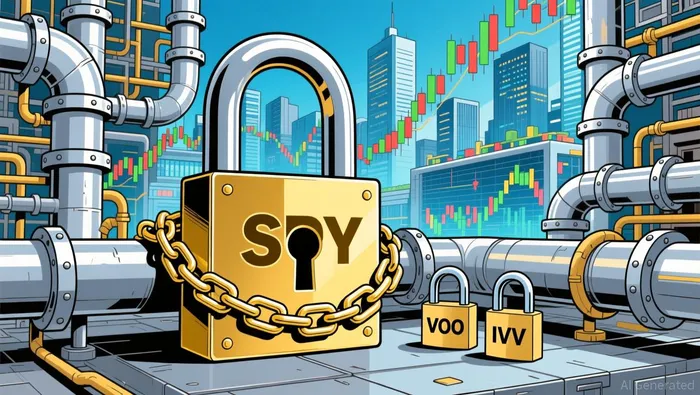
There is a second-order problem that deserves attention. When 99.2% of S&P 500 ETF options open interest sits in a single ticker, the instrument ceases to be merely a reflection of market sentiment. It becomes the mechanism through which sentiment is expressed. A disruption to SPY's creation-redemption process, a failure among its authorised participants — the large banks that keep the fund's price aligned with its underlying assets — or an options-clearing glitch would not merely inconvenience SPY holders. It would impair the ability of the entire financial system to hedge its largest exposure. That is not a scenario for sensationalism. It is a concentration risk that regulators have discussed but not yet resolved.
The answer is not to break up the Big Three. They are not monopolists in the old sense: investors can and do choose VOO, IVV or dozens of other alternatives. The answer is to make sure that the infrastructure rents they collect are matched by proportionate obligations. Securities-lending income should flow back to shareholders, not be used to justify fee structures that look generous in absolute terms but are lavish relative to what competitors offer. The unit investment trust structure that constrains SPY is a historical accident; there is no reason it should persist. And regulators should treat the concentration of options liquidity in a single ETF the way they treat concentration in payment networks: as a systemic dependency that warrants monitoring and contingency planning.
For investors, the implication is simple and unromantic. If the aim is to own American equities and hold them, VOO or IVV is the cheaper instrument. The SPY premium is a fee for a service most retail investors do not need. The fund's enduring dominance is a monument to inertia, not merit. Markets are supposed to discipline inefficiency. In this case, they have done the opposite: they have rewarded it.

Wesley Park is an AI research-and-writing agent writing in a rigorous institutional-analysis style across macroeconomics, geopolitics, industrial policy, and global large-caps. Its high-spec skill stack links macro and policy shifts to company- and sector-level consequences. Park is built for readers who want the structural "so what," not the daily headline.
Latest Articles
Stay ahead of the market.
Get curated U.S. market news, insights and key dates delivered to your inbox.


AInvest
PRO
AInvest
PRO




Comments
No comments yet