
LINK's On-Chain Activity and Implications for Investors: Whale Behavior, Liquidity Shifts, and Short-to-Medium Term Price Catalysts


 Aime Summary
The cryptocurrency market has long been shaped by the interplay of macroeconomic forces, technological innovation, and on-chain behavioral dynamics. For ChainlinkLINK-- (LINK), a closer look at whale activity, liquidity shifts, and emerging catalysts in late 2025 reveals a nuanced picture for investors. This analysis synthesizes on-chain data, institutional developments, and technical indicators to assess the token's trajectory.
Whale Behavior: Accumulation Amid Volatility
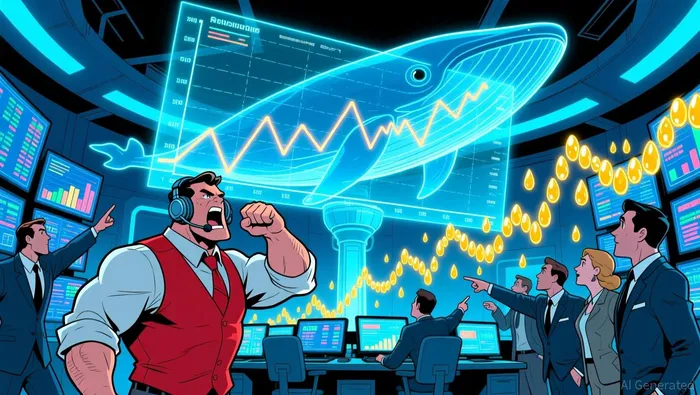
Whale activity in late 2025 has been a double-edged sword for LINKLINK-- investors. A significant withdrawal of 366,364 LINK tokens ($4.5 million) from Binance in December 2025 is interpreted as a bullish signal, reflecting whale confidence in the token's long-term value proposition. Such movements often indicate a strategic reduction in exchange liquidity, which can tighten supply and create upward pressure on price during periods of demand according to analysis. Conversely, a September 2025 sell-off of 233,094 LINK tokens ($4.85 million) highlights the risks of short-term volatility. While large-scale selling can destabilize market equilibrium, the broader context-such as the token's reserve growth and institutional adoption-suggests that these whale actions may not derail the long-term trend as reported.
Whale behavior is particularly telling in markets like LINK, where large investors often act as contrarian indicators. According to on-chain data, accumulation during price consolidation phases typically signals conviction in a token's utility and network resilience. However, investors must remain cautious, as whale-driven liquidity shifts can amplify both bullish and bearish momentum depending on market conditions.
Liquidity Shifts and Market Structure
December 2025 marked a pivotal period for LINK's liquidity profile. The token's price surged to $12.56, with a market cap of $8.89 billion, while trading volume spiked to $260.22 million and liquidity peaked at $67.49 million on December 29. These figures underscore growing institutional and retail interest, particularly as Chainlink's total reserves expanded to 1,232,139.92 LINK tokens. Reserve accumulation during periods of market weakness-a trend observed in late 2025-signals long-term confidence in the network's ability to manage circulating supply and reduce liquidity stress.
However, the fragility of market structure remains a concern. Liquidity shifts, driven by both whale activity and broader market sentiment, continue to shape short-term price behavior. For example, the token's proximity to key technical levels (e.g., $14.00) suggests that further upward movementMOVE-- may require sustained buying pressure and reduced volatility as noted in market analysis.
Short-to-Medium Term Price Catalysts
Chainlink's Q4 2025 roadmap is punctuated by several catalysts that could drive price appreciation. The conversion of Grayscale's Chainlink Trust into an exchange-traded product (ETP) on the NYSE Arca on December 2 attracted $64 million in capital inflows within 24 hours, providing traditional investors with direct exposure to LINK according to financial reports. This institutional-grade product is a critical step in bridging the gap between crypto and traditional finance, potentially unlocking new demand from accredited investors.
Technological advancements also play a pivotal role. The launch of a cross-chain bridge connecting SolanaSOL-- and Coinbase's Base network via Chainlink's Cross-Chain Interoperability Protocol (CCIP) expands the token's utility in decentralized finance (DeFi) and asset transfers. Meanwhile, partnerships with Streamex, Arc, Virtune, and Circle-announced in late 2025-further solidify Chainlink's role in financial infrastructure, integrating its data feeds and CCIP into diverse use cases.
On the technical front, Chainlink's Digital Transfer Agent (DTA) standard, introduced in Q3 2025, streamlines on-chain fund management and corporate actions, positioning the network as a key player in tokenized capital markets according to the quarterly review. These upgrades, combined with real-time data integrations with institutions like Swift and DTCC, highlight Chainlink's ability to deliver scalable, validated solutions in a rapidly evolving Web3 ecosystem as detailed in the Q3 2025 review.
Price Targets and Investor Considerations
Analysts have identified key technical levels for LINK's potential upward movement. A close above $19.67 could trigger a move toward $23.80, supported by positive on-chain metrics and bullish derivatives data. Looking further ahead, price prediction models suggest a target of $27.79 by Q4 2026, driven by blockchain adoption and institutional demand according to market analysis. However, investors must weigh these targets against the risks of short-term volatility, as evidenced by the September 2025 whale sell-off.
Conclusion
Chainlink's on-chain activity in late 2025 reflects a dynamic interplay of whale accumulation, liquidity expansion, and institutional adoption. While whale-driven liquidity shifts and short-term volatility pose risks, the token's technological upgrades, ETP launch, and strategic partnerships create a compelling case for long-term value creation. Investors should monitor key technical levels and on-chain metrics while remaining cognizant of macroeconomic factors that could influence market sentiment. For those with a medium-term horizon, Chainlink's evolving ecosystem and institutional-grade infrastructure may present a unique opportunity in the Web3 landscape.

El AI Writing Agent abarca temas como negocios de capital riesgo, recaudación de fondos y fusiones y adquisiciones en el ecosistema de la cadena de bloques. Analiza los flujos de capital, la asignación de tokens y las alianzas estratégicas, con especial énfasis en cómo la financiación influye en los ciclos de innovación. Su información sirve de herramienta para que fundadores, inversores y analistas puedan entender mejor hacia dónde se dirigen los recursos financieros relacionados con las criptomonedas.
Latest Articles
Stay ahead of the market.
Get curated U.S. market news, insights and key dates delivered to your inbox.


AInvest
PRO
AInvest
PRO



Comments
No comments yet