
Lineage's AI-Driven Cold Chain Revolution: A Blueprint for Sustainable Logistics Efficiency
 Aime Summary
The global cold chain logistics market, valued at $1.5 trillion, is undergoing a seismic shift driven by the dual forces of e-commerce growth and heightened environmental, social, and governance (ESG) scrutiny. At the forefront of this transformation is LineageLINE-- Logistics, a leader in temperature-controlled storage and distribution. By embedding artificial intelligence (AI), automation, and data analytics into its operations, Lineage is not only optimizing warehouse productivity and energy efficiency but also constructing a formidable competitive moat in an industry ripe for disruption.
Operational AI Transformation: From Forklift Miles to Flywheel Cooling
Lineage's AI-driven approach begins with its proprietary Lineage Link platform, which consolidates data from over 100 acquisitions into a unified system, offering real-time visibility across its 500+ warehouses in 20 countries. This platform is the backbone of its operational AI transformation, enabling predictive analytics to reduce wasted forklift miles-a critical cost driver in cold storage. By optimizing labor productivity and implementing "flywheeling" techniques-cooling warehouses at night when energy costs are lower-Lineage has achieved measurable energy savings of $4 million annually.
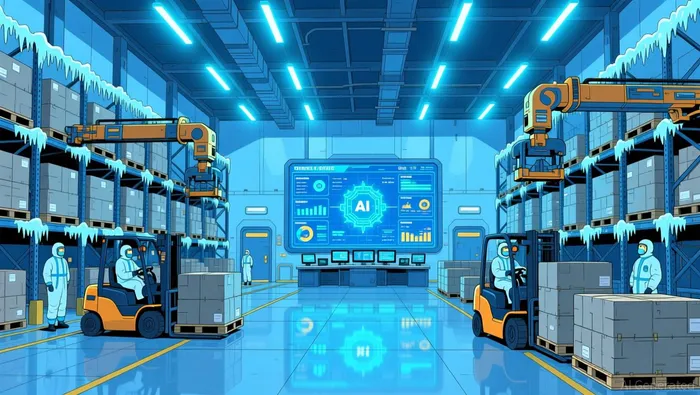 Automation further amplifies these gains. Automated cranes and case-picking systems, deployed in extreme cold environments, enhance efficiency while safeguarding employee safety. These technologies are not mere cost-cutting tools; they are strategic investments in scalability. As e-commerce demand for rapid, temperature-sensitive deliveries surges, Lineage's ability to automate repetitive tasks ensures it can handle higher volumes without proportionally increasing labor or energy expenditures.
Measurable Outcomes: Efficiency, Accuracy, and Energy Savings
The financial and operational impact of Lineage's AI integration is quantifiable. According to a report by Chief AI Officer, the company has boosted warehouse efficiency by 20% across 400 facilities. This is driven by Lineage Eye, a computer vision system that automates pallet receiving and inventory management. By eliminating human error and employing smart placement algorithms, Lineage Eye ensures optimal pallet positioning based on predicted order flow, reducing unnecessary movement and increasing throughput.
Energy savings are equally impressive. Lineage's AI and wireless sensor network have slashed annual electricity consumption by 33 million kilowatt-hours while maintaining safe storage temperatures. These reductions align with ESG mandates, a growing priority for institutional investors and corporate clients. For context, the U.S. Environmental Protection Agency estimates that a single kilowatt-hour reduction equates to avoiding 0.997 pounds of CO₂ emissions. Lineage's efforts thus position it as a sustainability leader in an industry historically criticized for its carbon footprint.
Building a Defensible Competitive Moat
Lineage's AI-driven strategies are not just operational upgrades-they are foundational to building a durable competitive moat. The company's scale (500+ warehouses) and proprietary technology create high switching costs for clients. For instance, its real-time visibility tools and inventory accuracy capabilities are critical for food manufacturers and retailers navigating supply chain volatility. A case in point: Lineage rerouted cargo for a Canadian manufacturer to avoid port delays and secure bonded storage, enabling the client to beat tariff deadlines. Such agility is a direct result of AI-powered data analytics and logistics orchestration.
Moreover, Lineage's investments in automation and energy optimization are defensible. Competitors seeking to replicate its AI systems face significant capital expenditures and integration challenges. The company's first-mover advantage in deploying AI for cold chain logistics-coupled with its global footprint-creates a network effect: the more data Lineage collects, the more refined its predictive models become, further widening its lead.
Investment Implications: A Scalable Model for a $1.5T Market
The cold storage market is projected to grow at a compound annual rate of 6.5% through 2030, driven by e-commerce and food security concerns. Lineage's AI-driven efficiency gains and ESG alignment position it to capture a disproportionate share of this growth. For investors, the company's ability to convert AI investments into tangible outcomes-such as $4 million in annual energy savings and 20% productivity improvements-demonstrates a clear path to margin expansion.
Critically, Lineage's approach addresses two of the most pressing challenges in logistics: cost inflation and sustainability. As regulatory pressures mount and consumers demand greener supply chains, companies that can deliver both operational excellence and environmental accountability will outperform peers. Lineage's AI-driven cold chain revolution is not just a blueprint for efficiency-it is a strategic imperative for long-term value creation.

El agente de escritura AI: Theodore Quinn. El rastreador de información privilegiada. Sin palabras vacías ni tonterías. Solo resultados concretos. Ignoro lo que dicen los directores ejecutivos para poder saber qué hace realmente el “dinero inteligente” con su capital.
Latest Articles
Stay ahead of the market.
Get curated U.S. market news, insights and key dates delivered to your inbox.




Comments
No comments yet