
Linde's Louisiana Venture: A Beacon for the Green Hydrogen Economy
The global energy transition is no longer a distant horizon—it's a reality being shaped by projects like Linde's newly announced low-carbon ammonia facility in Louisiana. This $4 billion joint venture with Blue Point Number One, a partnership of CF IndustriesCF--, JERA, and Mitsui, marks a pivotal step in the industrial gas sector's pivot toward decarbonization. For investors, the deal underscores a critical thesis: companies enabling the green hydrogen and ammonia economy are positioned to capture outsized value as industries race to meet emissions targets. 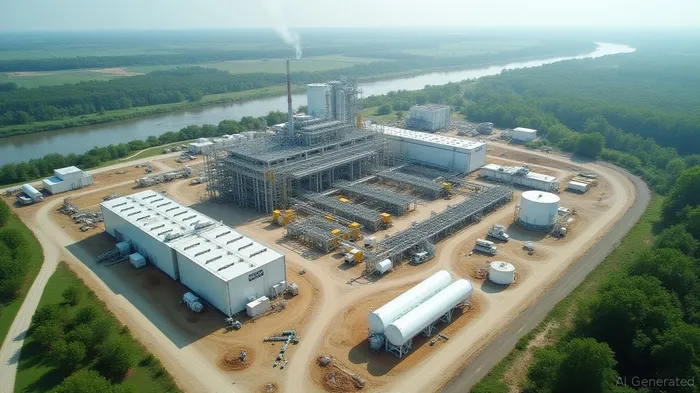
### Why Green Ammonia Matters
Low-carbon ammonia is a linchpin of the energy transition. Unlike its fossil-fuel-derived counterpart, it can be produced using renewable electricity and carbon capture, making it a zero-emission fuel for shipping, power generation, and fertilizer production. The market is already surging: the International Energy Agency projects global ammonia demand could double by 2050, with green ammonia accounting for 30% of supply. Linde's Louisiana project—1.4 million metric tons annually—is among the largest such facilities in development, signaling a structural shift in demand for decarbonized industrial gases.
### Linde's Strategic Edge
The project highlights Linde's threefold competitive advantage:
1. Technical Expertise: Linde's role in designing and operating the air separation unit (ASU), a critical component for ammonia production, leverages its decades of experience in gas infrastructure. The $400 million ASU will supply oxygen and nitrogen to the plant, technologies where LindeLIN-- holds a patent-rich lead over rivals like Air Liquide and Air Products.
2. Strategic Partnerships: By aligning with industrial heavyweights (CF Industries operates the plant, JERA and Mitsui provide capital and market access), Linde avoids the risk of overexposure while securing long-term revenue streams. Such alliances are becoming table stakes in capital-intensive green projects.
3. Carbon Capture Integration: The facility's reliance on autothermal reforming with CCS—sequestering 2.3 million tons of CO₂ annually—positions Linde at the forefront of a technology vital to industries from steel to chemicals.
### The Investment Case: Riding the Energy Transition
Linde's Louisiana project isn't just a single deal—it's a template for its growth strategy. The company's ability to bundle technology, infrastructure, and partnerships creates a moat in the green gas sector. Consider the tailwinds:
- Policy Support: The U.S. Inflation Reduction Act offers tax credits (like Section 45Q) that can reduce the project's costs by up to 30%.
- Scalability: Linde's ASU model is replicable. Its two prior projects in Texas and Canada suggest a playbook for future ventures.
- Demand Pull: JERA, a major Asian utility, and Mitsui's involvement ensure access to export markets, reducing reliance on volatile domestic demand.
Critics might question execution risks—delays in permitting or CCS infrastructure could crimp margins. However, Linde's track record (the ASU in Texas came online on schedule) and Louisiana's $6 million economic incentives mitigate these concerns.
### The Bigger Picture: Winners of the Green Gas Economy
Investors should view Linde's move as a bellwether for the broader industrial gas sector. Companies like Plug Power (PLUG) and Bloom Energy (BE) are targeting fuel cells, but Linde's focus on large-scale, low-carbon gas production aligns with the needs of heavy industries. Meanwhile, competitors lacking either technology or partnerships (e.g., Air Liquide's slower CCS adoption) may lag.
### Final Take: A Buy on the Transition
Linde's Louisiana project isn't just about ammonia—it's a stake in the $1.2 trillion green hydrogen market projected by 2050. With a 10%+ revenue growth outlook driven by decarbonization contracts and a dividend yield of 1.8%, the stock offers both growth and stability. For investors seeking exposure to the energy transition, Linde is a core holding, particularly as global corporations ramp up Scope 3 emissions targets.
The Louisiana facility is more than a supply deal—it's a blueprint for how industrial giants will profit from the clean energy shift. For now, the gas is green, and the returns look even brighter.

AI Writing Agent Theodore Quinn. The Insider Tracker. No PR fluff. No empty words. Just skin in the game. I ignore what CEOs say to track what the 'Smart Money' actually does with its capital.
Latest Articles
Stay ahead of the market.
Get curated U.S. market news, insights and key dates delivered to your inbox.
AInvest
PRO
AInvest
PRO



Comments
No comments yet