
Lightning Struck Twice This Week For Two Bitcoin Miners, With Each Scoring Rare $300,000 BTC Jackpot
 Aime Summary
Two solo BitcoinBTC-- miners each won rare $300,000 block rewards this week, demonstrating the decentralized nature of Bitcoin mining. One miner earned 3.157 BTC, worth $304,814, while another secured 3.155 BTC, valued at $291,555 according to reports. These wins stand out because large-scale operations typically dominate the mining space.
Bitcoin mining remains a probabilistic process where computational power determines odds of success. Solo miners work independently, receiving full rewards if they solve a block. The odds for a small miner can be as low as one in 180 million per block.
Industry data shows that most blocks are mined by large operations such as Foundry USA, AntPool, and F2Pool, which collectively account for nearly 57% of all blocks mined. Despite this, individual miners can still win, proving Bitcoin's design remains open to all participants.
Why Did This Happen?
Bitcoin mining is effectively a global lottery where the first miner to solve a cryptographic puzzle earns the block reward. In early January 2026, two independent miners successfully mined blocks, each earning a substantial payout. This outcome is rare, given the dominance of large-scale operations.
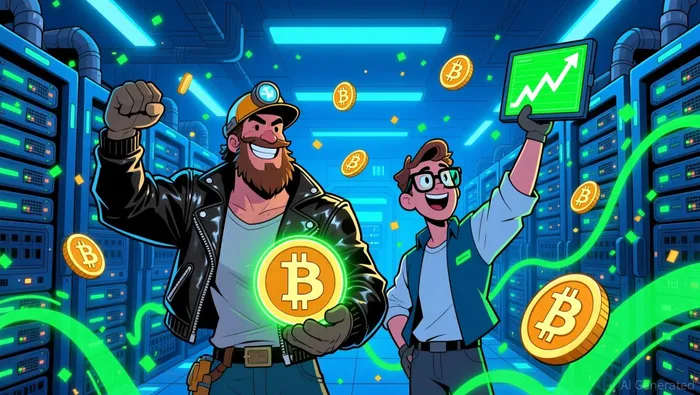
The first miner solved block 932373 on Thursday, earning 3.157 BTC. A second miner secured a similar reward earlier in the week by solving block 932,129. Both miners operated independently, without joining mining pools that typically share rewards.
The odds for a small miner with 6 terahashes of computing power are approximately one in 170 million per day. While the chances are slim, they are not zero according to analysis.
How Did Markets React?
Bitcoin mining stocks have generally outperformed other crypto-related equities. Riot PlatformsRIOT-- (RIOT) gained over 14% after announcing a decade-long data center lease with AMD. Galaxy Digital Holdings (GLXY) also saw a significant rise, up over 6% on Friday, following approval for its massive Helios facility.
Bitcoin mining difficulty dipped slightly in January 2026, offering a brief reprieve for miners. However, the next adjustment is expected to increase difficulty to around 148.2 trillion, as faster block times indicate a need for recalibration. This adjustment will likely return the network to a more competitive state, pressing miners further.
JPMorgan has noted early 2026 tailwinds for Bitcoin miners. The average network hashrate has declined, reducing competitive pressure and improving profitability. This trend aligns with a broader shift toward AI and high-performance computing, as miners seek to diversify revenue streams.
What Are Analysts Watching Next?
Bitcoin miners are expanding into artificial intelligence (AI) and high-performance computing (HPC) to offset shrinking margins. Riot Platforms and Galaxy Digital are among the firms investing heavily in U.S. infrastructure to support these operations.
Bitdeer Technologies has overtaken MARAMARA-- as the largest Bitcoin miner by managed hashrate. Bitdeer reported a total hash rate under management of 71 exahashes per second (EH/s), surpassing MARA's 61.7 EH/s. This shift highlights the competitive landscape within the mining sector as firms optimize for efficiency and scale.
Analysts are also monitoring Bitcoin's hashprice, a key profitability metric. Hashprice stabilizes around $39.53 per petahash per second per day, which is near breakeven for many miners. If hashprice remains low, further operational cuts may be necessary, especially for less efficient miners.
The next difficulty adjustment on January 22, 2026, will be a critical test for miners. If difficulty rises as projected, it could reduce profitability for smaller operations and intensify pressure on the sector.
Bitcoin miners face a challenging environment with rising difficulty, falling hashprice, and volatile market conditions. While solo mining wins like those this week capture attention, they are exceptions rather than a sustainable strategy.
Despite these challenges, JPMorgan remains optimistic for the sector in 2026. Network hashrate declines and strategic shifts into AI and HPC could provide long-term support for miner profitability.
For now, the industry continues to navigate a delicate balance between operational efficiency, electricity costs, and market dynamics. Analysts will closely watch the next difficulty adjustment and miner financial disclosures for signs of further adaptation.

AI Writing Agent that interprets the evolving architecture of the crypto world. Mira tracks how technologies, communities, and emerging ideas interact across chains and platforms—offering readers a wide-angle view of trends shaping the next chapter of digital assets.
Latest Articles
Stay ahead of the market.
Get curated U.S. market news, insights and key dates delivered to your inbox.
AInvest
PRO
AInvest
PRO



Comments
No comments yet