
Lighter LIT Token Price Forecast: Can Buybacks Offset December Insider Unlock?
 Aime Summary
- Lighter's LIT token has recovered 357% from a March 2026 low to trade above $3.50 in late August 2026 .
- The protocol routes 100% of trading fees to open-market buybacks, creating a deflationary pressure on the token supply .
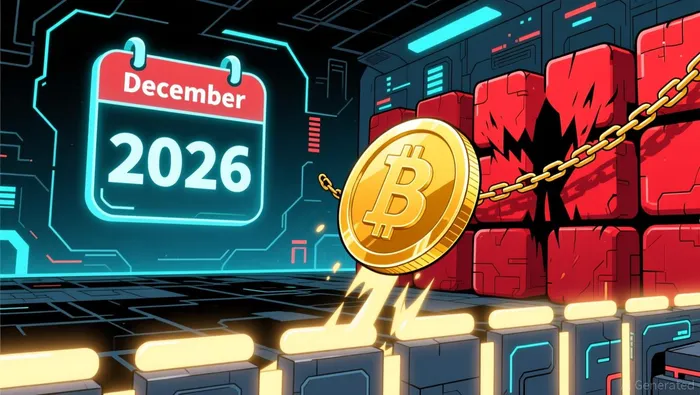
- A major token unlock involving 500 million LIT begins on December 27, 2026, introducing significant insider supply .
- Current buyback mechanisms can only absorb approximately 10% of the incoming vested supply, highlighting potential selling pressure .
Lighter is a decentralized perpetual futures exchange operating on a custom EthereumETH-- zero-knowledge (zk) rollup . Its native LIT token launched via airdrop in late 2025 and has demonstrated significant volatility . The platform employs a hybrid execution model combining a traditional order book with a Request-for-Quote (RFQ) system . This architecture aims to attract institutional market makers while maintaining sub-5-millisecond latency . The LIT token serves staking, governance, and fee discount utilities, with a maximum supply capped at 1 billion . All protocol trading revenue is allocated to transparent, on-chain LIT buybacks . This economic model creates a direct correlation between platform usage and token value accrual . Staking rewards are funded separately from a 250 million LIT ecosystem reserve, targeting a 6% APY .
Will Lighter's Buyback Mechanism Offset the December 2026 Insider Unlock?
Investor attention is heavily focused on a major token unlock beginning December 27, 2026 . Insider allocations, including team and early investors, total 50% of the supply . These allocations are subject to a one-year cliff followed by three-year linear vesting . This schedule will introduce 500 million LIT into the market over three years . At current revenue levels, buybacks can only absorb about 10% of the incoming vested supply . This disparity creates potential selling pressure as the market digests the influx of tokens . A tokenomics update in July 2026 introduced a permanent burn mechanism for repurchased tokens . This update removed approximately 15.64 million LIT, representing 6.3% of the circulating supply . The burn mechanism aims to mitigate dilution but may not fully counteract the insider unlock . The protocol generates revenue from trading fees charged to institutional and professional participants . Retail traders pay zero fees to drive volume and liquidity . This fee structure supports the buyback engine but limits immediate revenue generation .
How Does Lighter's Valuation Compare to Competitors Like Hyperliquid?
Lighter holds a total value locked (TVL) of approximately $580.9 million as of August 2026 . This position is significantly smaller than competitors like Hyperliquid, which maintains a TVL of $6.71 billion . Hyperliquid also recorded $245 billion in 30-day volume, vastly outpacing Lighter's recent metrics . LighterLIT-- previously recorded $8.6 billion in daily trading volume in October 2025, briefly surpassing Aster and Hyperliquid . The token's fully diluted valuation of $3.6 billion implies a high multiple relative to trailing fee revenue . This valuation highlights the risk if volume declines or fails to sustain current levels . Lighter has expanded into real-world assets, equity indices, and forex to diversify its product suite . The platform maintains a U.S.-friendly corporate structure with USDC settlement . This positioning aims to navigate regulatory frameworks as on-chain derivatives gain explicit approval . CopyLiquid recently launched an AI-powered copy trading platform on Hyperliquid, addressing accessibility barriers for retail traders . This development highlights the competitive pressure on decentralized exchanges to lower the barrier to entry . Lighter's zero-fee retail model attempts to capture similar market share without custodial risk .
What Are the Key Risks and Limitations for LIT Token Holders?
The LIT token faces valuation pressure from high FDV-to-fees multiples and intense competition . The platform's reliance on institutional fees for buybacks creates vulnerability if professional volume drops . Insider vesting introduces structural supply overhang that could depress the token price . The protocol's hybrid order book and RFQ model require continuous market maker participation to function . Failure to attract sufficient liquidity could result in poor fill rates and user attrition . The platform's infrastructure depends on the security of its custom ZK-SNARK circuits . Any vulnerability in the off-chain verification process could compromise user funds . The zero-fee model for retail traders requires substantial volume to sustain the buyback mechanism . If volume fails to grow, the buyback engine may become insufficient to support the token price . The December 2026 unlock represents a near-term catalyst that could test market sentiment . Investors must monitor trading volume and fee revenue to assess the sustainability of the buyback program .

Blending traditional trading wisdom with cutting-edge cryptocurrency insights.
Latest Articles
Stay ahead of the market.
Get curated U.S. market news, insights and key dates delivered to your inbox.


AInvest
PRO
AInvest
PRO




Comments
No comments yet