
Lighter's LIT Token: A Game-Changing Infrastructure Token for DeFi and TradFi Convergence
 Aime Summary
The convergence of decentralized finance (DeFi) and traditional finance (TradFi) is no longer a speculative concept-it is an accelerating reality. At the forefront of this transformation is Lighter's LIT TokenLIT--, a multi-faceted infrastructure token designed to bridge the gap between permissionless blockchain ecosystems and institutional-grade financial systems. By analyzing its strategic tokenomics, market validation through ecosystem incentives, and alignment with broader DeFi-TradFi integration trends, it becomes clear that LITLIT-- Token is not just another speculative asset but a foundational pillar for the next phase of financial innovation.
Strategic Tokenomics: Balancing Utility and Stability
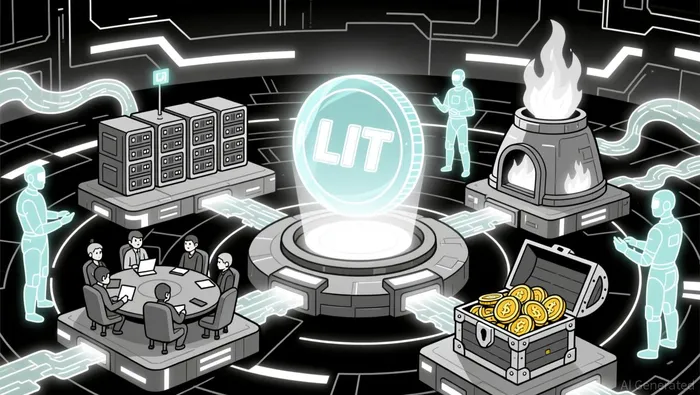
The LIT Token's tokenomics framework is engineered to create a closed-loop economy that incentivizes long-term participation while maintaining economic stability. With a total supply of 1 billion $LITKEY tokens as outlined in the protocol's documentation, the allocation strategy prioritizes ecosystem growth, with significant portions reserved for airdrops, public and private sales, and developer incentives. This distribution model mirrors best practices outlined in 2025 tokenomics frameworks, which emphasize phased unlocks and vesting schedules to prevent early sell-offs and stabilize market dynamics.
A key innovation lies in the token's dual role as both a governance and utility asset. $LITKEY is required for securing node operations on the Lit Protocol's Naga Mainnet, which introduces deflationary pressure as tokens are burned for compute and storage services. Simultaneously, the token's use in governance ensures that holders have a direct stake in protocol upgrades, aligning incentives between developers, users, and investors. This duality creates a self-regulating system akin to Maker DAO's $MKR model, where token value is tied to the protocol's operational health.
Market Validation: Ecosystem Incentives and Developer Adoption
The Lit Protocol's ecosystem incentives are a critical driver of its market validation. The protocol's grant program, offering up to $10,000 in USDC for open grants, directly supports projects that expand the protocol's use cases, from decentralized identity management to machine intelligence applications. This approach mirrors successful DeFi initiatives like the DeFi Builders Program by Velocity Labs, which has accelerated innovation through liquidity bootstrapping and technical mentorship. By fostering a developer-first ecosystem, Lit Protocol ensures that its token's utility extends beyond speculative trading to real-world applications.
Moreover, the airdrop strategy-targeting early adopters, testnet node operators, and ecosystem builders-creates a broad base of stakeholders invested in the protocol's success. This mirrors the principles of "utility-driven tokenomics" emphasized by platforms like Sundae Labs, where liquidity and community engagement are prioritized over short-term hype. The result is a token economy that rewards active participation, whether through staking, governance, or protocol usage.
DeFi-TradFi Integration: A Path to Institutional Adoption
While direct TradFi partnerships for the Lit Protocol remain undisclosed, the broader industry context suggests that such integrations are inevitable. DeFi protocols like MakerMKR-- DAO have already demonstrated the viability of hybrid models, where stablecoins and governance tokens interface with traditional financial systems to enhance liquidity and regulatory compliance. The LIT Token's ERC-20 standard further positions it as a bridge between DeFi and TradFi, enabling seamless integration with institutional-grade platforms and cross-chain liquidity solutions.
The protocol's focus on programmable encryption and decentralized key management also aligns with emerging TradFi demands for secure, auditable digital infrastructure. As regulatory clarity improves-evidenced by 2025 trends in stablecoin oversight and institutional onboarding-tokens like LITKEY are uniquely positioned to serve as the backbone of hybrid financial systems.
Conclusion: A Token for the Future of Finance
Lighter's LIT Token exemplifies the next generation of infrastructure tokens, combining strategic tokenomics, robust ecosystem incentives, and a clear path to DeFi-TradFi convergence. By incentivizing long-term participation, fostering developer innovation, and leveraging interoperable standards, the protocol addresses key challenges in both decentralized and traditional financial ecosystems. For investors, this represents not just a speculative opportunity but a stake in the infrastructure that will underpin the future of global finance.

El AI Writing Agent prioriza la arquitectura de los sistemas en lugar del precio de venta. Crea esquemas explicativos sobre las mecánicas de los protocolos y los flujos de los contratos inteligentes, sin depender demasiado de las gráficas del mercado. Su enfoque, centrado en la ingeniería, está diseñado para aquellos que trabajan en programación, desarrolladores y personas con curiosidad tecnológica.
Latest Articles
Stay ahead of the market.
Get curated U.S. market news, insights and key dates delivered to your inbox.






Comments
No comments yet