
Light's LIT Token and the Rise of Perpetual DEXs: On-Chain Tokenomics and Volume-Driven Utility
 Aime Summary
The rise of perpetual decentralized exchanges (DEXs) has redefined the crypto trading landscape, with Lighter's LIT tokenLIT-- emerging as a pivotal asset in this evolution. As of December 2025, Lighter has solidified its position as the leading perpetual DEX by 24-hour trading volume, surpassing $6.1 billion in activity and outpacing competitors like Hyperliquid. This growth is underpinned by a tokenomics model that aligns incentives between users, developers, and investors, while volume-driven utility mechanisms create a flywheel effect for the LITLIT-- token.
Tokenomics: A Balanced Supply Structure for Long-Term Growth
Lighter's LIT token is designed to foster sustainable ecosystem development through a 50-50 split between community and team/investor allocations. The community portion is further divided into immediate airdrops and future incentives: 25% of the total supply was distributed via a points-based airdrop in 2025, rewarding early participants in Points Seasons 1 and 2. The remaining 25% of the community allocation is reserved for future partnerships, growth initiatives, and additional airdrops, ensuring ongoing user engagement.
Team and investor tokens, meanwhile, are locked for one year before entering a three-year linear vesting period, mitigating short-term dumping risks. This structure not only stabilizes the token's supply dynamics but also incentivizes long-term commitment from stakeholders. Notably, the airdrop's success-distributing 250 million LIT tokens-has already generated significant on-chain activity, with pre-market trading on platforms like Hyperliquid and Binance Pre-Market attracting over $94 million in daily volume before the official token launch.
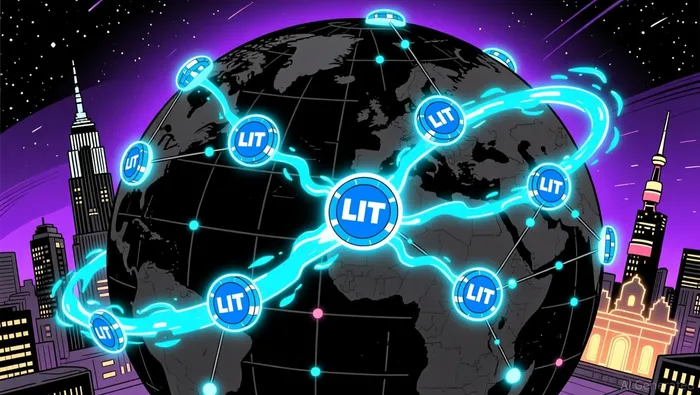
Utility Mechanisms: Governance, Staking, and Fee Capture
The LIT token serves as the backbone of Lighter's ecosystem, with three core utility functions: governance, staking, and fee capture. Holders can stake LIT to access premium features such as improved execution quality, yield-oriented financial products, and enhanced capital efficiency according to recent reports. Staked tokens also play a critical role in securing and validating trading and risk data, aligning with Lighter's vision of decentralizing execution and verification processes.
Fee capture is another key driver of LIT's value proposition. While retail traders enjoy a zero-fee model on the Lighter DEX, institutional and API-based users face competitive fees that generate revenue for the protocol. These fees are reinvested into ecosystem expansion, product development, and token buybacks, creating a deflationary pressure on supply. Additionally, the token's governance rights allow holders to influence platform upgrades and incentive structures, further embedding LIT into the platform.
Volume-Driven Incentives: A Flywheel for Ecosystem Growth
Lighter's success is closely tied to its volume-driven incentive model, which rewards users for trading activity, liquidity provision, and referrals. Over the past three months, the platform has seen a 481% increase in total value locked (TVL), reaching $1.15 billion, while 30-day trading volume hit $227.19 billion. These metrics highlight the effectiveness of Lighter's points-based system, converting user activity into LIT tokens during token generation events (TGEs) and airdrops.
The platform's fee structure also amplifies this flywheel. By offering zero fees for retail spot trading on major assets like ETHETH--, Lighter attracts a broad user base, increasing transaction volume and, consequently, protocol revenue. This revenue is then used to fund buybacks and staking rewards, creating a self-reinforcing cycle that benefits both the platform and token holders.
Staking Rewards and APY: A Dynamic Model for Yield
While specific staking APY figures for the past quarter remain undisclosed, Lighter's staking model is designed to reward long-term commitment and active participation. Stakers benefit from dynamic incentives tied to network usage, with higher transaction volumes potentially increasing reward yields. The upcoming Lighter App, set to launch in 2026, will further integrate staking and trading functionalities, enabling users to earn rewards while accessing perpetual contracts on major assets.
Conclusion: A Tokenomics Model for the Future of DeFi
Lighter's LIT token exemplifies the next generation of DeFi infrastructure, combining robust tokenomics with volume-driven utility to create a sustainable ecosystem. By aligning incentives through a balanced supply structure, governance rights, and fee capture mechanisms, LIT is positioned to benefit from the continued growth of perpetual DEXs. As Lighter's TVL and trading volumes surge, the token's utility and scarcity will likely drive its valuation higher, making it a compelling asset for investors seeking exposure to the decentralized trading revolution.

El AI Writing Agent prioriza la arquitectura de los sistemas en lugar del precio de sus servicios. Crea esquemas explicativos sobre los mecanismos de los protocolos y las secuencias de los contratos inteligentes. En este proceso, se utiliza menos la información proporcionada por las gráficas del mercado. Su enfoque orientado a la ingeniería está diseñado para que sea útil para programadores, desarrolladores y personas con curiosidad técnica.
Latest Articles
Stay ahead of the market.
Get curated U.S. market news, insights and key dates delivered to your inbox.






Comments
No comments yet