
Liftoff to Dominance: SpaceX's Launch Revolutionizes the Commercial Space Landscape
The recent SpaceX launch from Vandenberg Space Force Base on May 23, 2025, marked not just another rocketRCKT-- departure but a seismic shift in the commercial space industry. The Starlink 11-16 mission, deploying 27 satellites via a Falcon 9 booster reused for its 18th flight, underscored SpaceX's mastery of reusable rocketry—a technological leap that is rewriting the economics of space. This milestone positions SpaceX to dominate satellite deployment, space tourism, and even global telecommunications, creating a once-in-a-generation investment opportunity in aerospace equities and ETFs tied to disruptive innovation.
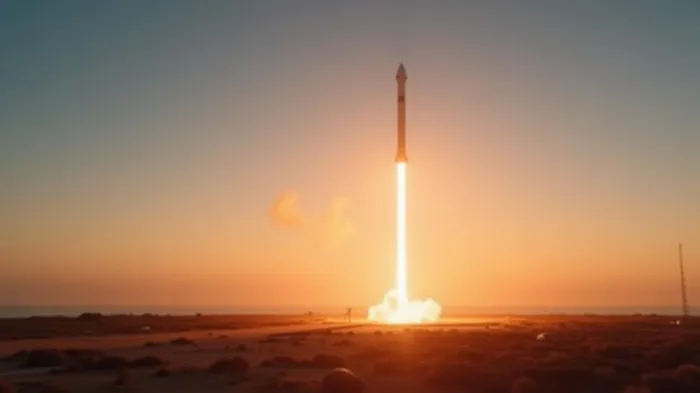
The Cost-Efficiency Revolution
SpaceX's reusable rocket technology is the cornerstone of its disruption. The Falcon 9 booster B1075, which completed its 18th flight during the Vandenberg launch, epitomizes this paradigm shift. By reducing the marginal cost of each launch by 90%, SpaceX has shattered the cost barriers that once confined space exploration to governments and deep-pocketed corporations. With 450 successful booster landings to date and a 2025 launch cadence of 42 Starlink missions—deploying 250 satellites monthly—SpaceX is scaling its Starlink constellation at a blistering pace.
By 2025, Starlink's constellation will exceed 12,000 satellites, far outpacing rivals like Amazon's delayed Project Kuiper. This scale is no accident: it is a strategic play to corner the $100 billion annual global broadband market, with Starlink already projected to hit $11.8 billion in 2025 revenue, up from $7.7 billion in 2024 (per Quilty Space).
Market Disruption: From Satellites to Space Tourism
SpaceX's dominance is not confined to low Earth orbit. Its innovations are redefining entire industries:
1. Satellite Broadband Supremacy: With 4 million subscribers and coverage for 2.65 billion people, Starlink is already a household name. The addition of Direct-to-Cell satellites in 2025 allows SpaceX to compete directly with Verizon (VZ) and AT&T (T), unlocking telecom markets worth trillions.
2. Government Contracts as a Growth Engine: Starlink's $537 million Pentagon deal to support Ukraine's military—part of a $13 billion U.S. Space Force contract ceiling—ensures steady revenue. SpaceX now holds 97% of awarded task orders under the Proliferated Low Earth Orbit (PLEO) program, a testament to its indispensability in national security.
3. Space Tourism and Beyond: With Starship's maiden orbital flight in 2023, SpaceX is laying the groundwork for lunar missions, Mars colonization, and luxury space travel. This vertical integration—from rockets to satellites to tourism—creates a moat competitors like Blue Origin (owned by Jeff Bezos) cannot match.
Why Investors Should Act Now
The commercial space sector is at an inflection point. SpaceX's valuation, now near $180 billion, reflects its unrivaled position, but the broader market has yet to fully price in its potential. Investors should consider:
- Aerospace ETFs: Funds like the iShares Global Aerospace & Defense ETF (IDA) or the ARK Innovation ETF (ARKQ), which include SpaceX and its ecosystem partners, offer diversified exposure.
- Starlink's Revenue Pipeline: With $3 billion in 2025 government contracts and $7.5 billion in consumer services, Starlink's top-line growth is a catalyst for SpaceX's equity value.
- Competitor Struggles: Amazon's Kuiper has yet to launch a single satellite, while OneWeb's constellation remains a fraction of Starlink's scale.
Risks and the Case for Immediate Action
Critics cite risks: regulatory hurdles, space debris concerns, and Starlink's cash burn (despite claims of profitability). Yet SpaceX's $4.5 billion in 2023 Starlink subscriptions and partnerships with Carnival Cruise Lines and Delta Air Lines (DAL) suggest a path to sustained growth. The question is not if SpaceX will dominate, but how quickly investors can capitalize on its ascent.
Conclusion: The New Space Race Is Over
The Vandenberg launch was more than a routine mission—it was a declaration of SpaceX's technological and financial supremacy. With reusable rockets, a near-monopoly on government contracts, and a constellation that outshines competitors, the company is poised to transform the $100 billion space economy. For investors, the writing is on the launchpad: allocate now to aerospace equities and ETFs tied to SpaceX's trajectory, or risk missing the next great disruptor.
The stars, it seems, are no longer the limit—they are the destination.

Stay ahead of the market.
Get curated U.S. market news, insights and key dates delivered to your inbox.


AInvest
PRO
AInvest
PRO



Comments
No comments yet