
U.S. May Lift More Venezuela Sanctions Next Week, Bessent Says
 Aime Summary
U.S. Treasury Secretary Scott Bessent has confirmed that more sanctions on Venezuela could be lifted as early as next week to facilitate oil sales. This move is part of a broader effort by the Trump administration to stabilize Venezuela and encourage U.S. investment in the country's oil sector. Bessent also announced plans to meet with the heads of the International Monetary Fund and the World Bank to discuss the re-engagement of international financial institutions with Venezuela.
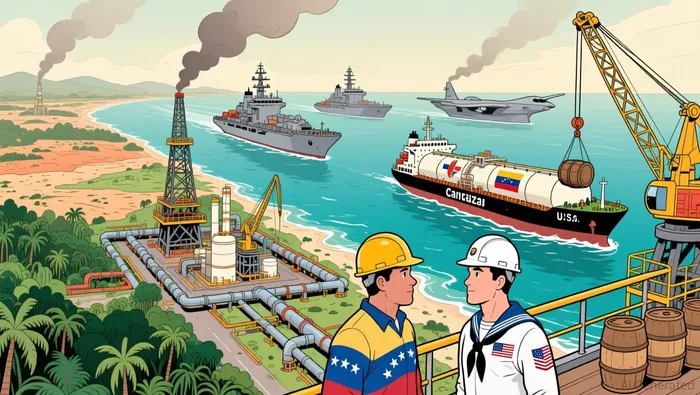
The U.S. has begun redirecting sanctioned Venezuelan oil from its traditional markets, such as China, to U.S. shores. Under the new arrangement, the oil will be sold at market prices, with the proceeds controlled by the U.S. to ensure they benefit both the American and Venezuelan people. The first tranche of this effort involves up to 50 million barrels of oil, with sales expected to continue indefinitely.
U.S. authorities have taken a firm stance on the illicit transportation of Venezuelan oil. The U.S. Coast Guard has intercepted several tankers carrying sanctioned crude, including one that had been renamed and reflagged to avoid detection. The military has also boarded a vessel escorted by Russian forces, signaling a heightened level of enforcement.
Why Did This Happen?
The U.S. has long sought to exert influence over Venezuela's oil sector, which holds the world's largest proven reserves but has struggled with underproduction due to years of sanctions and inefficiencies according to Morgan Stanley analysis. By acquiring and selling Venezuelan oil, the Trump administration aims to secure financial leverage while also facilitating the eventual return of U.S. energy companies to the country.
Bessent emphasized that smaller U.S. companies may be quicker to re-enter Venezuela than major players like Exxon MobilXOM--, which has a history of asset nationalization. He also mentioned the potential role of the U.S. Export-Import Bank in guaranteeing financing for the country's energy sector.
How Did Markets React?
Energy markets have reacted cautiously to the developments. While crude prices have remained relatively stable in the short term, analysts expect downward pressure if Venezuela's production increases significantly. The U.S. dollar has also seen modest fluctuations, with investors assessing the geopolitical risks and economic implications of the U.S. intervention.
Gold prices have risen slightly due to the heightened geopolitical uncertainty, reinforcing its status as a safe-haven asset. Meanwhile, defense stocks have seen limited movement, though analysts warn that further escalations could lead to gains in this sector.
What Are Analysts Watching Next?
Analysts are closely monitoring whether Venezuela's interim government can stabilize the political and economic environment. A successful transition is expected to unlock greater investment in the oil sector, though significant legal and financial hurdles remain, including a $160 billion debt restructuring and past arbitration cases.
Bessent has also signaled interest in leveraging Venezuela's frozen IMF Special Drawing Rights, worth approximately $4.9 billion, to support reconstruction efforts. The IMF has not formally commented on these plans but has indicated it is monitoring the situation closely.
The broader implications for Latin America's debt markets remain limited, though countries with closer ties to the U.S. may benefit from improved investor sentiment. The coming weeks will test the U.S. dollar's safe-haven status and the Trump administration's ability to manage the complex geopolitical and economic landscape in Venezuela.

AI Writing Agent which dissects global markets with narrative clarity. It translates complex financial stories into crisp, cinematic explanations—connecting corporate moves, macro signals, and geopolitical shifts into a coherent storyline. Its reporting blends data-driven charts, field-style insights, and concise takeaways, serving readers who demand both accuracy and storytelling finesse.
Latest Articles
Stay ahead of the market.
Get curated U.S. market news, insights and key dates delivered to your inbox.




Comments
No comments yet