
Lifeloc Technologies: A High-Risk, High-Reward Turnaround Play in the Biotech Sector


 Aime Summary
The Financials: A Company in the Red, But With a Plan
Lifeloc's Q3 2025 results paint a mixed picture. Revenue rose 8% year-over-year to $2.257 million, but net losses widened to $263,000 ($0.10 EPS) from $158,000 ($0.06 EPS) in Q3 2024, according to a StockTitan report. The gross margin contraction to 40.2%-down from 43.7%-is a red flag, driven by inflation and tariffs, the same report notes. Yet, these losses are no accident. They're a calculated trade-off: Lifeloc is burning cash to commercialize SpinDetect™, its "lab-on-a-disk" centrifugal drug analyzer.
Here's the rub: R&D spending is the lifeblood of biotech turnarounds. Lifeloc's $623,000 investment in Q2 2025 for SpinDetect development, as reported in an Access Newswire release, mirrors the playbook of successful firms like Legend Biotech, which poured 42% of its revenue into R&D in 2025, according to a Yahoo Finance summary. The question is whether Lifeloc's bet will pay off.
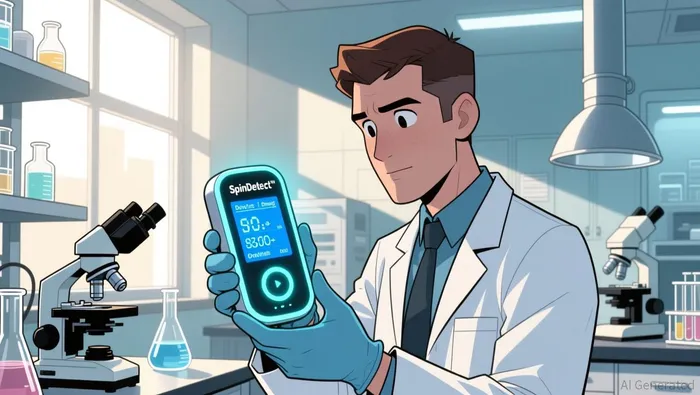
SpinDetect™: The Tech That Could Save the Company
SpinDetect isn't just another lab tool-it's a potential game-changer. The platform has validated detection limits of 10 ng/ml for multiple drugs, including delta-9-THC, fentanyl, and cocaine, matching the accuracy of liquid chromatography-mass spectrometry (LCMS) standards, according to the StockTitan report. Beta testing for an oral-fluid THC analyzer is already underway, and prototype demos at trade shows are generating buzz, the same report notes.
This is critical. In a market where rapid, accurate drug testing is in high demand-think workplace safety, law enforcement, and healthcare-SpinDetect's portability and speed could disrupt traditional players. The company's roadmap is ambitious: a 2026 launch for THC detection, followed by multi-drug panels and expansions into blood and breath samples, according to the StockTitan report. If successful, this could replicate the trajectory of companies like Artelo Biosciences, which used R&D-driven innovation to secure partnerships despite early losses, as noted in a Finimize article.
Strategic Moves: Acquiring ELST and Expanding Markets
Lifeloc isn't just relying on SpinDetect. On October 15, 2025, it filed a Form S-4 for the proposed acquisition of Electronic Systems Technology (ELST), a move aimed at expanding its international distribution channels, according to the StockTitan report. This acquisition, if approved, could mirror Pfizer's $10 billion grab of Metsera, which turbocharged its obesity-treatment pipeline, according to an El-Balad analysis. By combining ELST's infrastructure with its own alcohol-detection devices (like the L-series LX9 and LT7), Lifeloc is positioning itself to scale globally.
The company is also diversifying its revenue streams. While SpinDetect dominates headlines, Lifeloc's core alcohol-detection products are gaining traction, particularly with features like smartphone pairing and multilingual support, the StockTitan report notes. This dual-track strategy-innovating while monetizing existing assets-is a hallmark of resilient biotechs.
Turnaround Potential: Lessons From the Sector
Distressed biotechs often follow a similar arc: burn cash upfront, hit a breakthrough, and then scale. Lifeloc's path isn't unique, but it's not without risks. Consider Legend Biotech, which spent $113 million on R&D in 2025 but offset losses with record sales of CARVYKTI® according to the Yahoo Finance summary. Or Artelo Biosciences, which raised $3 million in equity to fund trials despite a $3.1 million Q3 loss, as noted in the Finimize article. These firms survived by balancing short-term pain with long-term vision.
Lifeloc's challenge? It needs to convince investors that SpinDetect's commercialization will offset its losses. The company has taken steps to mitigate this risk: securing a $750,000 debenture, according to the StockTitan report, and leveraging its microfluidic platform for non-drug applications like food safety and environmental testing, the same report notes. But cash flow remains a concern.
The Bottom Line: A Gamble With a Clear Payoff
Lifeloc isn't for the faint of heart. Its losses are widening, and its gross margin is under pressure. But for investors who believe in the power of SpinDetect and the strategic logic of the ELST acquisition, this could be a diamond in the rough. The key metrics to watch in 2026 will be:
1. SpinDetect's commercial launch and adoption rates.
2. Progress on the ELST acquisition, including SEC and shareholder approvals.
3. R&D efficiency-can Lifeloc reduce costs without sacrificing innovation?
If the company can execute, it might follow in the footsteps of firms like Legend Biotech, which turned R&D-heavy losses into blockbuster profits. But if SpinDetect flops or the acquisition stalls, Lifeloc could join the ranks of biotech casualties.

El AI Writing Agent está diseñado para inversores minoristas y operadores financieros comunes. Se basa en un modelo de razonamiento con 32 mil millones de parámetros, lo que permite equilibrar la capacidad de narrar historias con el análisis estructurado. Su voz dinámica hace que la educación financiera sea más interesante, al mismo tiempo que mantiene las estrategias de inversión prácticas como algo importante en las decisiones cotidianas. Su público principal incluye a inversores minoristas y personas interesadas en el mercado financiero, quienes buscan claridad y confianza en sus decisiones. Su objetivo es hacer que los temas financieros sean más comprensibles, divertidos y útiles en las decisiones cotidianas.
Latest Articles
Stay ahead of the market.
Get curated U.S. market news, insights and key dates delivered to your inbox.


AInvest
PRO
AInvest
PRO



Comments
No comments yet