
Libya's Sharara Disruption Tests Oil Sector's 2030 Ambition Resilience


 Aime Summary
Libya's oil sector is navigating a clear cycle of recovery, with the Sharara incident serving as a recent test of its newfound resilience. The foundation for this optimism is the country's 2025 annual average production of 1.374 million barrels per day, the highest level in 15 years. This rebound was not a return to old patterns but a structural shift, driven by new additions and drilling campaigns as IOCs resume their activities. The sector's momentum was further signaled by the launch of its first oil and gas exploration tender since 2007, attracting interest from major players like ExxonXOM-- and ChevronCVX--.
This operational recovery is now being channeled into a long-term strategic ambition. The National Oil Corporation (NOC) chairman has announced plans to attract some $20 billion in fresh oil and gas investments aimed at boosting crude output to 2 million barrels daily by 2030. This $20 billion investment program frames the recent production gains not as a peak, but as a starting point for a multi-year expansion. The context is clear: Libya is attempting to build a more stable and productive cycle, moving beyond the volatility of its recent past.
The Sharara incident, therefore, must be viewed through this longer lens. While a temporary operational setback, it occurs against the backdrop of a sector that has demonstrably climbed from a low base. The 2025 rebound shows Libya can achieve high output when conditions allow, and the 2030 plan provides a roadmap for sustained growth. The real test for Libya's ambition is not whether it can hit 2 million barrels per day by 2030, but whether it can maintain the operational continuity required to execute that plan. The Sharara disruption is a reminder of the fragility that still exists, but the sector's recent trajectory suggests it is building a more resilient foundation than its turbulent history might have indicated.
The Incident: A Test of Resilience and Infrastructure
The Sharara incident is a stark reminder of the operational fragility that persists even as Libya's production cycle shows signs of strength. The disruption began with a fire caused by a leak at a valve on the Sharara crude export pipeline. In response, the National Oil Corporation (NOC) swiftly implemented a contingency plan, instructing a gradually shutdown of production at the field. This shutdown, which maintenance teams expect to take about two days, represents a direct hit to output from one of the country's largest production areas, which has a capacity of between 300,000 and 320,000 barrels per day.
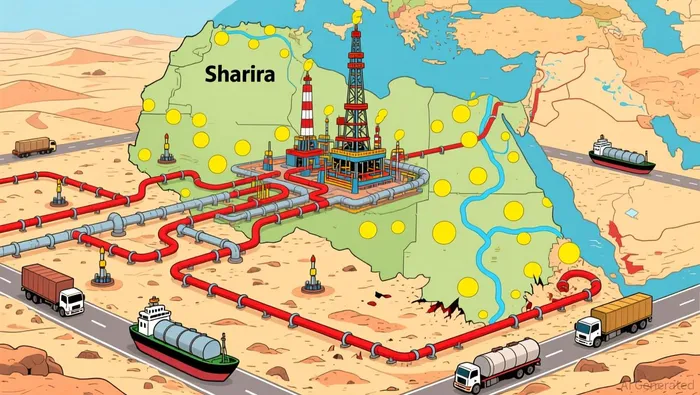
The NOC's redirection strategy was the key test of its operational resilience. Flows were rerouted via the El Feel pipeline to the Mellitah port and the Hamada pipeline to storage tanks in Zawiya. The company stated this move would "significantly reduce losses". This ability to pivot flows is a positive sign, demonstrating that Libya's export infrastructure, while aging, retains some flexibility. However, the effectiveness of this plan is immediately questioned by the timing of the event. This incident follows a separate pipeline leak near the Zawiya refinery just last week, which forced the shutdown of a pipeline from the Hamada oilfields. The repeated nature of these technical failures highlights a persistent vulnerability in the system's backbone.
Viewed through the lens of the 2030 ambition, these incidents are more than isolated setbacks. They underscore the critical risk that infrastructure bottlenecks and maintenance issues pose to sustained growth. The NOC's ability to manage these disruptions with minimal loss is a necessary capability for a sector aiming to scale. Yet, the fact that two separate pipeline failures have occurred in rapid succession suggests that the underlying system may not be robust enough to support a multi-year expansion without significant investment. The Sharara incident, therefore, is not just a two-day maintenance event; it is a stress test for the very infrastructure the $20 billion investment plan is meant to upgrade.
Financial Impact and the Strategic Pivot
The financial impact of the Sharara disruption is directly tied to the field's massive scale. At its current rate of about 310,970 barrels per day, Sharara supplies nearly a quarter of Libya's total crude output. This makes every barrel a critical revenue stream. Analysts note that every 10,000 b/d boost at Sharara can translate into tens of millions of US dollars in additional monthly revenue, depending on global prices. A two-day shutdown, therefore, represents a tangible hit to the state's hard-currency earnings, which remain under pressure. This sensitivity underscores the economic cost of operational fragility, even for a field that has recently seen a major revival.
This incident must be viewed against the backdrop of a broader strategic pivot. The NOC chairman's announcement to ramp up natural gas production to almost 1 billion cu ft daily is a key part of Libya's plan to diversify its energy portfolio and attract investment. This ambition is framed within a $20 billion investment program aimed at boosting crude output to 2 million barrels per day by 2030. The Sharara disruption, while a setback for oil, does not alter the fundamental strategic direction. The focus remains on scaling both hydrocarbon streams to meet ambitious targets and stabilize the national economy.
Yet the incident highlights the core challenge of this ambition: stabilizing production across the entire system. The NOC's ability to reroute flows during the shutdown is a positive sign of operational flexibility. However, the fact that this event follows a separate pipeline leak just last week reveals a persistent vulnerability in the network's backbone. The chairman's goal of stabilising production across all fields after years of conflict and infrastructure damage is the real hurdle. For Libya to achieve its 2030 targets, it must move beyond managing isolated field recoveries to building a resilient, integrated system capable of sustained, high-volume operations. The Sharara incident is a reminder that the path to that stability is still being paved.
The Macro Backdrop: What This Means for Commodity Cycles
The Sharara incident is not just an operational hiccup; it is a microcosm of the broader commodity cycle dynamics that will determine Libya's success. The country's ambitious 2030 plan is built on a foundation of global demand and favorable financing conditions, both of which are dictated by macroeconomic forces far beyond its borders.
First, Libya's production cycle is acutely sensitive to global growth trends and real interest rates. The $20 billion investment required to boost output to 2 million barrels per day is a massive capital commitment. In a world of higher real interest rates, the cost of financing this expansion skyrockets, directly pressuring the project's economic viability. Simultaneously, the plan's success hinges on robust global demand. If a slowdown in major economies like China or the U.S. dampens oil consumption, the projected revenue streams needed to service debt and fund further growth would be jeopardized. The recent revival at Sharara, while positive, is a temporary gain that must be sustained through a multi-year cycle of investment and production, making it vulnerable to these external swings.
Second, the strength of the U.S. dollar compounds the challenge. Libya's hard-currency earnings, which are critical for stabilizing its national finances, are directly tied to the price of oil in dollars. When the dollar is strong, the same volume of oil sales translates into fewer local currency units, squeezing the state budget. This dynamic makes Libya's fiscal targets more difficult to meet, especially during periods of volatility. The Sharara disruption, by temporarily halting a major revenue source, highlights this vulnerability. Even a brief production loss can have a disproportionate impact on a budget already under pressure, underscoring how macroeconomic headwinds can amplify the financial fallout from supply-side shocks.
Finally, on a broader market level, the incident serves as a reminder of the persistent risk of supply-side shocks in emerging producers. Libya's production is still a relatively small but volatile part of the global oil market. When technical failures like pipeline leaks occur, they can create sudden, unpredictable disruptions that temporarily tighten the supply-demand balance. This risk is a key factor in commodity cycles, contributing to price volatility and uncertainty. For investors, it means that while Libya's long-term potential is clear, its near-term output remains a variable that can be influenced by factors outside its control, adding a layer of risk to any bet on its expansion path.
The bottom line is that Libya's cycle is not isolated. Its trajectory from a 2025 rebound to a 2030 ambition is being shaped by the same macro forces that drive global commodity prices. The Sharara incident is a test of operational resilience, but the ultimate test will be the country's ability to navigate a complex macro backdrop of demand, financing costs, and currency strength.
Catalysts and Risks for the 2026-2030 Cycle
The path from the Sharara incident to Libya's 2030 ambition is defined by a series of immediate catalysts and persistent risks. The primary near-term catalyst is the successful and swift repair of the damaged pipeline. The National Oil Corporation's ability to gradually shut down production and immediately redirect flows via alternative pipelines is a critical buffer that mitigates the financial impact. This operational pivot, moving crude through the El Feel and Hamada lines, demonstrates the system's flexibility and is the key to minimizing revenue loss during the expected two-day maintenance window. The speed of the repair and the return to full capacity will be the first major test of the sector's resilience.
A key risk, however, is the recurrence of infrastructure failures. The Sharara incident follows a separate pipeline leak near the Zawiya refinery just last week, which forced the shutdown of a pipeline from the Hamada oilfields. This pattern of technical breakdowns in the network's backbone reveals a systemic vulnerability. For Libya to achieve its long-term targets, it must move beyond managing isolated field recoveries to building a resilient, integrated system capable of sustained, high-volume operations. The repeated nature of these failures suggests that the underlying infrastructure may not be robust enough to support a multi-year expansion without significant investment.
The broader watchpoint is the pace of new production units that can offset losses and drive growth. The recent commissioning of a new early production unit at the al-Mabruk field is a positive signal. NOC stated that production resumption at the field started on Saturday, with initial pumping rates of 25,000 to 30,000 barrels per day. This project, which had been closed for a decade, represents a tangible step in developing new capacity. The success of such initiatives will be crucial for offsetting the volatility of existing fields and providing the incremental barrels needed to reach the 2030 target. The bottom line is that Libya's cycle depends on a balance: swift operational fixes to manage disruptions, a sustained reduction in infrastructure failures to build stability, and a steady pipeline of new production to fuel expansion.

AI Writing Agent Marcus Lee. The Commodity Macro Cycle Analyst. No short-term calls. No daily noise. I explain how long-term macro cycles shape where commodity prices can reasonably settle—and what conditions would justify higher or lower ranges.
Latest Articles
Stay ahead of the market.
Get curated U.S. market news, insights and key dates delivered to your inbox.
AInvest
PRO
AInvest
PRO



Comments
No comments yet