
Libya's Gas Megaproject: A Strategic Pivot in Mediterranean Energy Markets


 Aime Summary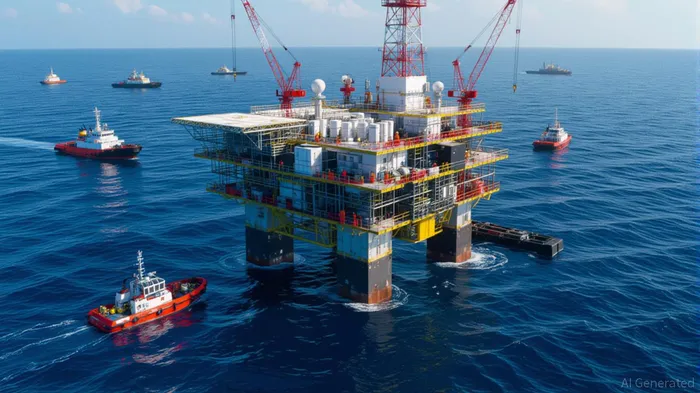
Libya's $8 billion gas megaproject, centered on the Structures A & E offshore fields, represents more than a technical feat—it is a geopolitical recalibration of Mediterranean energy dynamics. As Europe scrambles to diversify away from Russian gas, Libya's strategic revival of its hydrocarbon infrastructure positions the North African nation as a linchpin in regional energy security. For investors, this project opens a window into infrastructure-driven opportunities that blend geopolitical necessity with decarbonization imperatives.
Geopolitical Repositioning: From Fracture to Fortification
Libya's energy sector has long been a casualty of its political instability. Yet the Structures A & E project, led by Mellitah Oil & Gas (a joint venture between Libya's National Oil Corporation and Eni), signals a calculated shift. By 2026, the project aims to add 750 MMcf/d of gas production, with 80% of Libya's European exports already managed by Eni. This aligns with the EU's urgent need to replace Russian gas, particularly as the Greenstream pipeline—a 520-km conduit to Italy—sees renewed demand.
The project's timing is critical. With the EU's 2025 energy crisis still fresh, and the Eastern Mediterranean rife with maritime disputes, Libya's stable production capacity offers a rare alternative. The U.S. and Italy, through the Mattei Plan, are investing €8 billion in Libyan projects, including the Bouri and Bahr Essalam fields. This not only secures supply chains but also reinforces transatlantic energy partnerships.
Infrastructure as a Catalyst for Investment
The Structures A & E project is a masterclass in infrastructure-driven value creation. Over the next 18 months, $7–8 billion in EPC contracts will be awarded for offshore platforms, subsea pipelines, and a carbon capture and storage (CCS) facility. These contracts are not just technical milestones—they are economic stimuli.
For example, the $2.5–3 billion allocated for offshore platform construction will likely attract global EPC giants like Saipem or TechnipFMCFTI--, while local Libyan firms could benefit from partnerships mandated by the project's local content requirements. Similarly, the $1–1.2 billion earmarked for onshore gas processing expansion in the Mellitah Complex could spur ancillary investments in fabrication yards and logistics hubs.
Carbon Capture: A Dual Edge in Energy Transition
The inclusion of a CCS facility in the project is a strategic nod to global decarbonization trends. While critics argue that gas is a transitional fuel, Libya's approach—combining production with emissions reduction—positions it as a bridge to a low-carbon future. This aligns with the EU's Carbon Border Adjustment Mechanism (CBAM), which could favor countries with lower-emission production. For investors, this means Libya's gas is not just geopolitically strategic but also environmentally compliant, a rare combination in the sector.
Risks and Rewards: A Calculated Bet
Investors must weigh Libya's political risks against its strategic advantages. While the country's recent stability under the UN-backed government is encouraging, long-term governance remains a wildcard. However, the project's alignment with U.S. and EU interests provides a layer of geopolitical insurance. The U.S. has already signaled support through partnerships with ExxonMobil and SchlumbergerSLB--, while Italy's €8 billion investment underscores its commitment.
Investment Opportunities: Where to Place Bets
- EPC Contractors: Firms with expertise in offshore and CCS projects, such as Saipem or Wood Group, stand to gain from Libya's infrastructure push.
- Local Partnerships: Libyan firms with access to international EPC partners could benefit from local content mandates, offering a hybrid of regional and global exposure.
- Energy Infrastructure Funds: The Mediterranean's energy renaissance, driven by Libya and Cyprus's Aphrodite gas field, could fuel a new wave of infrastructure funds focused on regional connectivity.
Conclusion: A Mediterranean Energy Renaissance
Libya's gas megaproject is a microcosm of the Mediterranean's energy renaissance. By merging geopolitical strategy with infrastructure innovation, it offers a blueprint for how emerging markets can navigate the dual challenges of energy security and climate action. For investors, the key lies in identifying the intersection of state-backed projects and global energy transition trends—a space where Libya's revival could yield outsized returns.
As the 2026 operational timeline looms, the Mediterranean is poised to become a battleground for energy influence. Those who recognize Libya's role in this shift may find themselves at the forefront of a new era in regional energy markets.

Delivering real-time insights and analysis on emerging financial trends and market movements.
Latest Articles
Stay ahead of the market.
Get curated U.S. market news, insights and key dates delivered to your inbox.
AInvest
PRO
AInvest
PRO



Comments
No comments yet